Pencil Control Activity Booklet
Written by Adi Ackerman, Head Teacher
"Pencil Control Activity Booklet" is written for Kindergarten (Ages 3-6). If your little one is a year younger but already steady on writing, the page still works. You may just need to read the instructions out loud. And if they are older and pencil control never quite stuck, this is a short review rather than busywork.


13 pages in this set
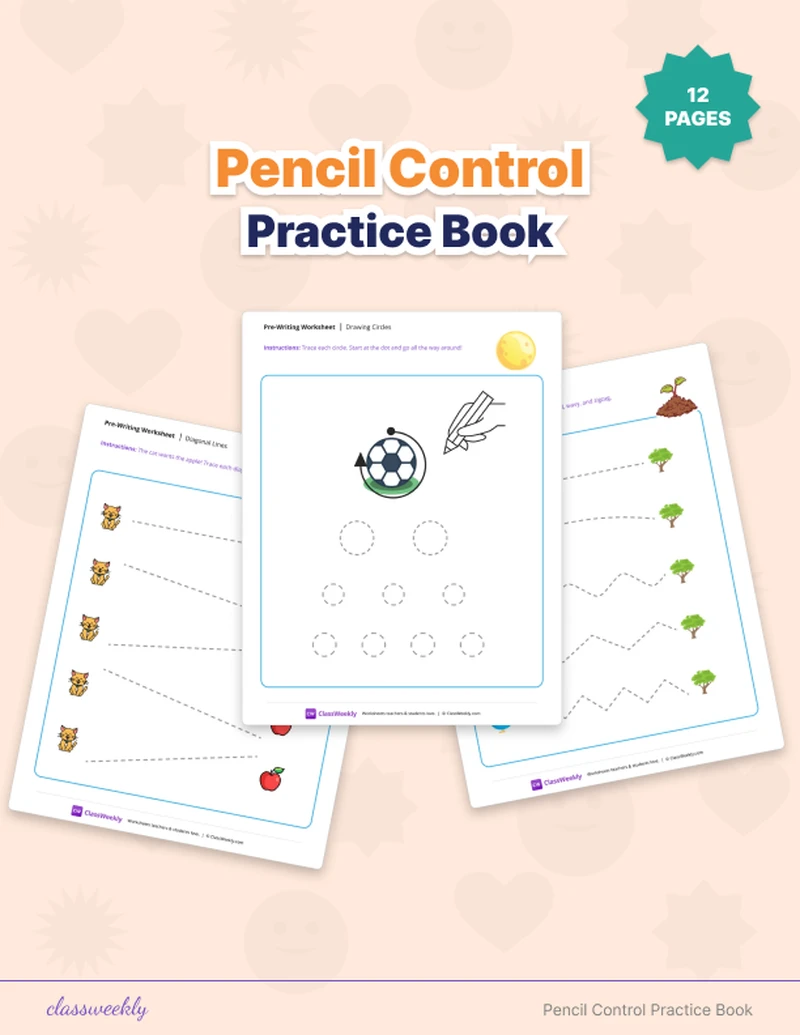
Free printable pencil control activity booklet for kindergarten: 12 pages of pre-writing tracing practice covering straight lines, diagonal lines, curves, zigzags, waves, and shape tracing (circles, squares, stars). Builds fine motor skills and handwriting readiness for beginning writers in preschool, kindergarten, and first grade. Aligned to Common Core W.K.1. Part of our pencil control writing collection.
How do I use this resource?
Before handing out the booklet, warm up students' hand muscles with a quick finger exercise: finger taps, fist squeezes, or drawing large circles in the air. Introduce the tracing direction for each page using a model on the board (top-to-bottom, left-to-right). Let students trace each line slowly with their finger first, then use a pencil. Encourage a correct tripod grip (pencil resting on the middle finger, held between thumb and index finger) from the first page. Work through 2-3 pages per session to avoid hand fatigue. Use the shape-tracing pages near the end as a confidence builder, since students can see familiar shapes forming. These pencil control resources work well as morning warm-ups, fine motor centers, homework packets, or supplemental support for students who need additional handwriting readiness practice.
What students will practice
- Students will practice tracing straight lines, diagonal lines, curves, zigzags, and waves to develop handwriting readiness.
- Students will build fine motor strength and pencil control through structured pre-writing tracing activities.
- Students will trace basic shapes (circles, squares, and stars) to prepare for letter and number formation.


Curriculum Links
Curriculum Standard
Writing · Kindergarten
Standard: Use a combination of drawing, dictating, and writing to compose opinion pieces in which they tell a reader the topic or the name of the book they are writing about and state an opinion or preference about the topic or book.
View all W.K.1 worksheets →Find this in the curriculum
Browse the grade, subject, and topic this belongs to.
FAQ
How do I use this pencil control resource?
⌄
Before handing out the booklet, warm up students' hand muscles with a quick finger exercise: finger taps, fist squeezes, or drawing large circles in the air. Introduce the tracing direction for each page using a model on the board (top-to-bottom, left-to-right). Let students trace each line slowly with their finger first, then use a pencil. Encourage a correct tripod grip (pencil resting on the middle finger, held between thumb and index finger) from the first page. Work through 2-3 pages per session to avoid hand fatigue. Use the shape-tracing pages near the end as a confidence builder, since students can see familiar shapes forming. These pencil control resources work well as morning warm-ups, fine motor centers, homework packets, or supplemental support for students who need additional handwriting readiness practice.
What does this resource teach?
⌄
This free pencil control activity booklet gives kindergarten students 12 pages of focused pre-writing tracing practice. Students trace a full range of line types: straight horizontal and vertical lines, diagonal lines, gentle curves, wavy lines, zigzags, and dotted paths, before progressing to shape tracing (circles, squares, and stars). Each page uses clear tracing templates with fun illustrations to keep beginning writers engaged. The activities build the fine motor control and pencil grip strength that students need before they start forming letters and numbers. Regular practice with these handwriting templates develops muscle memory and hand-eye coordination, making the transition to letter writing much smoother. The booklet works equally well for preschool, kindergarten, and first-grade students who need foundational pre-writing practice.
Can I use this pencil control resource for homeschool or classroom?
⌄
Yes, both. We made it for Kindergarten writing, and the page works the same whether it lands on a kitchen table or a center rotation. At home, most families go through it together and talk the answers out loud, and that talking is where most of the learning happens with pencil control. In class it runs well as independent work while you pull a small group. Print one copy or thirty, whichever the day needs.
What is included in this pencil control activity booklet?
⌄
This free pencil control activity booklet includes 12 printable pages of pre-writing tracing practice for kindergarten. Students trace straight horizontal and vertical lines, diagonal lines, curves, wavy lines, and zigzags before moving on to shape tracing: circles, squares, and stars. Each page uses clear tracing templates with engaging illustrations to keep beginning writers motivated. The booklet is formatted for standard US Letter paper (8.5x11 inches) and can be printed at home or school without any special setup. Pages are designed to be completed in short sessions of 5 to 10 minutes, making the booklet ideal for daily warm-ups, fine motor centers, or take-home practice packets.
What are fine motor skills and why do they matter for writing?
⌄
Fine motor skills are the small, precise movements made by the fingers, hands, and wrists. For writing, fine motor skills control how a child holds a pencil, applies pressure to the paper, and guides the pencil along a path. Without adequate fine motor development, children struggle to form letters legibly, tire quickly during writing tasks, and feel frustrated by activities that require precision. Pencil control practice (tracing lines, curves, and shapes) directly trains the fine motor muscles needed for handwriting. Research shows that children who complete structured pre-writing activities in kindergarten develop neater, faster handwriting by first grade. Complementary activities that strengthen fine motor skills include cutting with scissors, playdough manipulation, bead stringing, and using tweezers to pick up small objects.
When should children start pencil control practice?
⌄
Most children are ready for structured pencil control activities between ages 3.5 and 5. Before formal pre-writing practice, children should be able to hold a crayon or thick marker with a three-finger grasp and make intentional marks on paper. The typical developmental sequence begins with vertical and horizontal lines (ages 2–3), then circles (age 3), then diagonal lines (ages 3.5–4), then crosses and simple shapes (ages 4–5). Kindergarteners (ages 5–6) are developmentally ready to practice all of the tracing paths in this booklet. Children who struggle with pencil control at kindergarten age benefit most from short, frequent practice sessions of 5 to 10 minutes rather than long, tiring activities. If a child's pencil grip is very unusual or causes pain, consult an occupational therapist.
How do I use these pencil control resources in the classroom?
⌄
These pencil control resources work well in several classroom contexts. Use them as a daily morning warm-up by placing one page on each student's desk before the school day begins. Add them to a fine motor skills center alongside scissors, playdough, and lacing cards. Send the full 12-page booklet home as a weekly homework packet for students who need additional practice. Use individual pages as supplemental support for students who struggle with letter formation, targeting the specific stroke type (curves, diagonals, zigzags) that appears in the letters they are working on. Before beginning each page, model the tracing direction on a whiteboard so students internalize the correct movement pattern. Always encourage correct pencil grip before starting; grip habits formed early are difficult to change later.
How can I help my child hold a pencil correctly?
⌄
The ideal pencil grip for young writers is the dynamic tripod grasp: the pencil rests on the middle finger and is pinched between the thumb and index finger, with the other two fingers gently curled underneath. To encourage this grip, offer short, thick pencils or triangular pencils that naturally guide finger placement. Foam pencil grips are also helpful for children who consistently revert to a fist grasp. Avoid pressuring children to correct their grip mid-activity, as this creates frustration. Instead, do a short grip check at the start of each tracing session before they begin. Fine motor warm-ups such as finger taps, squeezing a stress ball, or finger stretches prepare the hand muscles and make a functional grip easier to maintain throughout the activity.
What pre-writing strokes should kindergarteners practice before writing letters?
⌄
Before writing letters, kindergarteners should master eight foundational pre-writing strokes: vertical lines (top to bottom), horizontal lines (left to right), circles (counterclockwise), diagonal lines (top-left to bottom-right and top-right to bottom-left), crosses, squares, triangles, and diagonal crosses (X shapes). These strokes appear as components of every letter in the alphabet. For example, the letters L, E, F, and H are built from vertical and horizontal lines; O, C, G, and Q use circle strokes; A, K, M, N, V, W, X, Y, and Z use diagonal lines. This activity booklet covers the most foundational strokes: straight lines, diagonals, curves, zigzags, and basic shapes, giving beginning writers the motor building blocks they need to approach letter formation with confidence.
Ratings & Reviews
No reviews yet. Be the first to share what you think.
Reviews are for ClassWeekly members.
Make a Request
Spotted something to fix, or want a resource we don't have yet? Tell us and we'll make it.
Resource Details
| Grade | Kindergarten |
| Subject | Resources |
| Topic | Writing |
| Standard | W.K.1 |
| Pages | 1 page |
| Difficulty | Medium |
What is ClassWeekly?
ClassWeekly offers free worksheets and printable learning resources for kids in preschool to grade 5. All worksheets are aligned to Common Core, NGSS, and C3 Framework standards and designed by educators. Become a member to access the full library and download unlimited PDFs.