What Is Elapsed Time?
Taught in US schools
Key Takeaways
- Elapsed time is the total amount of time that passes between a start time and an end time.
- Common strategies for solving elapsed time problems include open number lines, clock jumping, and T-charts.
- Students must understand AM vs. PM and be able to add or subtract hours and minutes, including when crossing the hour.
What Is Elapsed Time?
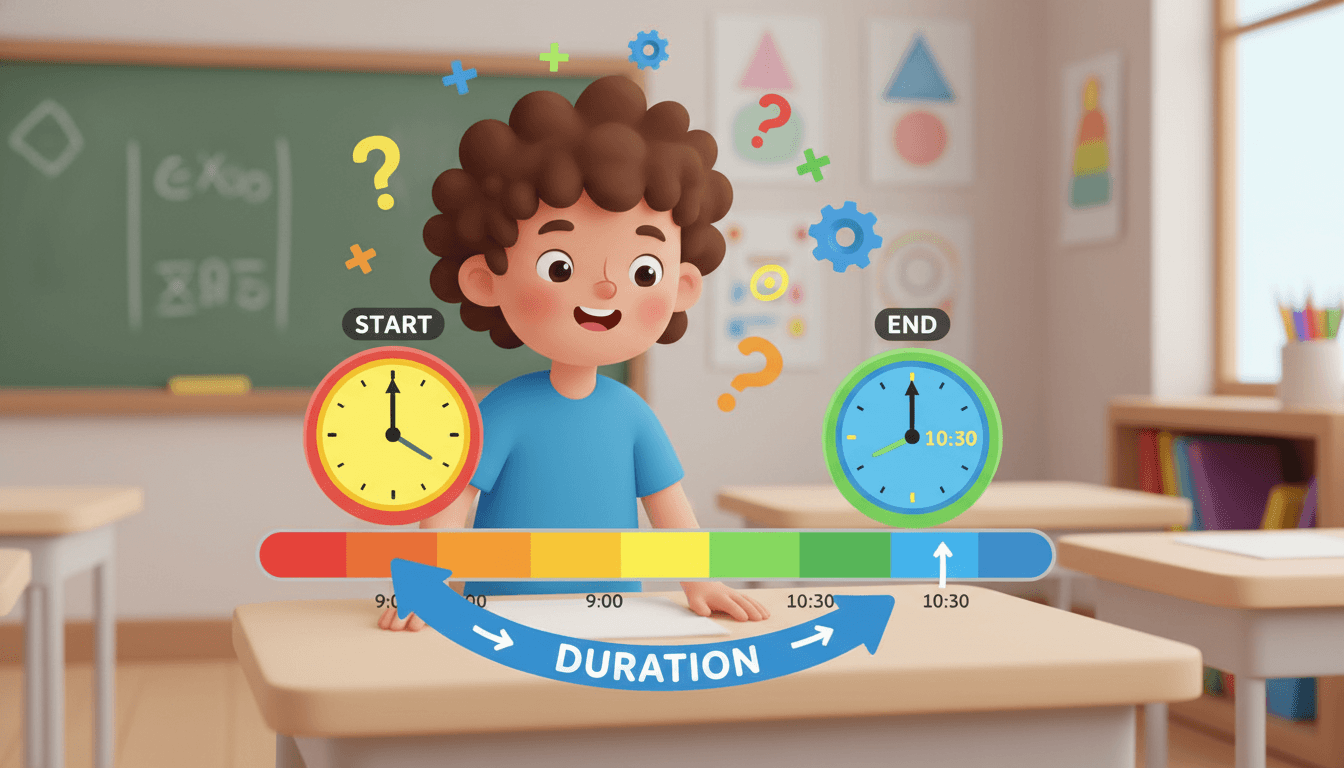
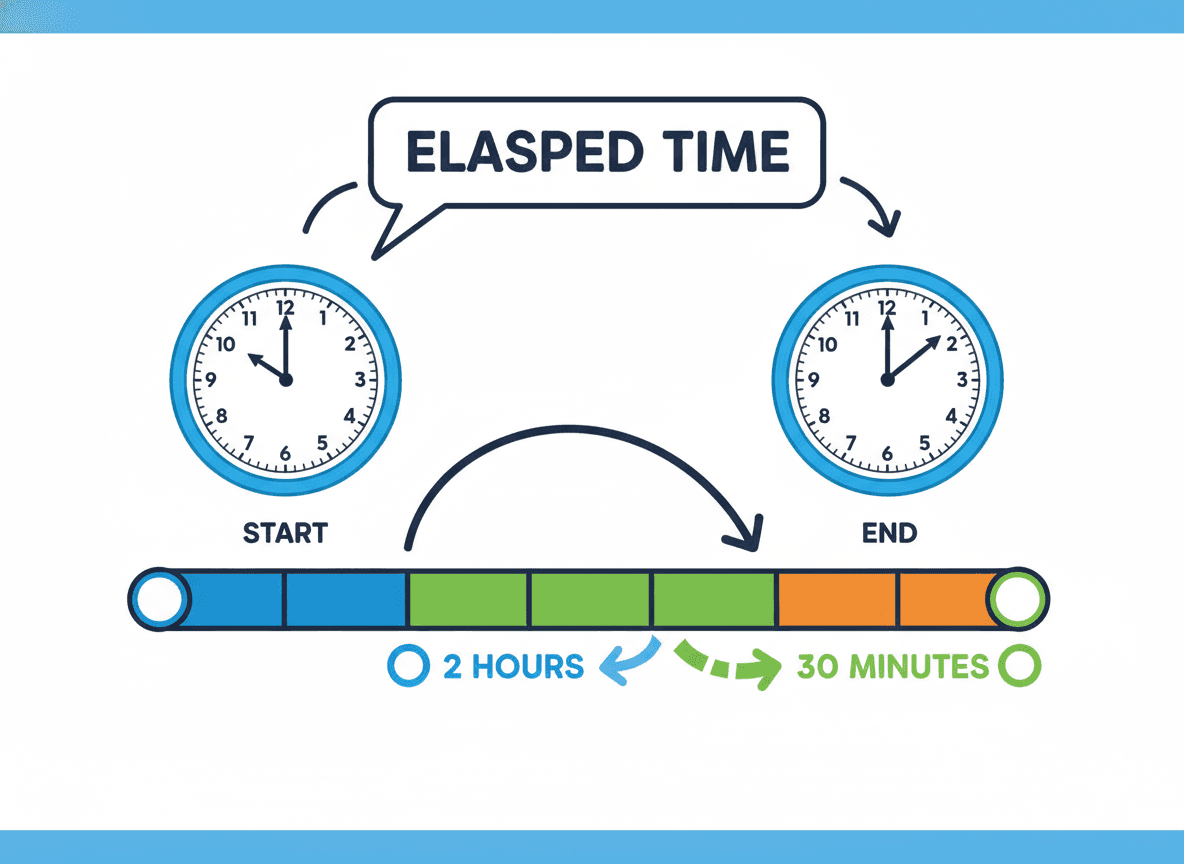
Elapsed time is the amount of time that passes between a start time and an end time. It answers questions like "How long did it take?" or "What time will it be after 2 hours and 30 minutes?"
Elapsed time is formally introduced in 3rd grade (3.MD.A.1) and reinforced in 2nd and 4th grade with increasing complexity.
Three Key Concepts
Before working with elapsed time, students need to understand:
- Reading a clock - both analog (hour and minute hands) and digital.
- AM vs. PM - AM is midnight to noon; PM is noon to midnight.
- Hours and minutes - there are 60 minutes in 1 hour; time does not use base-10 (you don't "carry" at 10, you carry at 60).
Strategies for Finding Elapsed Time
1. Open Number Line
This is the most visual and flexible strategy.
- Write the start time on the left end of a blank number line.
- Jump forward in friendly intervals (1-hour jumps, then 15-minute or 5-minute jumps).
- Stop when you reach the end time.
- Add up all the jumps.
Example: Start: 8:20 AM - End: 10:05 AM
- Jump +1 hour → 9:20 AM
- Jump +1 hour → 10:20 AM
- Jump back −15 minutes → 10:05 AM Total: 2 hours − 15 minutes = 1 hour 45 minutes
2. Clock Jumping
Students draw two clock faces - start and end - and count up in intervals of 5 minutes or whole hours.
3. T-Chart
A three-column organizer:
9:15 AM: 2 hr 30 min - 11:45 AM Fill in any two columns to find the third. T-charts help students solve both types of elapsed time problems:
-
Find the elapsed time (given start and end)
-
Find the end time (given start and elapsed time)
Common Word Problem Types
- "A movie starts at 1:30 PM and is 2 hours 15 minutes long. What time does it end?"
- "School starts at 8:00 AM and ends at 3:30 PM. How long is the school day?"
- "Maya started her homework at 4:45 PM and finished at 6:10 PM. How long did she work?"
Crossing the Hour: A Common Challenge
Students often struggle when elapsed time requires crossing from one hour to the next or crossing noon (AM to PM). The number line strategy helps most because jumps make hour boundaries visible.
Tip: Practice "friendly jumps" - jumping to the nearest hour first, then counting remaining minutes.
Practice Activities
- Post a daily schedule and ask students to calculate how long each activity lasts using an open number line.
- Give students analog clocks (manipulatives) to physically move the hands while solving word problems.
- Create a class "Time Detectives" challenge: post a start time and end time on the board each morning; students solve the elapsed time on entry.
- Use a worksheet with T-charts where one column is missing (sometimes start, sometimes end, sometimes elapsed).
- Have students record what time they start and finish reading at home, then calculate elapsed time the next day.
Frequently Asked Questions
What is the difference between AM and PM?
AM (from Latin ante meridiem, meaning 'before midday') refers to times from midnight to just before noon (12:00 AM to 11:59 AM). PM (post meridiem, 'after midday') refers to times from noon to just before midnight (12:00 PM to 11:59 PM). Many elapsed time word problems require students to work across AM and PM.
What is the open number line strategy for elapsed time?
An open number line is a blank line where students mark the start time on the left. They then jump forward in friendly chunks - usually hours first, then remaining minutes - until reaching the end time. They add up all the jumps to find the total elapsed time. This strategy makes the math visible and reduces errors.
What is a T-chart strategy for elapsed time?
A T-chart has three columns: Start Time, Elapsed Time, and End Time. Students fill in two of the three and calculate the third. For example: start = 9:15 AM, end = 11:45 AM → elapsed = 2 hours 30 minutes. The T-chart helps students organize the information before computing.
Free Elapsed Time Worksheets
Curriculum-aligned printable worksheets for 2nd – 4th Grade. Download free.
Common Core Standards