What Are Exponents?
Taught in US schools
Key Takeaways
- An exponent shows how many times a base number is multiplied by itself - for example, 2³ means 2 × 2 × 2 = 8.
- The base is the number being multiplied; the exponent (written as a small raised number) tells how many times.
- Powers of 10 are especially important - 10² = 100, 10³ = 1,000 - and connect directly to place value.
What Are Exponents?
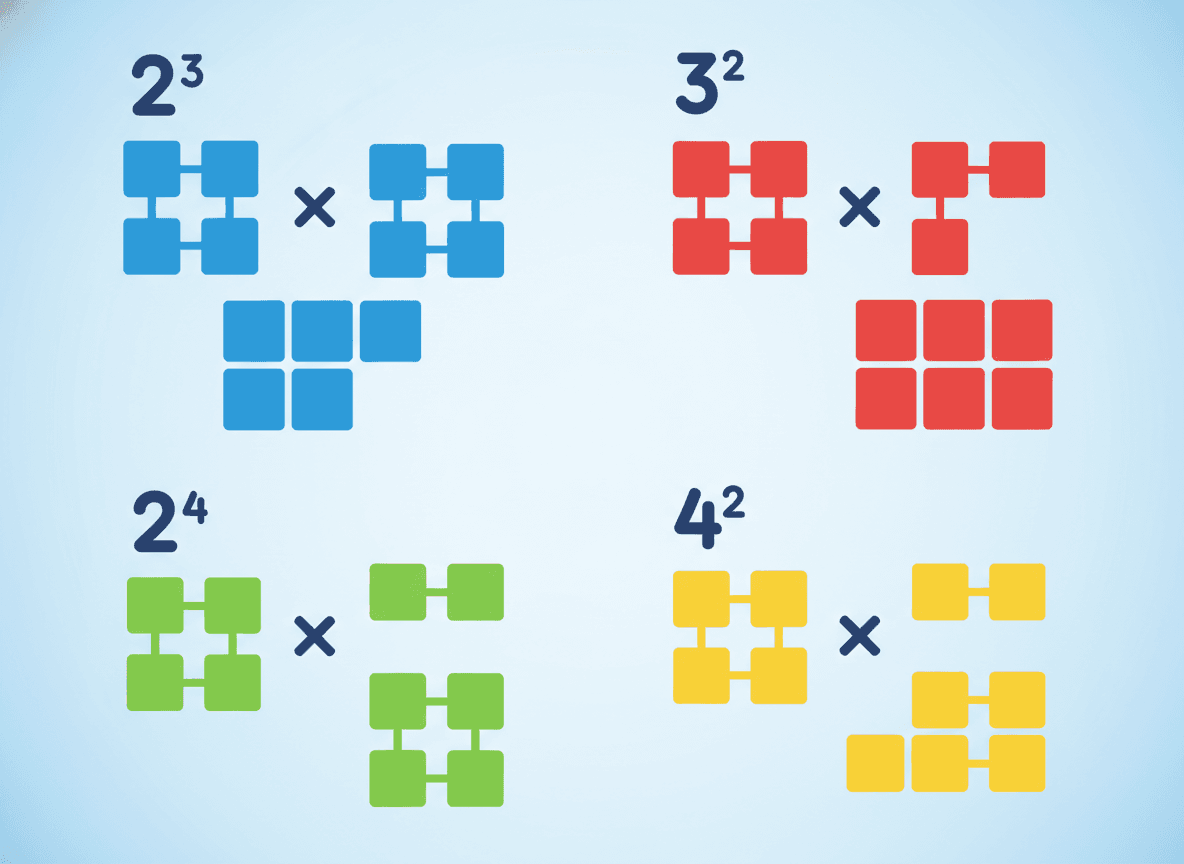
An exponent is a shorthand notation for repeated multiplication. Instead of writing 2 × 2 × 2, you can write 2³ - which means "multiply 2 by itself 3 times."
Every expression with an exponent has two parts:
-
Base - the number being multiplied (e.g., the 2 in 2³)
-
Exponent - the small raised number that tells how many times (e.g., the 3 in 2³)
2³ = 2 × 2 × 2 = 8
Exponents are formally introduced in 5th grade in connection with place value and powers of 10.
Reading Exponents
3²: "3 to the second power" or "3 squared" - 3 × 3 - 9
4³: "4 to the third power" or "4 cubed" - 4 × 4 × 4 - 64
5⁴: "5 to the fourth power" - 5 × 5 × 5 × 5 - 625
10²: "10 squared" or "10 to the second power" - 10 × 10 - 100
Powers of 10
The powers of 10 are especially important in 5th grade because they connect exponents to place value:
10¹: 10 - 10
10²: 10 × 10 - 100
10³: 10 × 10 × 10 - 1,000
10⁴: 10 × 10 × 10 × 10 - 10,000
Pattern: Each time the exponent increases by 1, the value is multiplied by 10 - one more zero is added.
Multiplying by a power of 10 shifts digits to the left in place value. Dividing by a power of 10 shifts digits to the right (moves the decimal point).
Square Numbers and Cube Numbers
-
Square numbers use an exponent of 2: 1, 4, 9, 16, 25, 36, 49, 64, 81, 100. They form perfect square arrays.
-
Cube numbers use an exponent of 3: 1, 8, 27, 64, 125. They form perfect cube shapes.
These terms come up frequently in math discussions and competitions.
What Exponents Are Not
A common misconception: students multiply the base times the exponent instead of using repeated multiplication.
Incorrect: 3² = 3 × 2 = 6 Correct: 3² = 3 × 3 = 9
Emphasize that the exponent is not a multiplication partner - it is an instruction for how many times to use the base.
Evaluating Expressions with Exponents
When evaluating an expression like 4 + 2³:
- Evaluate the exponent first: 2³ = 8
- Then add: 4 + 8 = 12
This connects to order of operations (PEMDAS/GEMDAS), where exponents are evaluated before multiplication, division, addition, or subtraction.
Practice Activities
- Have students expand exponent expressions into repeated multiplication (e.g., 6³ → 6 × 6 × 6) before calculating.
- Create a "Powers of 10" chart together, identifying the pattern of zeros.
- Give students a set of base/exponent cards and ask them to match expressions to their values.
- Play "Exponent War": each student flips two cards (base and exponent) and the higher value wins the round.
- Use grid paper to draw square arrays for perfect squares (2², 3², 4², 5²) to make the "squared" vocabulary concrete.
Frequently Asked Questions
What does it mean when a number has an exponent of zero?
Any number (except 0) raised to the power of zero equals 1. For example, 5⁰ = 1 and 100⁰ = 1. This rule is introduced informally in 5th grade when exploring patterns in powers of 10.
What are square numbers?
A square number is the result of multiplying a whole number by itself - using an exponent of 2. For example, 4² = 4 × 4 = 16, so 16 is a perfect square. Square numbers are named after the fact that they can be arranged into a square array.
How do powers of 10 connect to place value?
Each place in our number system is 10 times greater than the one to its right. This can be expressed with exponents: 10¹ = 10 (tens place), 10² = 100 (hundreds place), 10³ = 1,000 (thousands place). Understanding this pattern helps students multiply and divide by powers of 10 by shifting digits left or right.
Free Exponents Worksheets
Curriculum-aligned printable worksheets for 5th Grade. Download free.
Common Core Standards