What Are Decimals?
Taught in US schools
Key Takeaways
- Decimals extend the place value system to the right of the ones place: tenths, hundredths, thousandths.
- The decimal point separates whole units (left) from parts of a unit (right).
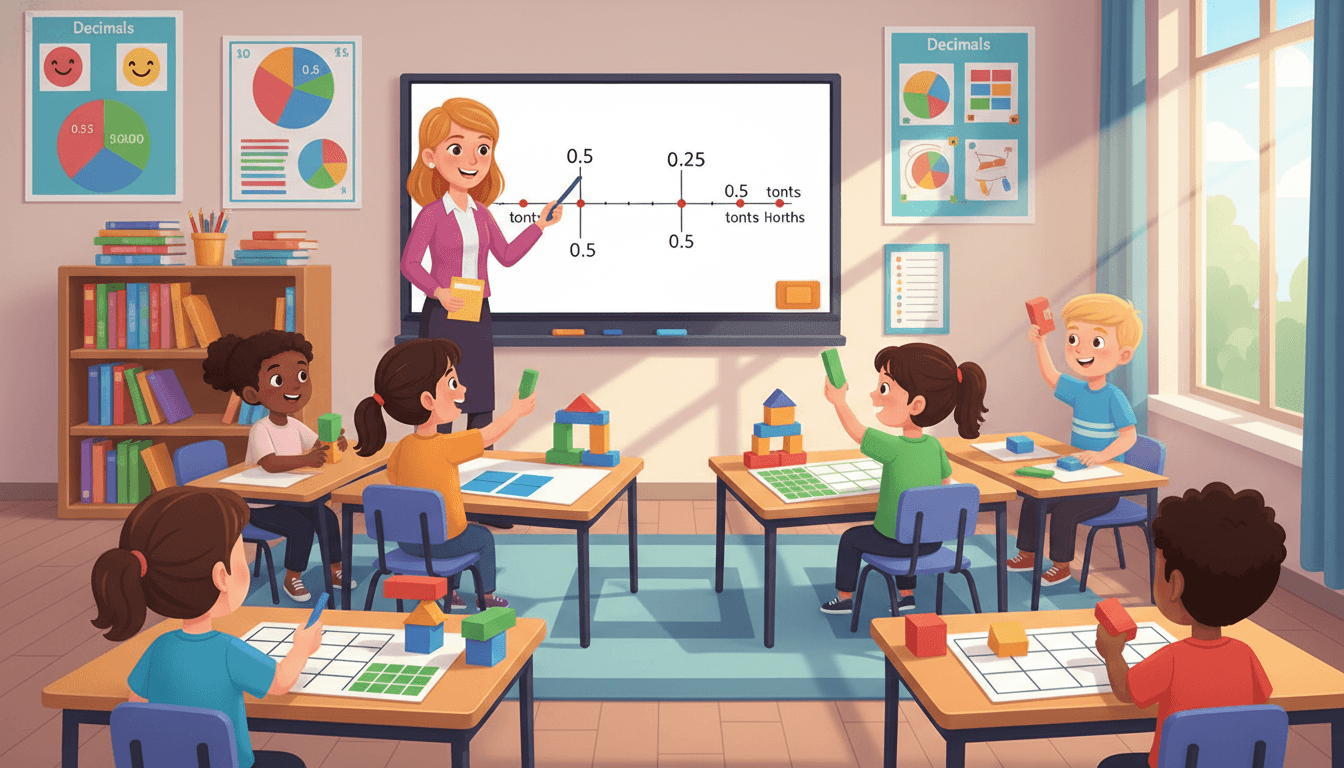
- Decimals and fractions represent the same values: 0.5 = ½, 0.25 = ¼, 0.75 = ¾.
- Comparing decimals requires understanding place value - 0.3 is greater than 0.25 even though 25 > 3.
What Are Decimals?
A decimal is a number that uses a decimal point to show parts of a whole. The decimal point separates whole units (left) from fractional parts (right).
In 3.47:
-
3 = 3 whole units (ones place)
-
4 = 4 tenths (0.4 = 4/10)
-
7 = 7 hundredths (0.07 = 7/100)
Total: 3 + 4/10 + 7/100 = 3 and 47/100
Decimal Place Value
The place value system extends to the right of the decimal point:
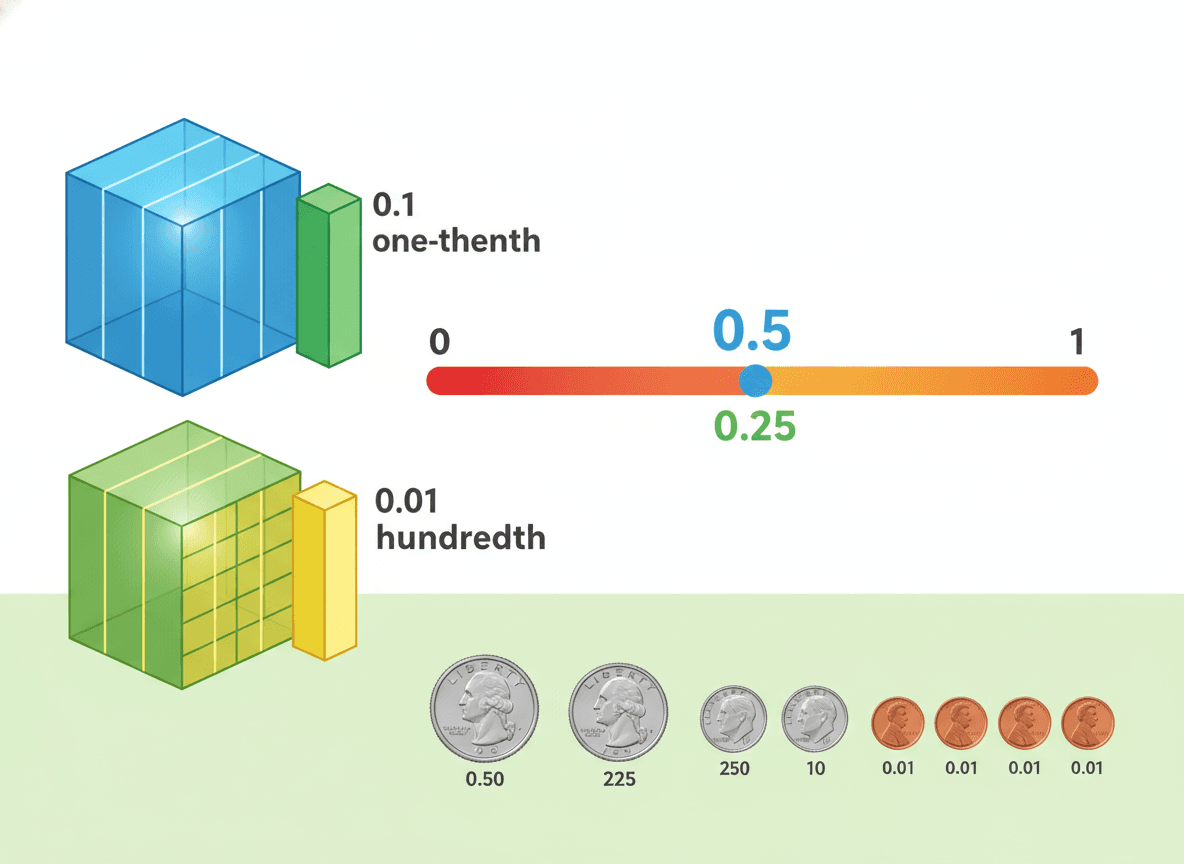
1: . - 0.1 - 0.01 - 0.001 Each place is one-tenth the value of the place to its left - the same pattern as the whole number side, just continuing in the other direction.
Decimals and Fractions
Every decimal with a terminating form equals a fraction with a power-of-10 denominator:
- 0.1 = 1/10
- 0.25 = 25/100 = 1/4
- 0.5 = 5/10 = 1/2
- 0.75 = 75/100 = 3/4
Common Core 4th grade connects decimal notation directly to fraction knowledge.
What Grade Do Kids Learn Decimals?
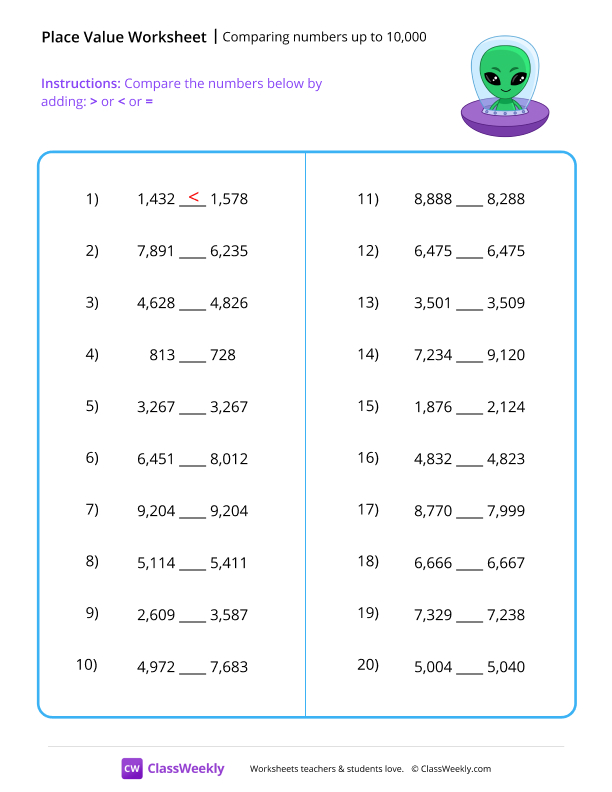
4th Grade: Decimal notation for fractions with denominators 10 and 100. Comparing decimals to hundredths using >, =, <. Locating decimals on a number line.
5th Grade: Place value of decimals to thousandths. Reading, writing, and comparing decimals. Rounding decimals. Adding, subtracting, multiplying, and dividing decimals.
Common Misconceptions
"More digits after the decimal = bigger number." 0.3 > 0.25 even though 25 has more digits. Comparing digit by digit without understanding place value produces systematic errors.
"0.10 and 0.1 are different numbers." They're identical - 0.10 = 10 hundredths = 1 tenth = 0.1. Trailing zeros after a decimal point don't change the value.
"The decimal point is just a separator with no mathematical meaning." The decimal point's position is everything - it defines what each digit represents. Moving the decimal point one place multiplies or divides by 10.
Practice Activities
-
Decimal number lines: Place decimals on a 0-to-1 number line divided into tenths and hundredths. Builds intuition for size.
-
Money models: Use $1 = 1.00, dime = 0.10, penny = 0.01 as physical decimal models.
-
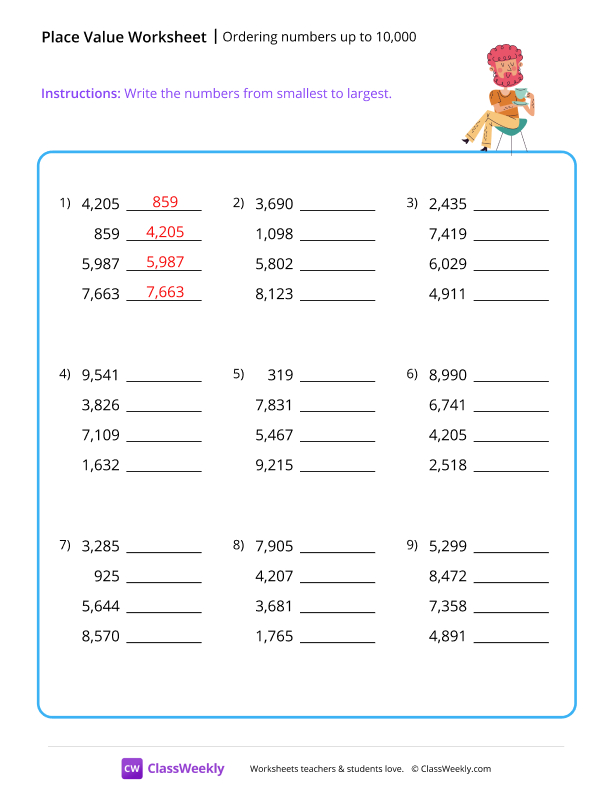
Compare and order: Given 5 decimals, order from least to greatest. Justify each comparison.
-
Fraction-decimal match: Cards showing fractions and equivalent decimals - match pairs.
-
Expanded form: Write 4.73 as 4 + 0.7 + 0.03. Reinforces place value understanding.
Frequently Asked Questions
What is the decimal point and what does it mean?
The decimal point is the dot that separates the whole number part from the fractional part. Everything to the left of the decimal point is a whole unit or more. Everything to the right is less than one - tenths (0.1), hundredths (0.01), thousandths (0.001). In 4.73: the 4 is in the ones place (4 whole units), the 7 is in the tenths place (7 tenths = 7/10), and the 3 is in the hundredths place (3 hundredths = 3/100).
How are decimals and fractions related?
Decimals and fractions are two ways to write the same values. 0.5 = 5/10 = ½. 0.25 = 25/100 = ¼. 0.1 = 1/10. Every decimal can be written as a fraction with a denominator that's a power of 10. And every fraction can (eventually) be written as a decimal - some terminate (½ = 0.5), others repeat (⅓ = 0.333...). The connection between fractions and decimals is a major 4th-5th grade focus.
Why is 0.3 greater than 0.25 even though 25 > 3?
This is one of the most common decimal errors. 0.3 means 3 tenths (3/10 = 30/100). 0.25 means 25 hundredths (25/100). Comparing: 30/100 > 25/100, so 0.3 > 0.25. Kids who compare digits without understanding place value make the 'longer decimal = bigger number' error. Using a number line or fraction/decimal strips to visualize the comparison is more effective than rules.
When do kids learn to add and subtract decimals?
Adding and subtracting decimals with hundredths is a 5th grade standard. The key rule: line up decimal points (which aligns place values) before computing. This is the same principle as lining up ones in whole number addition. 4th grade focuses on understanding decimal place value and comparing decimals, not yet on computing with them.
What are common real-world uses of decimals?
Money (dollars and cents: $4.75), measurement (3.5 inches, 2.7 kg), sports statistics (batting average .315, 9.58 seconds), science data (temperature 98.6°F, pH 7.4). Money is the most accessible real-world context for introducing decimals - kids often know that $0.25 is a quarter (one fourth of a dollar) before they formally study decimals.
Free Decimals Worksheets
Curriculum-aligned printable worksheets for 4th – 5th Grade. Download free.