Preschool Poems Worksheets
Ages 3-5 · 10 worksheets · 10 answer keys · Print-ready PDFs
Free printable poems reading worksheets for preschool students (Ages 3-5). Covers Rhyming poems.
Written by Adi Ackerman, Head Teacher
Filters
Grade: Preschool
Subject: Reading
Topic: Poems
Subtopic
Poems▼
Frequently Asked Questions
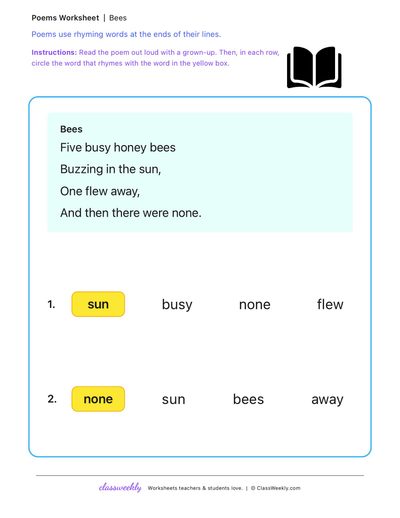
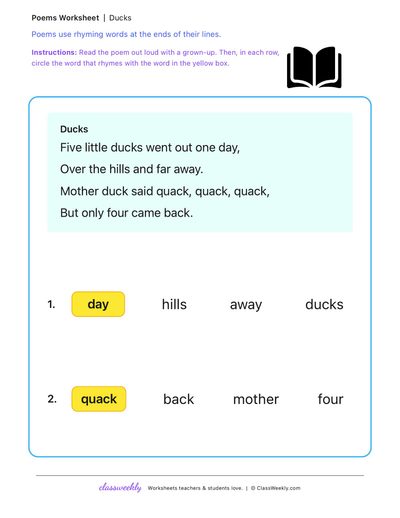
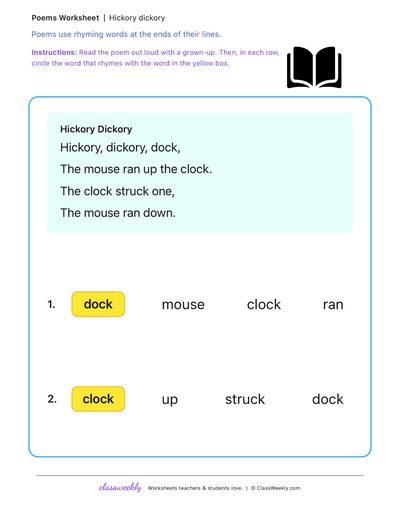
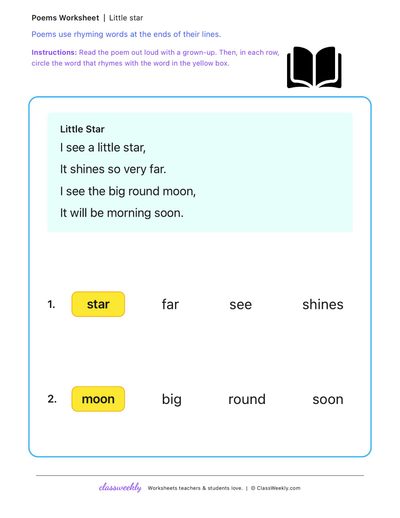
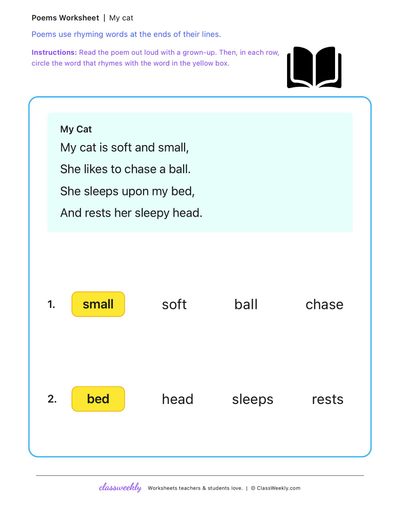
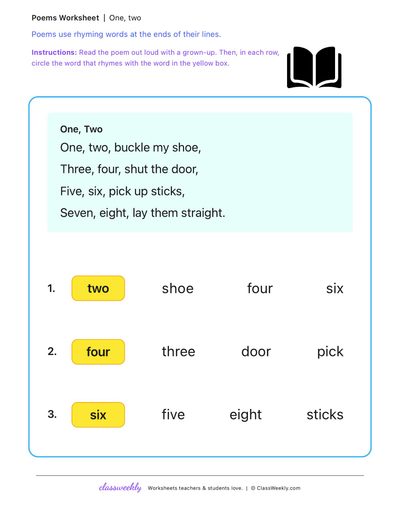
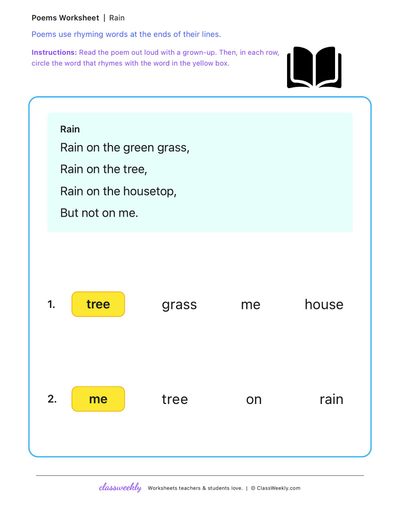
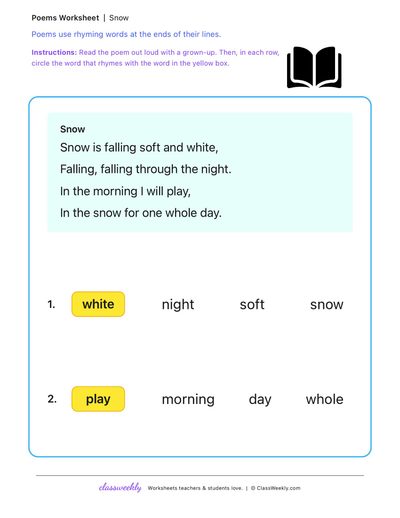
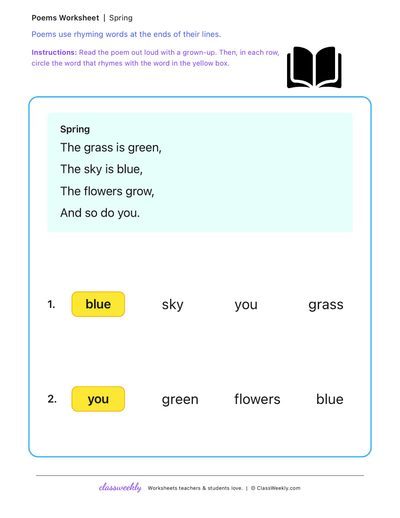
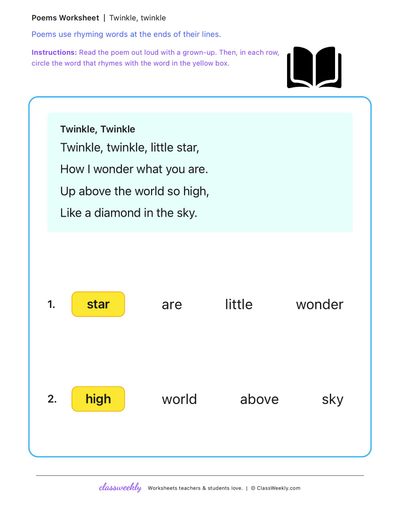
Short rhyming poems give young children a lot of language practice in a small space. The steady beat and repeated sounds make poems easy to remember and satisfying to say aloud, and listening for the rhyming words strengthens the same ear for sounds that later helps with phonics. Many children aged 3–5 already know a few traditional rhymes by heart. Each of the 10 pages pairs a short poem, including Twinkle, twinkle, Hickory dickory, Rain and Bees, with a rhyming task. A grown-up and child read the poem aloud together, and then the child circles the word in each row that rhymes with the word in the yellow box. Reading the poem more than once, clapping along to the beat or acting it out are easy ways to get more from a single page. Answer keys are included for all 10.
Nursery rhymes and short poems repeat sounds, rhymes and rhythms in a way that is easy for young children to remember. Saying them again and again helps children hear rhyme and the beats in words, adds new vocabulary, and gives them their first experience of a complete piece of text they can say from start to finish.
Read the poem aloud once with expression while your child listens, then read it again and let them join in on the rhyming words. Pausing just before a rhyming word so they can fill it in works well. Clapping the beat or adding simple actions keeps them involved, and a short poem can be reread over several days.
Good poems for this age are short, have a strong steady rhythm, use clear rhymes and talk about familiar things like animals, weather or bedtime. Repetition helps too, since young children enjoy anticipating a line they know. Traditional nursery rhymes fit all of these points, which is part of why they have lasted so long.
10 printable worksheets, all free to preview. Downloads are included with a ClassWeekly free trial, and every page prints on standard 8.5 x 11 paper.
These are written for preschool children, roughly ages 3-5. Start with the first few pages, use the free preview to judge the fit, and come back to harder ones as your child gets steadier.
No. Most pages ask children to circle, match, color, or cut and paste, and a grown-up can read the instructions aloud. Pages that do ask for letters, like letter tracing, start with tracing over dashed guides.
Yes. Nothing here assumes a classroom of 25, so they work the same one-to-one at the kitchen table as they do in a Preschool classroom, a learning center, or a tutoring session.
More reading worksheets
Explore all of our preschool reading worksheets, covering alphabet, letter recognition, letter sounds, word building, and more.
What is ClassWeekly?
ClassWeekly offers free worksheets and printable learning resources for kids, from preschool up. Preschool worksheets build early math, reading, writing, science, and social studies skills for ages 3-5 and are designed by educators. We also have free online learning games for thousands of skills, and kids' answers turn into a progress report for the grown-up. Start a free 30-day trial to download the worksheets.