What Are Fractions?
Taught in US schools
Key Takeaways
- A fraction represents equal parts of a whole. The denominator tells how many equal parts the whole is divided into; the numerator tells how many parts are being counted.
- Fractions require the parts to be equal in size - this is where many kids go wrong.
- Equivalent fractions (½ = 2/4 = 3/6) are a key concept that connects to simplifying, comparing, and adding fractions.
- The number line is one of the most important fraction models - it shows fractions as numbers with specific positions, not just pieces of a shape.
Fractions are where many kids' math confidence takes its first big hit. And it's no wonder - fractions introduce a whole new set of rules that seem to contradict everything kids thought they knew about numbers. A bigger number in the denominator means smaller parts? You can't just add the numerators and denominators? The same pizza slice can be called ½ or 2/4? It's a lot to reorganize.
The good news is that fractions, taught well with strong conceptual models, make beautiful sense.
What Is a Fraction?
A fraction represents part of a whole or part of a group.
A fraction is written as one number over another: numerator/denominator (or numerator ÷ denominator).
- The denominator (bottom) tells how many equal parts the whole has been divided into
- The numerator (top) tells how many of those parts are being counted
¾ means: the whole is divided into 4 equal parts, and we're counting 3 of them.
The equal parts requirement is critical and easily overlooked. If a pizza is cut into 4 pieces but they're not equal, ¾ doesn't describe a meaningful fraction. Equal-sized parts is a non-negotiable condition.
Fraction Models
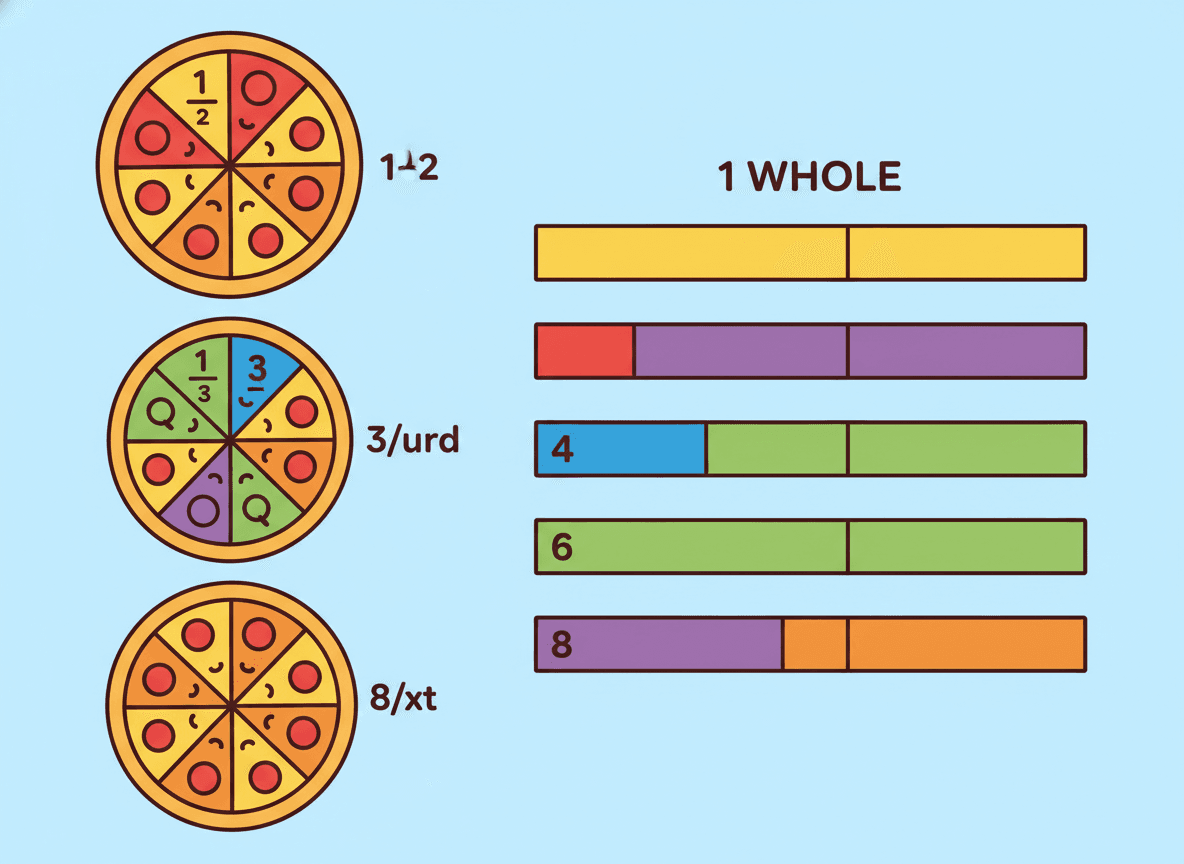
Area model (fraction circles and rectangles): Shade parts of a divided shape. The most common visual, but be careful - shapes where parts are obviously not equal confuse kids about the equal-parts rule.
Set model: Fractions of a collection. 3/5 of the dogs in a picture are spotted. The "whole" is the entire group (5 dogs); the numerator counts a portion of that group (3).
Number line model: Mark fractions as specific points on a number line. ¾ sits exactly ¾ of the way from 0 to 1. This model is crucial for understanding fractions as numbers - not just "pieces of something" - and for ordering and comparing fractions.
Fraction bar / strip model: Paper strips folded or divided into equal parts. Comparing ½ to ⅓ by placing strips side by side makes the relationship visual and concrete.
What Grade Do Kids Learn Fractions?
1st Grade: Partitioning shapes into equal halves and fourths. Understanding that equal shares of the same whole are the same size.
2nd Grade: Partitioning circles and rectangles into halves, thirds, and fourths. Understanding that the more equal pieces a shape is divided into, the smaller each piece.
3rd Grade: Fractions as numbers. Unit fractions (1/b). Fractions on a number line. Equivalent fractions. Comparing fractions with the same numerator or denominator.
4th Grade: Equivalent fractions, simplifying fractions, comparing fractions with different numerators and denominators, adding and subtracting fractions with like denominators, multiplying a fraction by a whole number.
5th Grade: Adding and subtracting fractions with unlike denominators. Multiplying fractions by fractions. Dividing unit fractions by whole numbers.
Why Fractions Are Hard (And How to Help)
The core difficulty is that fractions violate whole-number intuitions:
- Bigger denominator = smaller parts (opposite of what kids expect from bigger numbers)
- Can't add numerators and denominators directly (1/2 + 1/3 ≠ 2/5)
- One quantity has many names (1/2 = 2/4 = 3/6 = 0.5 = 50%)
- Fractions can be greater than 1 (improper fractions: 5/3)
The fix: extensive work with models before any procedures. Kids who deeply understand what ½ and ⅓ look like on a number line - how much of the whole they represent - are much better positioned to reason about fraction operations.
Common Misconceptions
"Fractions always mean something less than 1." Until 4th grade, kids mostly see fractions between 0 and 1. When improper fractions appear (5/3, 7/4), kids who think fractions always describe "part of a thing" are confused. A fraction is just a number - it can be greater than, less than, or equal to 1.
"When comparing fractions, the bigger numbers are always the bigger fraction." A classic error: thinking 3/8 > 3/4 because 8 > 4. Understanding the denominator's role (more pieces = smaller pieces) is essential.
"Adding fractions means adding numerators and denominators." 1/2 + 1/2 = 2/4? No - it equals 1 (or 2/2). This intuitive-but-wrong procedure is one of the most common fraction errors and requires explicit correction with visual models.
"Fractions must always be 'proper' (less than 1)." Some kids think an answer of 7/4 must be wrong. Improper fractions are perfectly valid representations of numbers.
How to Teach Fractions
Use fraction bars and number lines together. Area models are good for getting started; number lines are essential for understanding fractions as numbers with size and position.
Emphasize equal parts relentlessly. Before any fraction notation, ask: "Are these parts equal?" Draw non-equal partitions and have kids explain why they don't work as fractions.
Teach equivalent fractions with models. Show ½ and ¼ on fraction bars side by side. How many fourths equal one half? The visual answer is far more convincing than "multiply top and bottom by 2."
Connect fractions to division. 3/4 means 3 ÷ 4. This connection becomes essential in 5th grade (dividing fractions) and in ratio work.
Use real-world contexts. Cooking, sharing food, measuring with a ruler. Fractions were invented to describe situations that whole numbers can't describe.
Practice Activities
-
Fraction strips: Fold paper strips into halves, fourths, eighths. Compare strips side by side. Seeing ½ = 2/4 = 4/8 physically is more convincing than any explanation.
-
Number line placement: Draw a number line from 0 to 1. Mark where ½, ⅓, ¼, ¾ belong. Discuss why ⅔ is greater than ½.
-
Fraction sorting: Sort fraction cards (with pictures and symbols) into "less than ½," "equal to ½," and "greater than ½." Builds the ½ benchmark.
-
Equivalent fraction chains: Start with ½. How many equivalent fractions can you write? 2/4, 3/6, 4/8, 5/10... What's the pattern?
-
Fraction of a set: Put 12 counters on the table. Show ¼ of the set. Now show ⅓ of the set. Which is more? Why?
Frequently Asked Questions
Why do kids find fractions so hard?
Several reasons. Fractions behave differently from whole numbers in ways that violate kids' existing intuitions: a bigger denominator means smaller parts (1/8 < 1/4), adding fractions doesn't work like adding whole numbers (1/2 + 1/3 ≠ 2/5), and the same amount can be written many ways (1/2 = 2/4 = 3/6). All of these break rules kids thought were universal. Building strong conceptual understanding - especially using models like fraction bars, number lines, and area models - before introducing procedures helps enormously.
What is the difference between a numerator and a denominator?
The denominator (bottom number) tells how many equal parts the whole has been divided into. The numerator (top number) tells how many of those parts you're counting. In 3/4: the whole is divided into 4 equal parts (denominator), and we're talking about 3 of them (numerator). A memory trick: denominator and 'down' both start with D - the denominator goes down at the bottom. The numerator 'names' how many - N for number.
What are equivalent fractions?
Equivalent fractions are fractions that represent the same amount, even though they're written differently: 1/2 = 2/4 = 3/6 = 4/8. You create equivalent fractions by multiplying or dividing both the numerator and denominator by the same nonzero number. Visually, ½ of a pizza is the same amount of pizza as 2/4 of a pizza - it's just cut into more pieces. Equivalent fractions are essential for comparing fractions, adding and subtracting fractions with unlike denominators, and simplifying.
When do kids learn to add fractions?
Adding fractions with the same denominator (like denominators) is a 4th grade standard: 1/4 + 2/4 = 3/4. Adding fractions with different denominators (unlike denominators) - which requires finding a common denominator - is a 5th grade standard. Before 4th grade, the focus is on understanding what fractions mean, comparing them, and finding equivalent fractions. Rushing to procedures before this conceptual foundation is solid is a common source of fraction errors in later grades.
What is a mixed number?
A mixed number combines a whole number and a fraction: 2¾ means 2 whole units plus ¾ of another unit. Mixed numbers and improper fractions (where the numerator is larger than the denominator, like 11/4) represent the same amount and can be converted back and forth. 2¾ = 11/4. Mixed numbers are introduced in 3rd-4th grade and become important when adding and subtracting fractions that result in amounts greater than 1.
Free Fractions Worksheets
Curriculum-aligned printable worksheets for 1st – 5th Grade. Download free.