What Is Multiplication?
Taught in US schools
Key Takeaways
- Multiplication is repeated addition of equal groups.
- The numbers being multiplied are called factors; the result is the product.
- Fluency with multiplication facts (up to 10×10) is the goal by end of 3rd grade.
- Properties of multiplication (commutative, associative, distributive, identity, zero) are the foundation for mental math and algebra.
Multiplication is the first big leap in elementary arithmetic. It asks kids to think about numbers in a new way - not as linear sequences to count along, but as groups and structures. Getting multiplication right, conceptually and procedurally, sets up everything that follows: division, fractions, ratios, algebra.
What Is Multiplication?
Multiplication is the operation of combining equal groups to find a total.
3 × 4 means 3 groups of 4 - or 4 + 4 + 4 = 12.
It can also mean 4 groups of 3 (by the commutative property), giving the same result: 3 + 3 + 3 + 3 = 12.
The formal vocabulary:
-
Factors: the numbers being multiplied (3 and 4)
-
Product: the result (12)
-
Times sign (×) or dot (·) or adjacent parentheses: the operation symbol
Models for Multiplication
Kids understand multiplication better when they encounter multiple representations:
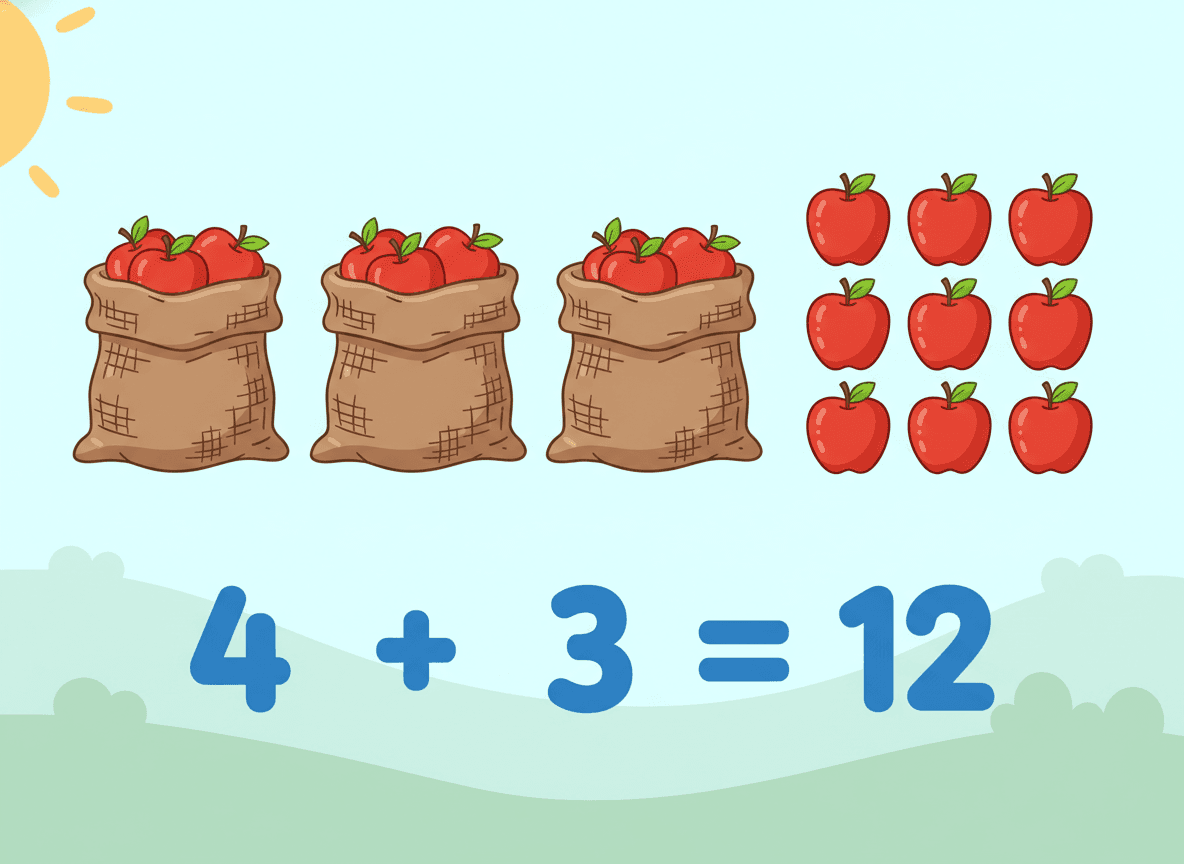
Equal groups: 3 bags of 5 apples each = 15 apples. The most intuitive starting point.
Arrays: 4 rows × 3 columns = 12. Rectangle arrangements that make the structure of multiplication visible. Key for connecting multiplication to area.
Number lines: Jump forward by equal-sized hops. 4 hops of 3 = 12. Connects to skip counting.
Area model: A rectangle with side lengths representing factors. Area = product. This model becomes essential for multi-digit multiplication and polynomials.
Properties of Multiplication (Why They Matter)
Commutative property: a × b = b × a. The order of factors doesn't change the product. 6 × 8 = 8 × 6. This property halves the number of multiplication facts to memorize.
Associative property: (a × b) × c = a × (b × c). You can multiply factors in any order. Useful for mental math: 4 × 7 × 5 = 4 × 5 × 7 = 20 × 7 = 140.
Distributive property: a × (b + c) = (a × b) + (a × c). Breaking a hard fact into easier ones. 7 × 8 = 7 × (5 + 3) = 35 + 21 = 56.
Identity property: Any number × 1 = that number. 9 × 1 = 9.
Zero property: Any number × 0 = 0. 7 × 0 = 0.
These aren't just abstract rules - they're the tools kids use to figure out facts they've forgotten and to compute efficiently without a calculator.
What Grade Do Kids Learn Multiplication?
2nd Grade: Foundations - equal groups, arrays, skip counting by 2s, 5s, and 10s. Introduction to the concept that multiplication is repeated addition. Even and odd numbers.
3rd Grade: The multiplication year. Meaning of multiplication and division, properties of multiplication, relationship between multiplication and division, fluency with all facts 0–10. This is the biggest new operation since addition.
4th Grade: Multi-digit multiplication (up to 4-digit × 1-digit, 2-digit × 2-digit). Area models. Partial products. Patterns in the multiplication table.
5th Grade: Fluent multi-digit multiplication. Multiplication with decimals. Multiplication of fractions.
Why Multiplication Matters
Multiplication is not just faster addition - it's a conceptually different operation that enables:
-
Division (which is the inverse of multiplication)
-
Fractions (multiplication with numbers less than one)
-
Area and perimeter (geometric measurement)
-
Ratios and proportions (multiplication as scaling)
-
Algebra (expressions, equations, functions)
A child who reaches 4th grade without automatic multiplication facts will struggle with almost everything that follows, because fact retrieval will compete with the new cognitive load of more complex procedures.
Common Misconceptions
"Multiplication always makes numbers bigger." True for whole numbers greater than 1. But multiplying by a fraction or decimal less than 1 makes the product smaller than the original number. 6 × ½ = 3. This is a critical concept in 5th grade and a common stumbling block.
"Zero times anything is zero because zero makes things disappear." This is often held as a procedural rule without understanding. The conceptual explanation: 0 groups of 5 = 0. You have no groups, so you have nothing.
"Knowing that 6 × 8 = 48 is the same as understanding multiplication." Fact recall is important, but conceptual understanding of what the equation means - 6 groups of 8, or 6 rows of 8 columns - is what allows kids to apply multiplication flexibly to new situations.
"I don't need to know the commutative property; I just memorize all the facts." A student who doesn't see that 7 × 9 = 9 × 7 has to memorize 100 facts instead of 55. The properties dramatically reduce memorization load and build algebraic thinking.
How to Teach Multiplication
Build meaning before facts. Equal groups, arrays, number line hops - concrete models of what multiplication means should come before any fact memorization. Kids who memorize facts without meaning can't apply them.
Use arrays relentlessly. Arrays connect multiplication to geometry, make properties visible, and provide a reliable model for multi-digit multiplication through area models.
Teach facts in related clusters. Start with 2s, 5s, and 10s (tied to skip counting). Then squares (1×1, 2×2, 3×3...). Then use properties: knowing 3×7 means knowing 7×3. Then near-doubles: 4×6 is double 3×6.
Make properties explicit. Name the commutative property, show why it matters, and give kids a chance to discover it with arrays. Same for distributive - 7×8 is hard; 7×5 + 7×3 is easier.
Connect multiplication to division early. They're inverse operations. If you know 6 × 8 = 48, you know 48 ÷ 8 = 6. Fact families for multiplication and division reinforce both.
Practice Activities
-
Equal groups stories: "The baker made 4 trays of 8 cookies each. How many cookies?" Writing and solving multiplication story problems.
-
Array building with counters: Build an array to match a multiplication fact. Rotate it to see the commutative property in action.
-
Multiplication table patterns: Color-code a multiplication table by factors. Notice the patterns (all even products in ×2, alternating 0s and 5s in ×5). Understanding patterns beats rote memorization.
-
Skip counting out loud: 3, 6, 9, 12, 15... in unison. Set it to rhythm or music. Builds fluency for the 3s table.
-
Factor pairs puzzles: Given a product (24), list all the factor pairs: 1×24, 2×12, 3×8, 4×6. Builds flexible fact thinking and is preparation for fractions and area.
Frequently Asked Questions
When should kids know their multiplication tables?
Common Core expects fluency with multiplication facts within 100 (all facts up to 10×10) by the end of 3rd grade. This means quick, automatic recall - not counting on fingers or working through every problem. Building toward fluency should begin in 2nd grade with skip counting and equal groups, with more explicit fact practice in 3rd grade.
What is the best way to help kids memorize multiplication facts?
The research favors: (1) building conceptual understanding first (equal groups, arrays, number lines) so kids know what multiplication means; (2) using skip counting to build the rhythmic patterns in each table; (3) using properties strategically - the commutative property means knowing 6×8 also gives you 8×6, halving the memorization load; (4) tackling easier facts first (2s, 5s, 10s, doubles) to build momentum; and (5) distributed practice daily rather than massed practice weekly. Timed drills work for some kids but create math anxiety in others - watch carefully.
What is the distributive property of multiplication?
The distributive property says that multiplying a number by a sum gives the same result as multiplying each addend separately and then adding: a × (b + c) = (a × b) + (a × c). For example: 6 × 7 = 6 × (5 + 2) = (6 × 5) + (6 × 2) = 30 + 12 = 42. Kids use this property to break hard facts into easier ones and to understand multi-digit multiplication. It's also the foundation for algebra (the FOIL method is just distributive property).
What is the difference between multiplication and repeated addition?
They give the same result for whole numbers, but they're not identical concepts. Repeated addition is 5 + 5 + 5 = 15. Multiplication is 3 × 5 = 15. The multiplication version is more compact and becomes more efficient as numbers grow. More importantly, multiplication extends to contexts where repeated addition breaks down - like multiplying fractions (3 × ½ is not 'adding ½ three times' in a meaningful way for many kids) or multiplying decimals. Understanding multiplication as scaling, not just repeated addition, is a key conceptual shift in 4th-5th grade.
What does an 'array' have to do with multiplication?
An array is a rectangular arrangement of objects in rows and columns. A 4×3 array has 4 rows and 3 columns, totaling 12 objects. Arrays make the commutative property visible (rotate the array 90° and 4×3 becomes 3×4), connect multiplication to area (a rectangle with 4 rows and 3 columns has an area of 12 square units), and help kids see multiplication as more than counting. Arrays are a central model in 2nd and 3rd grade multiplication instruction.
Free Multiplication Worksheets
Curriculum-aligned printable worksheets for 2nd – 5th Grade. Download free.