What Is Division?
Taught in US schools
Key Takeaways
- Division splits a quantity into equal groups or finds how many times one number goes into another.
- Division is the inverse of multiplication - knowing 6×8=48 means knowing 48÷8=6.
- The dividend is the number being divided, the divisor is what you divide by, and the quotient is the result.
- Fluency with division facts within 100 is a 3rd grade Common Core expectation.
Division often gets a reputation as the hardest of the four operations. And it's true that multi-digit long division is procedurally complex. But the concept itself - splitting things into equal parts - is one kids understand intuitively from very early on. The challenge is connecting that intuition to the formal operation.
What Is Division?
Division is the operation of splitting a quantity into equal groups or finding how many times one number fits into another.
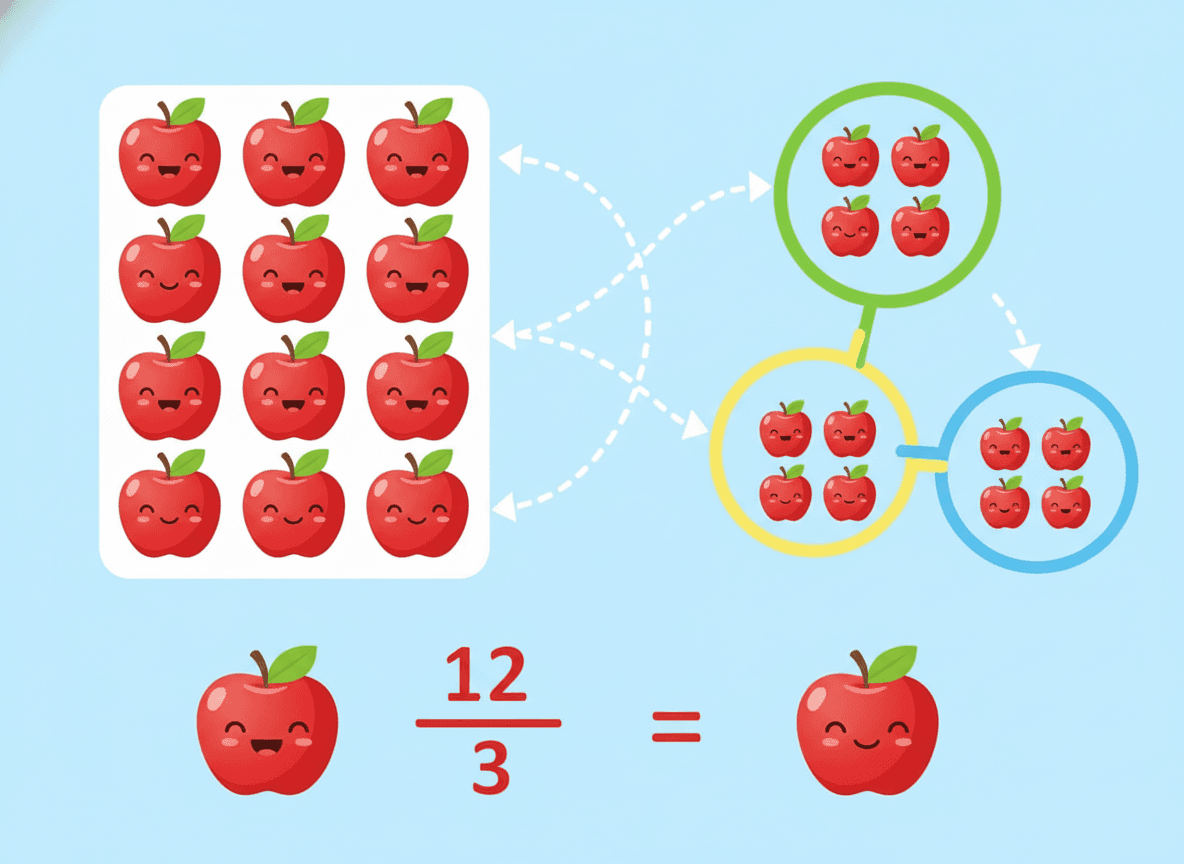
12 ÷ 3 can mean:
- Split 12 into 3 equal groups - how many in each group? (4)
- How many groups of 3 fit into 12? (4)
Both give the same answer - 4 - but they represent different real-world situations.
The vocabulary:
-
Dividend: the number being divided (12)
-
Divisor: the number you divide by (3)
-
Quotient: the result (4)
-
Remainder: what's left over when division isn't exact (17 ÷ 5 = 3 R2)
Division as the Inverse of Multiplication
This is the most powerful insight about division: every division fact is the flip side of a multiplication fact.
If you know 6 × 9 = 54, you automatically know:
- 54 ÷ 6 = 9
- 54 ÷ 9 = 6
Teaching division through fact families - showing the four related equations from the same three numbers - makes division far less intimidating and dramatically less work to memorize.
What Grade Do Kids Learn Division?
3rd Grade: Introduction to division as sharing and grouping. Division as the inverse of multiplication. Fact families. Fluency with division within 100 (all single-digit divisor facts). Word problems using both partitive and measurement division.
4th Grade: Division with multi-digit dividends (up to 4 digits) and single-digit divisors. Estimating quotients. Long division algorithm. Interpreting remainders in context.
5th Grade: Division of multi-digit numbers by 2-digit divisors. Division of decimals. Connecting division to fractions (a÷b = a/b).
Common Misconceptions
"Division always makes numbers smaller." True for dividing by numbers greater than 1, but dividing by a fraction less than 1 makes numbers bigger. 8 ÷ ½ = 16. This surprises kids who treated "division = smaller" as a rule.
"You have to divide the larger number by the smaller one." 3 ÷ 12 is perfectly valid - it equals ¼. The convention that dividends are "bigger" comes from early whole-number instruction but doesn't hold universally.
"The remainder is the final answer." Remainders need to be interpreted in context. Sometimes round up, sometimes round down, sometimes the remainder itself is the answer to the question.
How to Teach Division
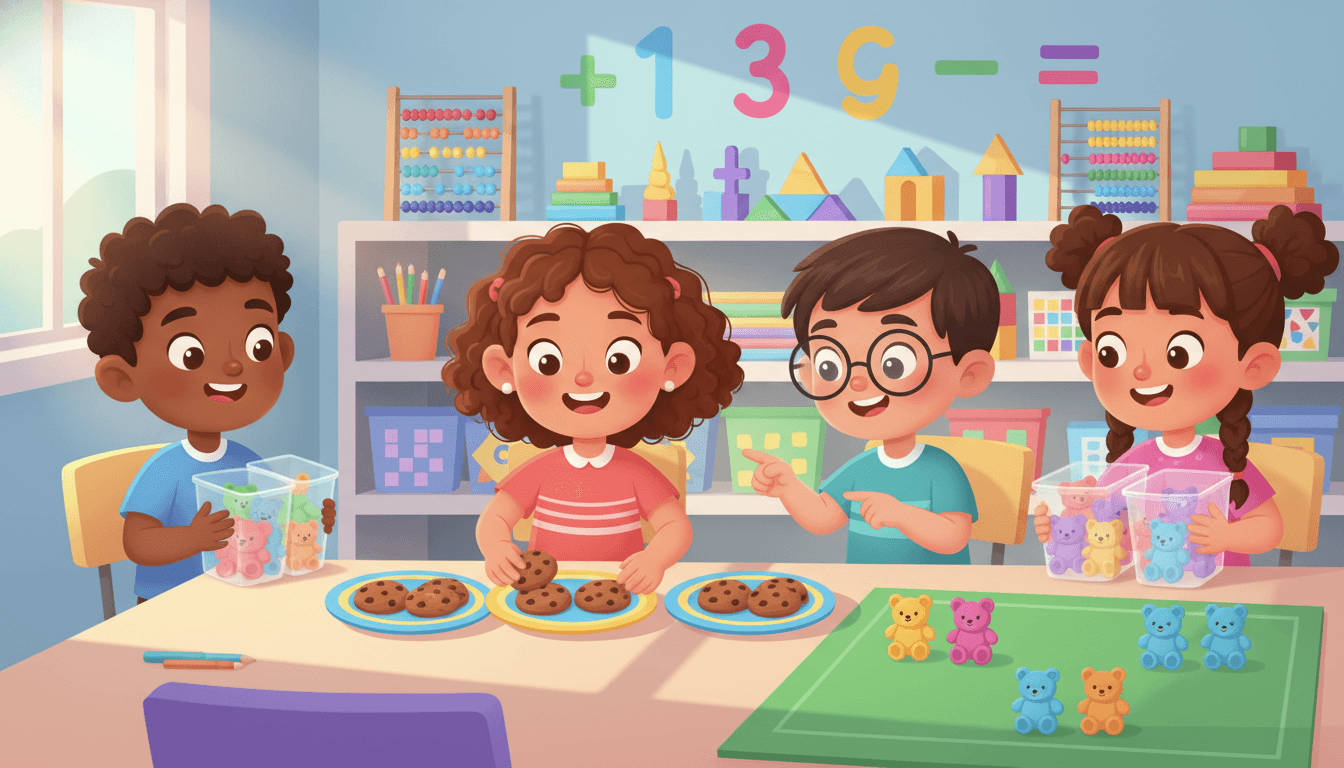
Start with sharing stories. "12 apples, 3 friends - how many each?" Concrete, relatable, no algorithm needed. Let kids physically distribute objects.
Use arrays. A 3×4 array represents both 3×4=12 and 12÷3=4 (or 12÷4=3). Arrays make the inverse relationship visual.
Teach fact families together. From the moment multiplication is introduced, pair every fact with its division counterparts.
Address remainders with real situations. "27 students, tables of 4 - how many tables?" The math is 27÷4=6R3. The real answer is 7 tables (because 6 isn't enough). Remainders need context.
Build long division on understanding, not just steps. Before the algorithm, make sure kids can estimate ("about how many times does 7 go into 63?") and know what each step represents.
Practice Activities
-
Equal groups with manipulatives: Distribute counters into equal groups. Write the corresponding division sentence.
-
Fact family triangles: Three numbers at the corners - write all four equations (two multiplication, two division).
-
Division word problem sorts: Sort problems into "sharing" (partitive) and "grouping" (measurement) types before solving.
-
Remainder situations: Give a division problem; give four different real contexts. What do you do with the remainder in each case?
-
Long division estimate-first: Before computing, estimate the quotient. Then solve. Then compare - was the estimate reasonable?
Frequently Asked Questions
What is the difference between the dividend, divisor, and quotient?
In 48 ÷ 6 = 8: the dividend (48) is the number being divided up. The divisor (6) is the number you're dividing by - the size of each group or the number of groups. The quotient (8) is the result. A helpful memory trick: the divisor 'divides' the dividend to produce the quotient.
What does it mean when division has a remainder?
A remainder is what's left over when a number can't be divided evenly. 17 ÷ 5 = 3 remainder 2, because 5 goes into 17 three full times (15), with 2 left over. In real-world problems, remainders need interpretation: if you're putting 17 kids into groups of 5, you'd have 3 full groups and 2 kids needing a group - meaning you need a 4th group.
When should kids know their division facts?
Common Core expects fluency with division within 100 by end of 3rd grade - meaning all single-digit divisor problems (up to 81÷9). Since division facts are derived from multiplication facts, students who know their multiplication tables automatically know their division facts. The connection should be made explicit from the start.
What is long division and when do kids learn it?
Long division is a step-by-step algorithm for dividing larger numbers. Kids encounter it in 4th grade (dividing up to 4-digit numbers by 1-digit divisors) and 5th grade (dividing by 2-digit divisors). The steps - divide, multiply, subtract, bring down - are memorized procedurally, but understanding what each step represents (how many groups? what's left?) prevents errors.
What are the two ways to think about division?
Partitive division (fair sharing): split 24 cookies evenly among 4 friends - how many does each person get? Measurement division (repeated subtraction): you have 24 cookies; each bag holds 4 - how many bags do you need? Both equal 24÷4=6, but the mental model is different. Both types appear in word problems, so kids need fluency with both.
Free Division Worksheets
Curriculum-aligned printable worksheets for 3rd – 5th Grade. Download free.