What Is Rounding?
Taught in US schools
Key Takeaways
- Rounding replaces a number with a close, simpler value - the nearest ten, hundred, thousand, etc.
- The key question: which benchmark value (multiple of 10, 100, etc.) is the number closest to?
- The digit to the RIGHT of the rounding place determines direction: 5 or more rounds up, 4 or less rounds down.
- A number line makes rounding visual and intuitive - you're literally finding the closer endpoint.
Rounding seems simple until kids get to the halfway case (does 25 round to 20 or 30?) or until they need to round to a place value that isn't tens. The concept is straightforward - find the nearest benchmark - but the execution needs careful teaching.
What Is Rounding?
Rounding means replacing a number with a simpler, nearby value at a specified level of precision.
Why? Sometimes exact numbers are more detail than we need. If you drove 47 miles to visit a friend, you'd probably say "about 50 miles." If a school has 793 students, the principal might say "nearly 800." Rounding makes numbers more manageable for estimation and communication.
The result of rounding is always a multiple of the unit you're rounding to:
- Round to nearest ten → result ends in 0 (30, 40, 50...)
- Round to nearest hundred → result ends in 00 (300, 400, 500...)
- Round to nearest thousand → result ends in 000
The Rules
Identify the rounding digit - the digit in the place you're rounding to.
Look one place to the right - that digit decides direction.
-
5 or more → round up (increase the rounding digit by 1)
-
4 or less → round down (keep the rounding digit as is)
Replace all digits to the right with zeros.
Example: Round 3,847 to the nearest hundred.
- Rounding digit: 8 (hundreds place)
- Look right: 4 (tens digit)
- 4 is less than 5 → round down
- Result: 3,800
Using a Number Line
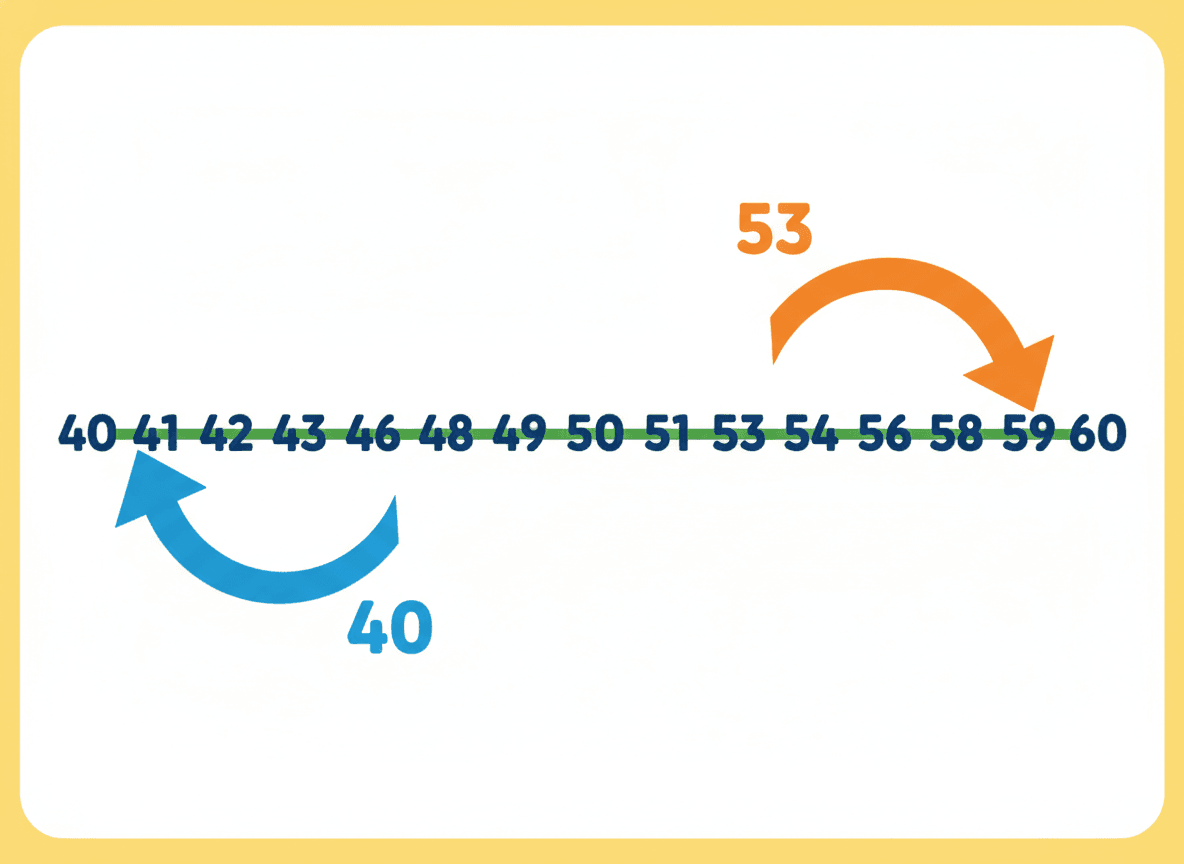
The most intuitive way to understand rounding is a number line. Place the number between two benchmarks and ask: which end is it closer to?
For 47 between 40 and 50: it's at the 7th mark out of 10, closer to 50 than 40. Round up to 50.
For 43: it's at the 3rd mark, closer to 40. Round down to 40.
For 45: exactly halfway. Convention says round up to 50.
What Grade Do Kids Learn Rounding?
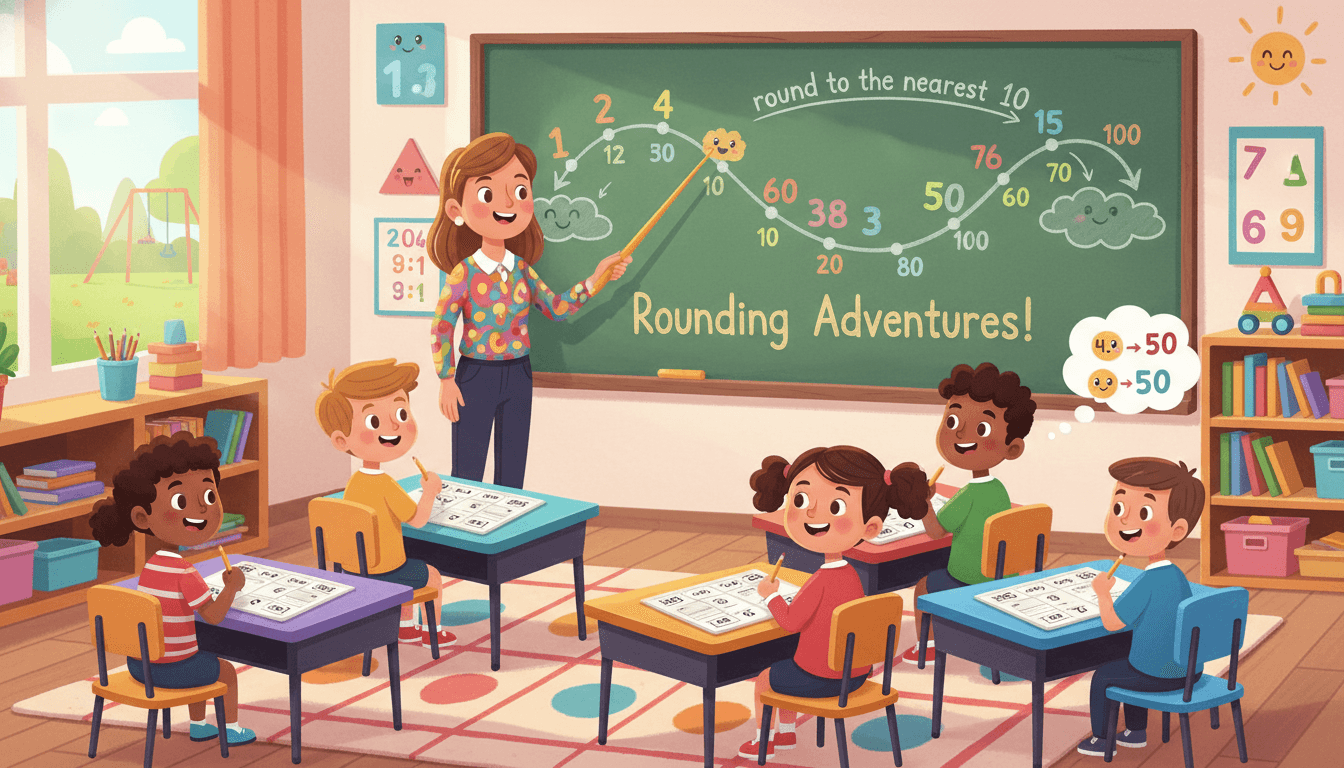
3rd Grade: Round to the nearest 10 and 100 for numbers within 1,000. Use rounding for estimation.
4th Grade: Round multi-digit whole numbers to any place. Apply rounding in multi-step word problems.
5th Grade: Round decimals to any place (tenths, hundredths, thousandths).
Common Misconceptions
"Always round 5 down." The convention is 5 rounds up. Kids who've heard conflicting rules need this clarified explicitly.
"After rounding 347 to the nearest hundred, the answer is 3." The hundreds digit is 3, but rounding produces 300, not 3. The zeros are not optional - they maintain the number's value.
"Round step by step." A common error: rounding 349 to the nearest hundred by first rounding to nearest ten (350) and then to nearest hundred (400). This is wrong. Always round directly to the target place using the original number.
Practice Activities
-
Number line placement: Draw a number line between two tens (or hundreds). Place the number to be rounded and identify the closer endpoint.
-
Round and estimate: Before computing 48 × 31, round to 50 × 30 = 1,500. Compute the exact answer. How close was the estimate?
-
Rounding sort: Cards with numbers - sort into "rounds to 400," "rounds to 500," "rounds to 600."
-
Real-world rounding: Look at grocery store prices. Round each to the nearest dollar to estimate total cost.
-
Rounding race: Students round a series of numbers as fast as they can accurately. Build fluency through volume of practice.
Frequently Asked Questions
How do you round a number to the nearest ten?
Look at the ones digit. If it's 5 or more, round up (increase the tens digit by 1, change ones to 0). If it's 4 or less, round down (keep the tens digit, change ones to 0). Example: 47 → ones digit is 7 (≥5) → round up → 50. Example: 43 → ones digit is 3 (<5) → round down → 40.
Why does 5 round up and not round down?
The 'round half up' rule is a mathematical convention, not a natural law. 5 is exactly halfway between two tens (e.g., 45 is exactly between 40 and 50). When a number is exactly halfway, mathematicians agreed to round up to avoid ambiguity. Some advanced contexts use 'round half to even' (banker's rounding) to avoid systematic bias, but this isn't a K-5 topic.
What does it mean to round to the nearest hundred?
Same idea, but you look at the tens digit (the digit one position to the right of the hundreds place). 472 → tens digit is 7 (≥5) → round up → 500. 431 → tens digit is 3 (<5) → round down → 400. The hundreds digit stays or increases by 1; everything to its right becomes zeros.
When do kids learn to round decimals?
Rounding decimals is a 5th grade standard. Students round decimals to the nearest whole number, tenth, or hundredth. The same rule applies: look at the digit one place to the right of where you're rounding. 3.47 rounded to the nearest tenth → look at the hundredths digit (7) → round up → 3.5.
What's the difference between rounding and estimating?
Rounding is a specific technique: replacing a number with a nearby value at a specified place value. Estimation is broader: getting an approximate answer using any suitable method, which may or may not involve rounding. You might estimate 49 × 52 as 50 × 50 = 2,500 - that uses rounding. But you might also estimate by knowing 'it's between 2,000 and 3,000.' Rounding is the most common estimation tool, but not the only one.
Free Rounding Worksheets
Curriculum-aligned printable worksheets for 3rd – 5th Grade. Download free.