What Is Mental Math?
Taught in US schools
Key Takeaways
- Mental math uses flexible strategies to compute quickly without paper or calculator.
- Key strategies include making tens, compensation, decomposing numbers, and using known facts.
- Strong mental math is a sign of deep number sense, not just memorization.
- Mental math builds the speed and flexibility needed for estimation and multi-step problem solving.
What Is Mental Math?
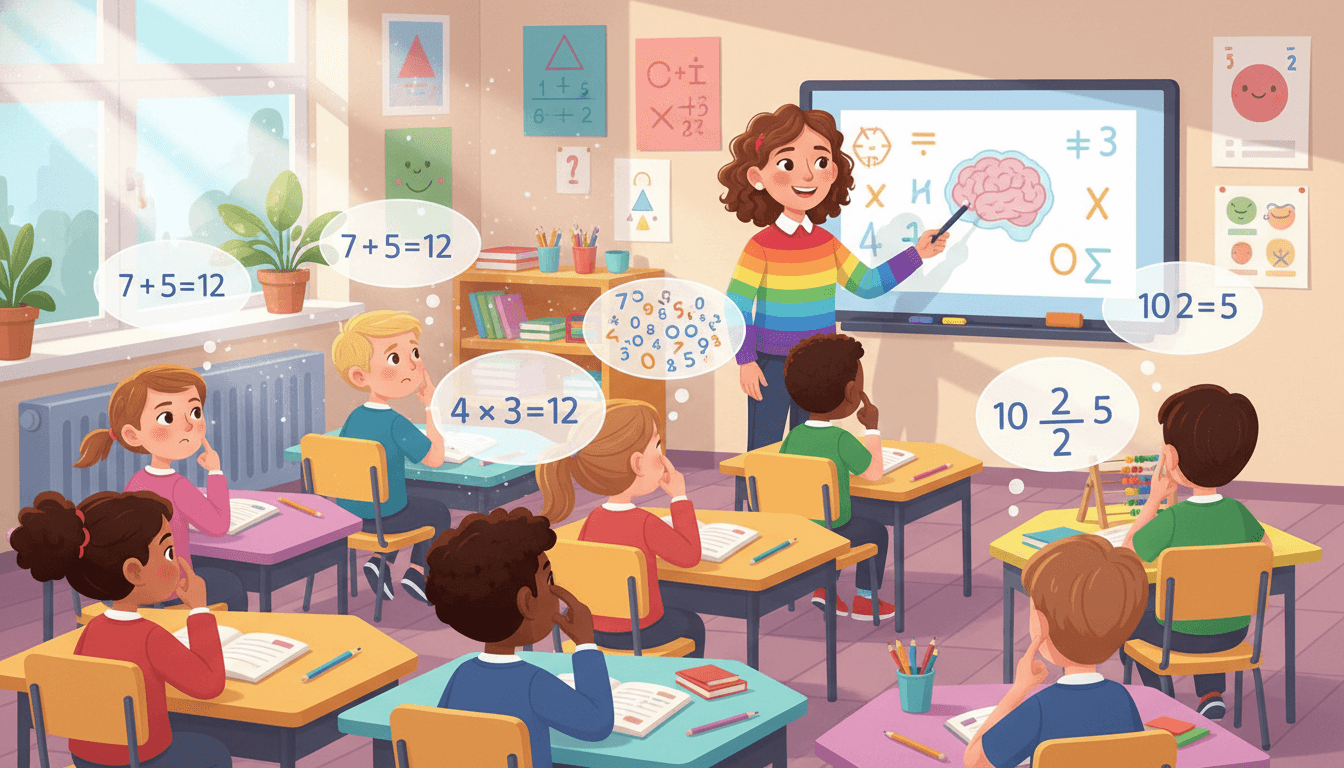
Mental math is the practice of calculating answers in your head, using flexible thinking strategies rather than paper, pencil, or a calculator. It is not about speed alone - it is about understanding numbers well enough to find the most efficient path to an answer.
Mental math is a hallmark of strong number sense. A student who can mentally solve 99 + 57 by thinking "100 + 57 = 157, minus 1 = 156" understands place value and compensation at a deep level.
Core Mental Math Strategies
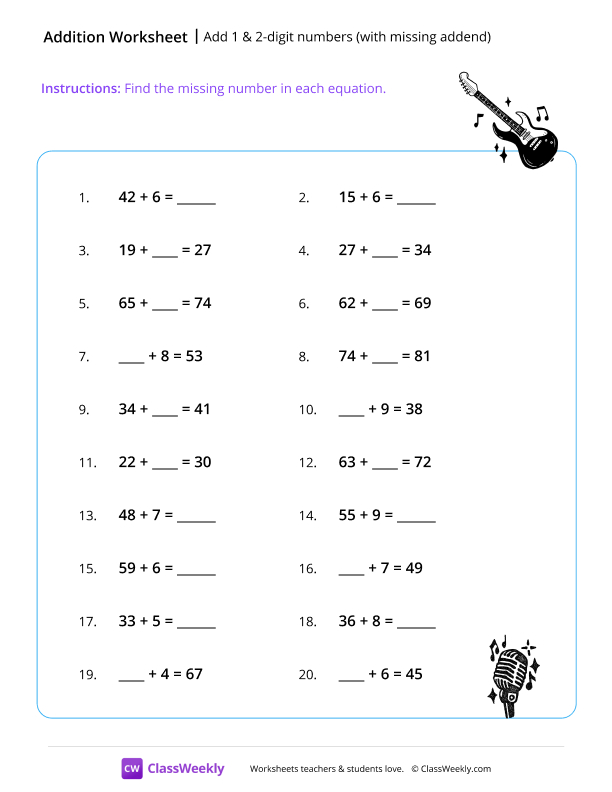
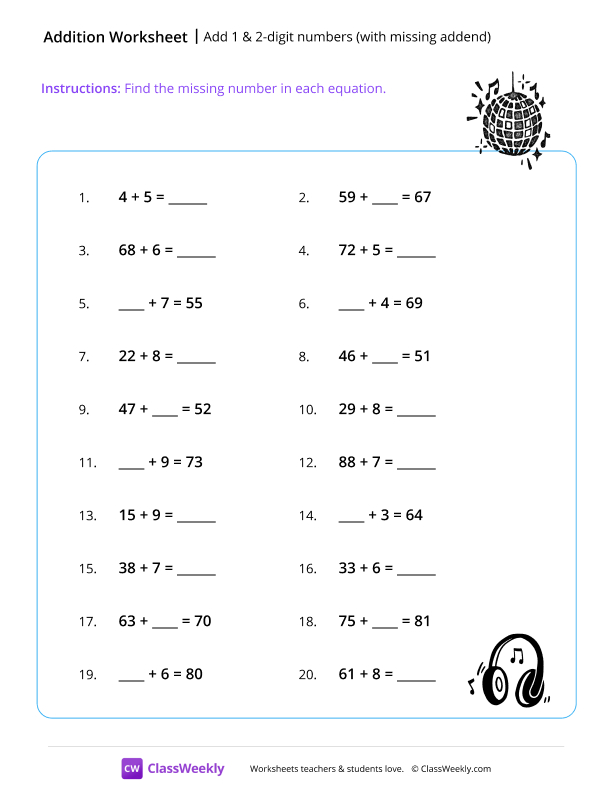
Making tens: Combine numbers to reach the nearest 10 before continuing.
- 7 + 6 → (7 + 3) + 3 = 10 + 3 = 13
Compensation: Round one number up to a friendly number, then adjust.
- 48 + 37 → 50 + 37 = 87, then subtract 2 → 85
Decomposing: Break numbers into place-value parts.
- 63 + 24 → (60 + 20) + (3 + 4) = 80 + 7 = 87
Doubling and halving (multiplication): If one factor is even, halve it and double the other.
- 4 × 18 → 8 × 9 = 72
Using known facts: Build on memorized facts to find unknown ones.
- I know 6 × 7 = 42, so 7 × 7 = 49 (add one more group of 7)
What Grade Do Kids Practice Mental Math?
1st grade: Making tens, counting on from the larger number.
2nd grade: Adding and subtracting two- and three-digit numbers mentally using place value.
3rd grade: Using properties (commutative, distributive) to multiply mentally.
4th–5th grade: Applying mental strategies to larger numbers, fractions, and decimals.
Mental Math vs. Written Algorithms
Written algorithms (like the standard addition algorithm with carrying) are important, but they are not always the most efficient approach. Mental math encourages students to choose the best tool for the problem. Teaching both - and asking students to justify their strategy choices - builds mathematical flexibility.
Common Misconceptions
Mental math is just fast memorization: Students sometimes think mental math means recalling facts instantly. While fact fluency helps, true mental math is about applying strategies flexibly to unfamiliar calculations.
There is only one right mental math strategy: Many problems can be solved efficiently in multiple ways. Sharing different student strategies is one of the most valuable parts of mental math instruction.
Mental math is only for simple problems: Students can and should apply mental math to multi-digit numbers, estimation, and even fractions with practice.
Practice Activities
-
Number talks: Teacher presents a problem; students solve mentally and share their strategies. Class discusses all approaches.
-
Strategy journal: Students record and name the mental strategy they used to solve each problem.
-
Mental math warm-up: Begin each math class with 3–5 mental math problems at increasing difficulty.
-
Speed without pressure: Students solve in their head and compare strategies rather than racing for the fastest answer.
-
Real-world contexts: Calculate the total cost of 4 items at $0.99 each, or split 48 crackers among 6 friends - no paper allowed.
Frequently Asked Questions
What is mental math?
Mental math is the ability to calculate answers in your head using flexible strategies. Rather than following a single written algorithm, mental math draws on number sense to find the most efficient path to an answer. For example, to add 48 + 35, a student might think: 50 + 35 = 85, then subtract 2 to get 83.
What are the most important mental math strategies?
Key strategies include: Making tens (combine numbers to reach a multiple of 10), compensation (round one number up, adjust at the end), decomposing (breaking numbers into place values), doubling and halving (for multiplication), and using known facts (if I know 6 × 6 = 36, then 6 × 7 = 42).
How is mental math different from memorization?
Memorization is recalling a stored fact (like 7 × 8 = 56). Mental math is reasoning through an unfamiliar calculation using strategies. Both are valuable: fact fluency (memorization) is fast for known facts, while mental math strategies handle new or more complex problems. The strongest mathematicians use both.
At what grade level should students develop mental math skills?
Mental math develops across all elementary grades. First graders learn to make tens. Second graders add and subtract within 1,000 using strategies. Third graders use properties of multiplication. By 4th and 5th grade, students apply mental math to multi-digit numbers, fractions, and decimals.
Why is mental math important?
Mental math builds number sense, supports estimation, and accelerates computation. It is also a lifelong skill - most day-to-day math (calculating a tip, estimating change, splitting a bill) happens mentally. Students who can compute mentally also check written answers more effectively.
Free Mental Math Worksheets
Curriculum-aligned printable worksheets for 1st – 5th Grade. Download free.