What Is Number Sense?
Taught in US schools
Key Takeaways
- Number sense is flexible, intuitive understanding of how numbers work - not just memorized facts.
- Key components: counting, quantity recognition, number relationships, magnitude, estimation, and part-whole understanding.
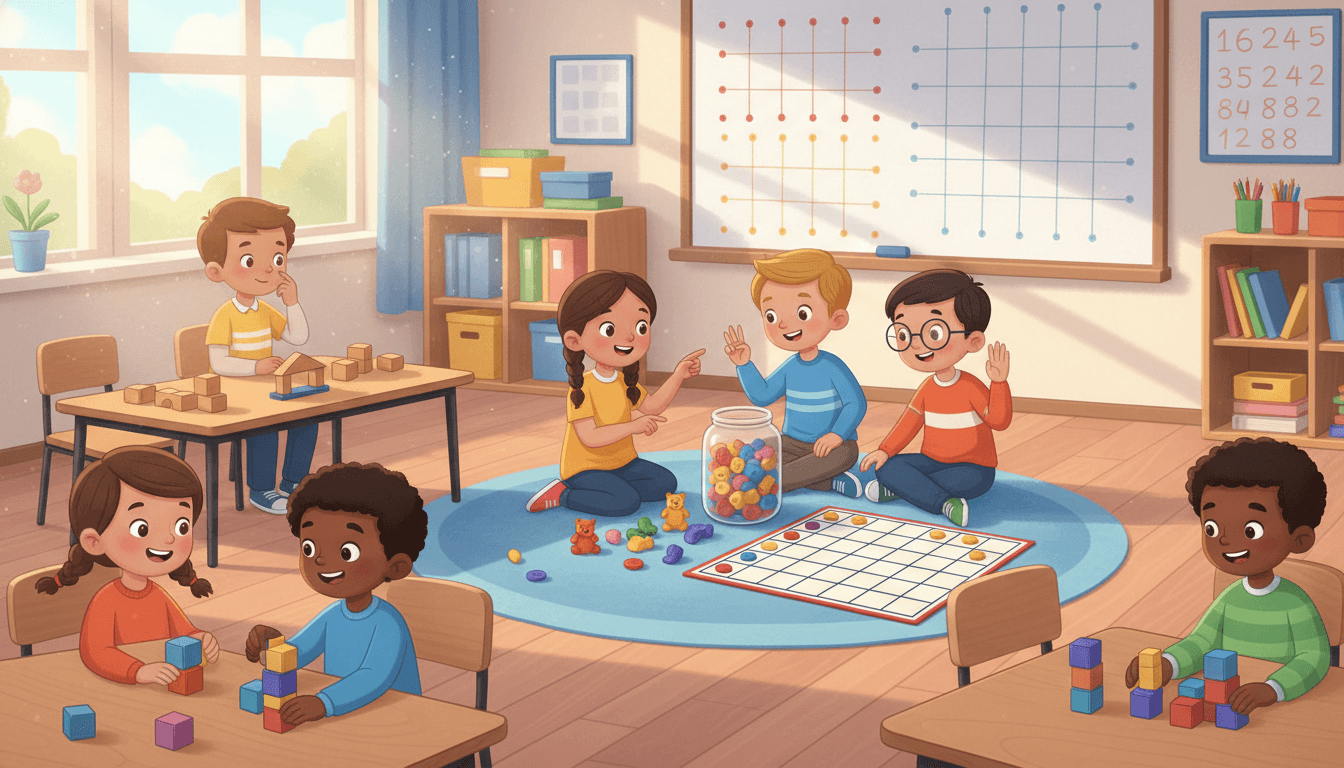
- Number sense develops through concrete experience, not just drill - manipulatives, number talks, games.
- Strong number sense makes multi-digit arithmetic and fractions dramatically easier to understand.
What Is Number Sense?
Number sense is flexible, intuitive understanding of numbers and how they work.
It's the difference between knowing that 8 + 7 = 15 (a fact) and understanding why - seeing that 8 + 7 can be solved as 8 + 2 + 5 (making 10), or as 10 + 5 (doubling and adjusting), or as 7 + 7 + 1.
Number sense is the mathematical intuition that underlies all arithmetic. Students with strong number sense:
- Choose efficient strategies rather than always using a standard algorithm
- Estimate before computing and check for reasonableness
- See numbers as flexible and related, not fixed and isolated
Key Components of Number Sense
Counting and cardinality (K–1) One-to-one correspondence; knowing that the last number said = the total.
Subitizing (K–1) Instantly recognizing small quantities without counting. Seeing 5 dots and knowing it's 5.
Number relationships (K–2) 7 is one more than 6; two less than 9; one more than double 3.
Magnitude and comparison (K–3) Which is bigger? How much bigger? Where does this number sit on a number line?
Part-whole understanding (K–3) 8 can be decomposed as: 5+3, 4+4, 6+2, 1+7. This is the foundation of fact fluency.
Place value (1–5) Digits have different values based on position. 35 means 3 tens + 5 ones.
Estimation (2–5) Reasonable approximation before or instead of exact computation.
Building Number Sense
Number sense is NOT built through drill alone. It develops through:
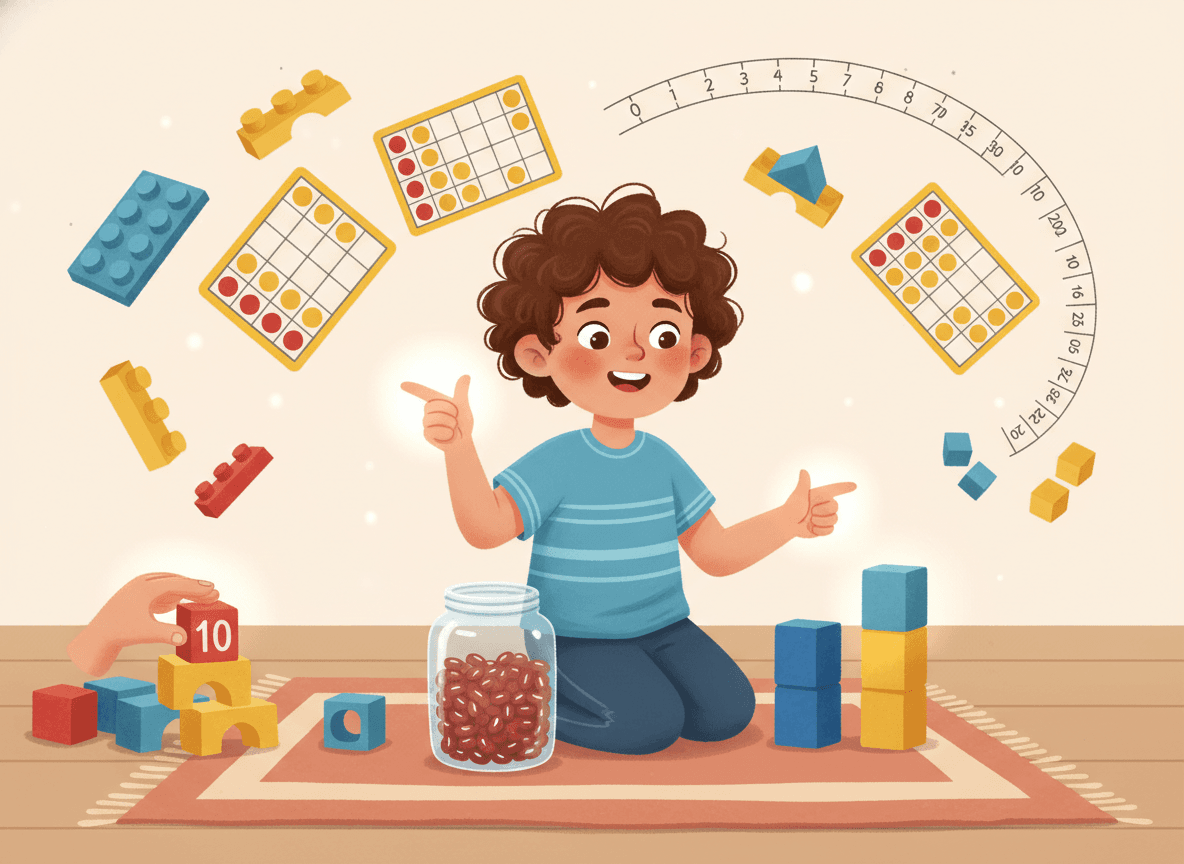
Concrete manipulation: Counting physical objects, using ten frames, rekenreks, base-ten blocks.
Number talks: Brief mental math discussions where students share multiple strategies for solving a problem mentally.
Games and contexts: Board games with number cubes, measurement activities, shopping scenarios.
Decomposition practice: Regularly breaking numbers apart in multiple ways (7 = 3+4 = 5+2 = 6+1).
Estimation routines: Estimate first, then calculate, then compare.
Number Talks: The High-Impact Routine
A number talk is a 5-10 minute mental math discussion:
- Teacher writes a problem (e.g., 38 + 24)
- Students solve mentally and hold up a quiet signal
- Multiple students share their strategies
- Teacher records each strategy; class discusses which is most efficient
This builds number sense by showing that mental flexibility - not just the standard algorithm - is valued and powerful.
What Grade Do Kids Develop Number Sense?
Kindergarten: Counting and cardinality; subitizing; comparing; understanding more/less.
1st Grade: Place value to 120; counting forward and backward; representing numbers in multiple ways.
2nd Grade: Place value to 1,000; flexible addition and subtraction strategies.
3rd Grade: Multiplication as repeated addition; fractions as parts of wholes.
4th–5th Grade: Applying number sense to multi-digit computation, fractions, and decimals.
Common Misconceptions
"Fast computation = strong number sense." Speed and fluency are not the same as number sense. A student who quickly applies a memorized procedure without understanding what they're doing has fluency but limited number sense.
"Number sense is a natural talent." Number sense develops through experience and instruction. Classrooms that emphasize multiple strategies, mental math discussion, and estimation build number sense intentionally.
"Drill is enough." Drill builds fluency with specific facts. Understanding the relationships between numbers - number sense - requires conceptual engagement.
Practice Activities
-
Number talks: Daily 5-10 minute mental math discussions with strategy sharing.
-
Rekenrek counting: Slide beads to build numbers; see patterns of 5s and 10s.
-
Dot card subitizing: Flash dot cards; students recognize quantities without counting.
-
True/False equations: "Is 47 + 35 = 72? How do you know without computing?" Builds estimation and relationship thinking.
-
Number of the day: Students represent the same number 5 different ways (expanded form, number line, tens/ones, decomposition, word form).
Frequently Asked Questions
What are the components of number sense?
Counting and cardinality: one-to-one correspondence, counting sequences, understanding that the last number counted = the total. Quantity recognition (subitizing): instantly recognizing small quantities (up to 5) without counting. Number relationships: understanding that 7 is one more than 6, two less than 9, halfway between 5 and 9. Magnitude: understanding which is more or less; relative size. Part-whole understanding: 8 is 5+3, 4+4, 6+2, 7+1. Place value: the value of digits based on position. Estimation: reasonable approximation before or instead of exact calculation.
What is subitizing and why does it matter?
Subitizing is the ability to instantly recognize small quantities without counting - seeing 4 dots on a die and knowing it's 4 without counting one by one. Perceptual subitizing (recognizing up to 4-5 items instantly) is a natural early skill. Conceptual subitizing (seeing larger groups by recognizing sub-groups - seeing 6 as a group of 4 and a group of 2) develops through instruction. Subitizing is a core component of early number sense and supports the development of part-whole understanding, mental math, and fact fluency.
How does number sense develop?
Number sense develops through concrete experience - handling physical objects, playing number games, discussing quantities, and solving problems in contexts that make numbers meaningful. Research shows that children who have strong number sense before formal schooling perform better in arithmetic throughout elementary school. Key experiences: counting collections of real objects, comparing quantities ('more/less/same'), playing board games with number cubes, using ten frames and rekenreks, engaging in number talks (mental math discussions). Drill alone does not build number sense - conceptual engagement with quantities is essential.
What is a number talk and how does it build number sense?
A number talk is a brief (5-10 minute) whole-class mental math routine where students solve a math problem mentally and share multiple strategies. Example: 'How did you solve 27 + 15 in your head?' Students share: 'I made 27 into 30 by adding 3, then added 15, then subtracted 3 → 42.' 'I added 20+10=30, then 7+5=12, then 30+12=42.' Number talks build number sense by exposing students to multiple efficient strategies and showing that mental flexibility - not just the standard algorithm - is valued. Regular number talks are one of the highest-impact math routines for number sense development.
How is number sense different from arithmetic fluency?
Arithmetic fluency is the ability to compute accurately and efficiently - knowing that 8×7=56. Number sense is the conceptual understanding that makes fluency meaningful and flexible. A student with arithmetic fluency but weak number sense can compute correctly but can't estimate, doesn't catch unreasonable answers, and can't adapt when a rote procedure doesn't work. Strong number sense supports fluency - a student who understands that 8×7 = 8×5+8×2 = 40+16 = 56 has both fluency AND understanding. Both are needed; neither alone is sufficient.
Free Number Sense Worksheets
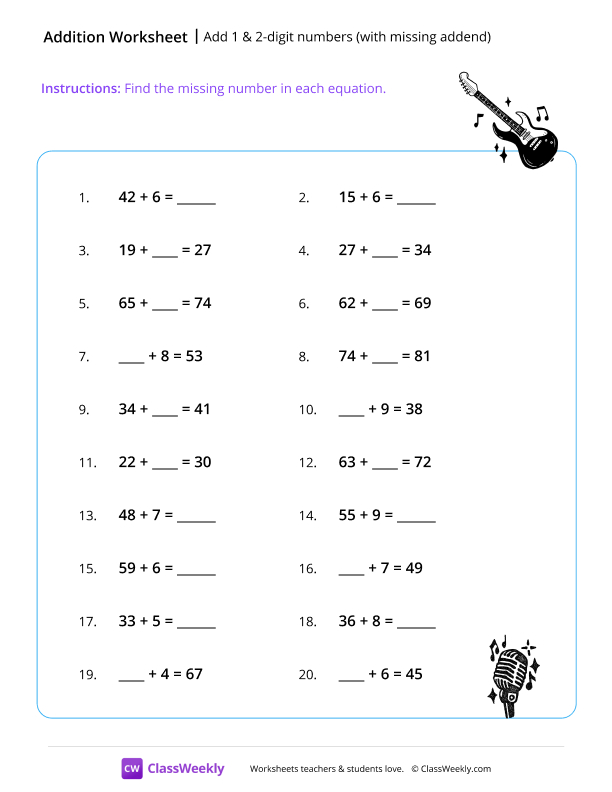
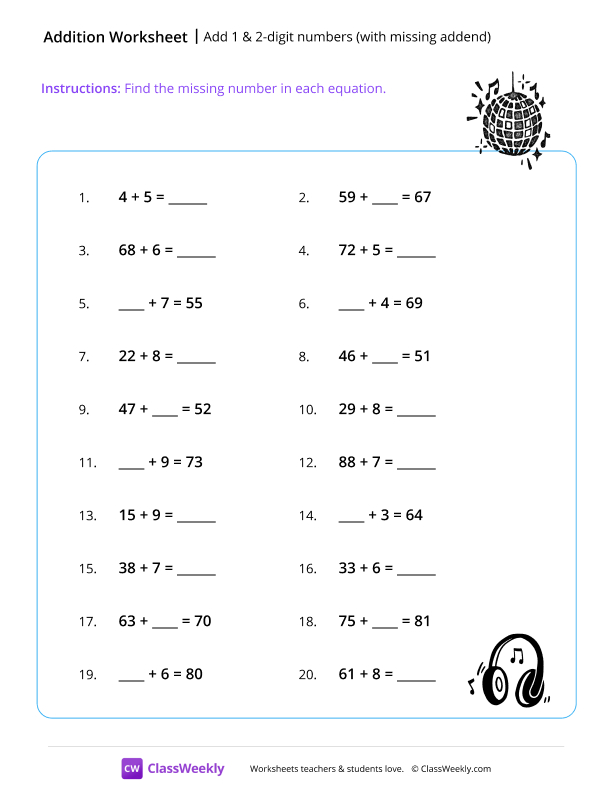
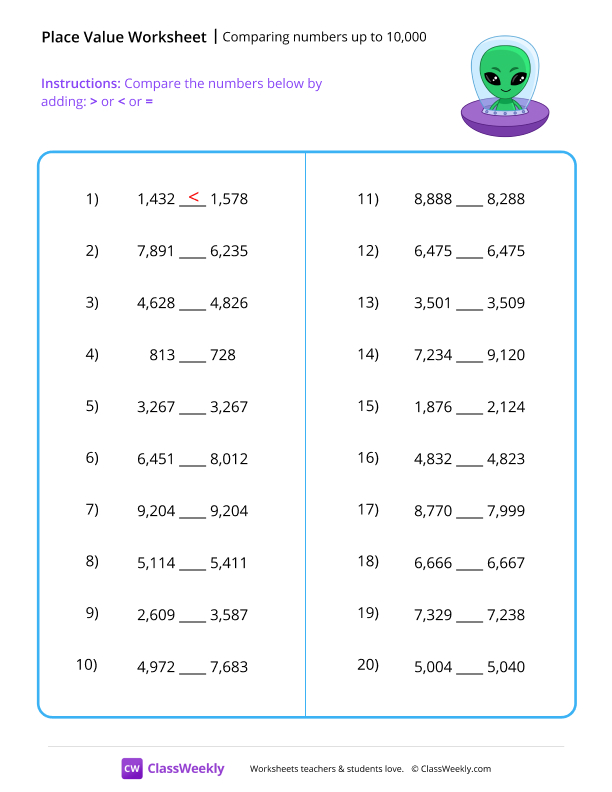
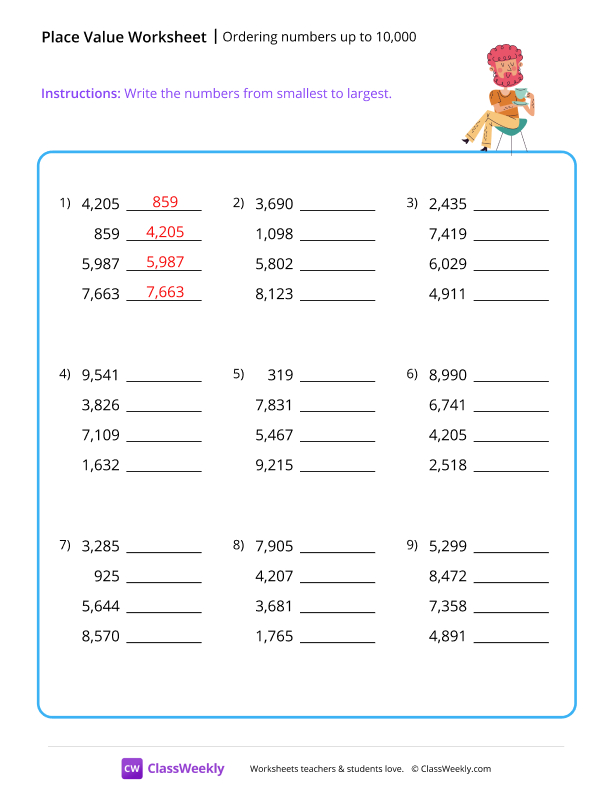
Curriculum-aligned printable worksheets for Kindergarten – 5th Grade. Download free.