What Is Skip Counting?
Taught in US schools
Key Takeaways
- Skip counting means counting by a number other than 1 - by 2s, 5s, 10s, 3s, etc.
- It's the bridge between counting and multiplication - 5, 10, 15, 20 is the same as repeated addition of 5.
- Counting by 2s, 5s, and 10s are the most important and are introduced as early as kindergarten.
- Skip counting on a number line or hundreds chart makes patterns visible.
Skip counting doesn't always get the respect it deserves. It sounds like a simple counting exercise, but it's actually doing foundational work for multiplication, number sense, and pattern recognition - all at once. Kids who can skip count fluently have a significant advantage when multiplication arrives in 3rd grade.
What Is Skip Counting?
Skip counting means counting forward or backward by a number other than 1.
Examples:
- By 2s: 2, 4, 6, 8, 10, 12...
- By 5s: 5, 10, 15, 20, 25...
- By 10s: 10, 20, 30, 40, 50...
- By 3s: 3, 6, 9, 12, 15...
The "skip" refers to skipping over the numbers in between - jumping from 10 to 20 to 30, skipping 11–19 and 21–29.
The Connection to Multiplication
Skip counting is multiplication in disguise. When a child counts by 6s - 6, 12, 18, 24, 30 - they're reciting the 6 times table. When they need 6 × 7, they can count six jumps on a number line: 6, 12, 18, 24, 30, 36, 42.
This connection is worth making explicit to students. "You're already doing multiplication" is a motivating realization for kids who have been drilling skip counting since kindergarten.
What Grade Do Kids Learn Skip Counting?
Kindergarten: Count to 100 by ones and tens. The hundreds chart, counting by 10s from any number.
1st Grade: Count to 120. Skip counting by 2s, 5s, and 10s within 100. Beginning understanding of even/odd via skip counting by 2s.
2nd Grade: Skip counting by 5s, 10s, and 100s within 1,000. Skip counting forward and backward. Hundreds chart patterns.
3rd Grade: Skip counting as a multiplication strategy. Practicing all times tables connects to skip counting sequences.
Common Misconceptions
"Skip counting is the same as multiplication." It's a strategy for multiplication, not the operation itself. A child who skip counts by 7s to find 7×8 is using a counting strategy. Automatic recall - knowing 7×8=56 instantly - is the goal, with skip counting as a bridge.
"You can only skip count starting from the skip number itself." Kids should practice starting from any multiple - "count by 5s starting from 35: 35, 40, 45, 50..." This flexibility is important for real-world applications.
How to Teach Skip Counting
Use a hundreds chart. Have kids color every 2nd square, every 5th square, every 10th square. The visual patterns (columns, diagonals, rows) make the structure of skip counting concrete.
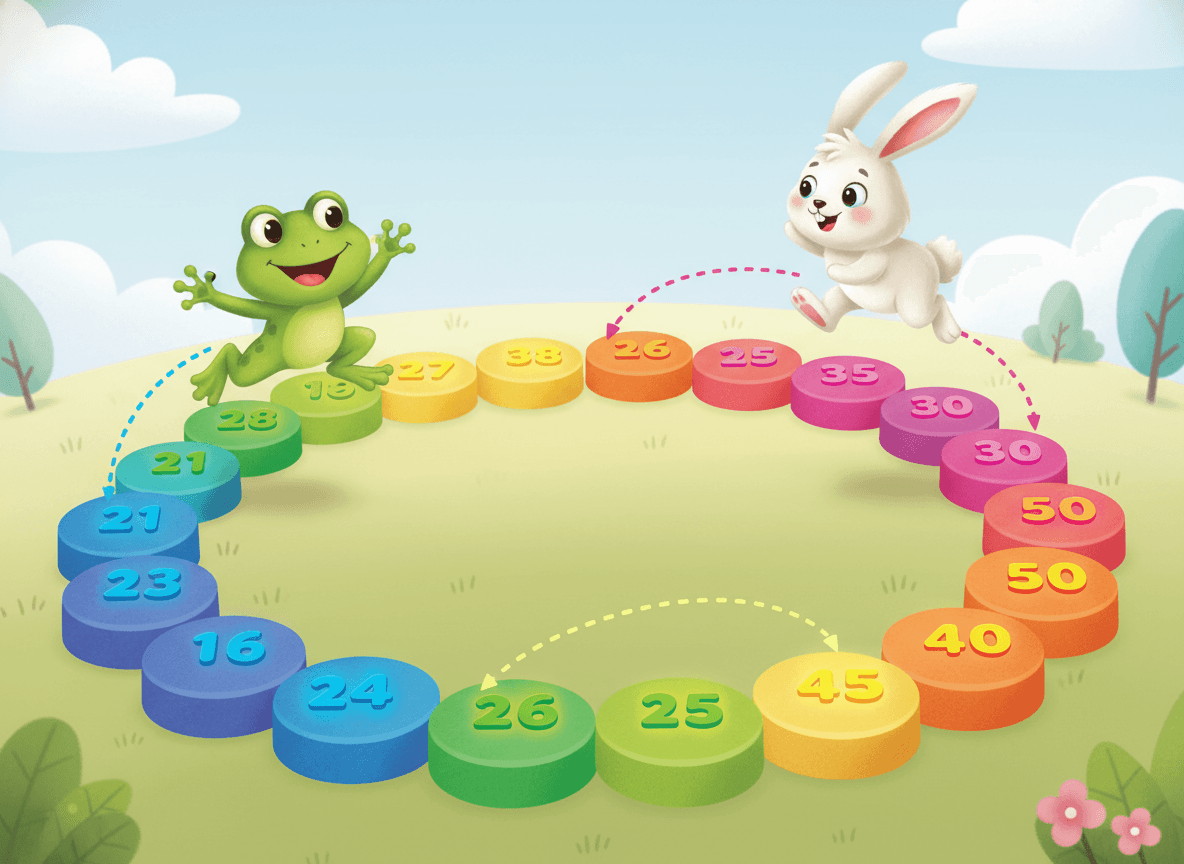
Make it rhythmic. Chant skip counting sequences with a beat. Clap on the "counted" numbers, stomp on the "skipped" ones. Physical rhythm helps memory.
Count real objects. Count fingers by 5s, shoes by 2s, coins (nickels by 5s, dimes by 10s). Real contexts make the purpose clear.
Connect explicitly to multiplication. Once 3rd grade multiplication begins, show that the 4 times table is the same as skip counting by 4s.
Practice Activities
-
Hundreds chart coloring: Color every nth square and discover the pattern. Identify what skip count sequence was used.
-
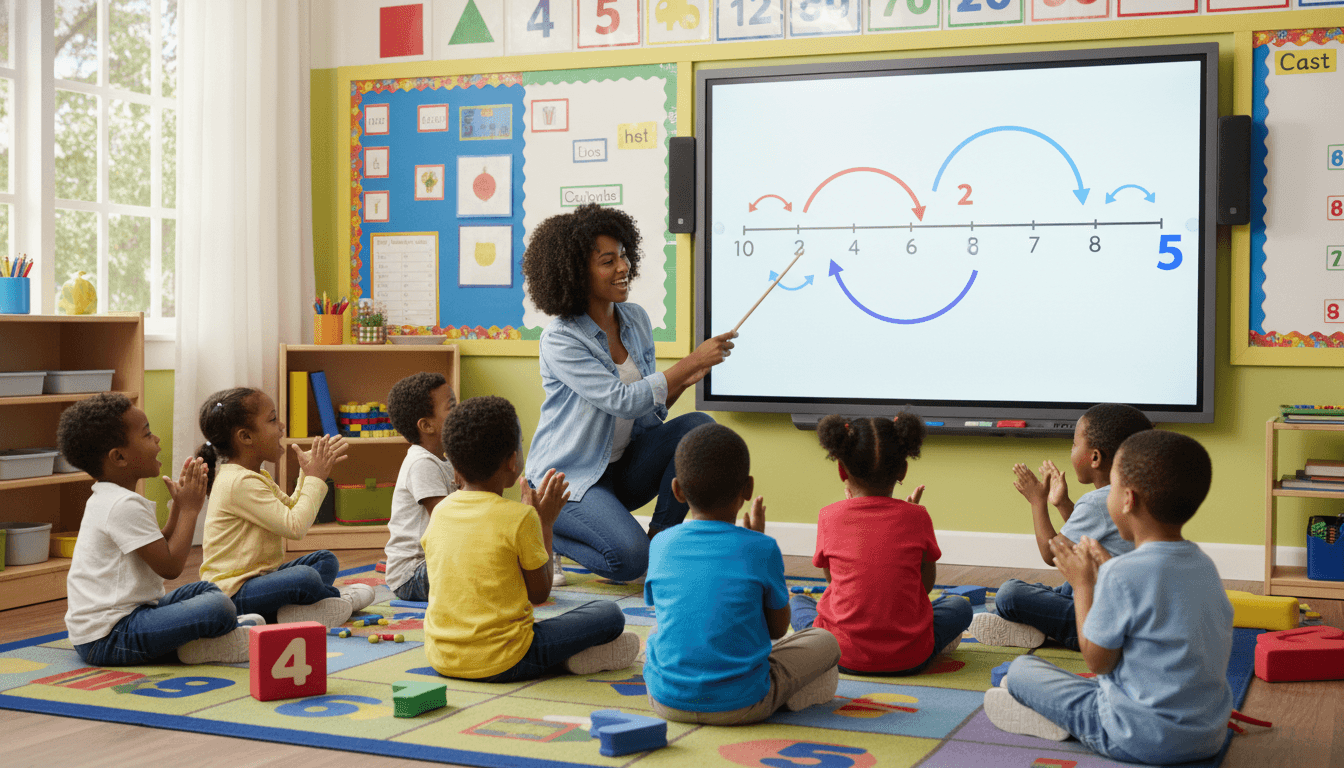
Number line hops: Draw hops of equal size on a number line. Write the sequence.
-
Fill in the blanks: "5, 10, ___, 20, ___, ___" - sequencing tasks build pattern recognition.
-
Skip count to find the total: "6 bags of 3 apples - count by 3s to find the total."
-
Backward skip count challenge: Starting at 50, count backward by 5s. How far can you go?
Frequently Asked Questions
Why is skip counting important?
Skip counting builds several skills at once. It strengthens number sense by showing how numbers relate to each other in patterns. It develops the rhythm of multiplication - counting by 6s (6, 12, 18...) is the same sequence as the 6 times table. And it prepares kids for concepts like even/odd numbers, multiples, and fractions. Kids who fluently skip count have a significant head start when multiplication is introduced in 3rd grade.
What order should skip counting be taught?
Start with 10s and 5s - these are the most intuitive (fingers and toes, clock face) and appear earliest in the standards. Then 2s (even numbers, pairs). Then skip counting on the hundreds chart for any sequence. 3s, 4s, 6s, 7s, 8s, and 9s are practiced as part of multiplication fluency in 3rd grade. There's no rush to do all sequences in K-1; mastery of 2s, 5s, and 10s is the realistic kindergarten target.
How is skip counting connected to multiplication?
Skip counting by a number is exactly the same as listing the multiples of that number. Counting by 4s: 4, 8, 12, 16, 20... is the same as the 4 times table. When kids count by 6s to find 6×7, they're using skip counting as a multiplication strategy. The explicit connection - 'you're already doing multiplication!' - motivates skip counting practice.
Should kids skip count forward and backward?
Yes. Counting backward (20, 18, 16, 14...) builds understanding that skip counting is a pattern, not just rote memorization forward. Backward skip counting is also preparation for subtraction and division reasoning. It's harder, so introduce it after forward sequences are secure, typically in 2nd grade.
What tools help with skip counting?
Hundreds charts are the most useful - kids can see visual patterns emerge when they color every 2nd, 5th, or 10th square. Number lines work well for individual sequences. Rhythmic chanting (clapping or stomping on each counted number) helps kids remember the pattern. Multiplication tables can serve as a reference once kids are ready to see the formal connection.
Free Skip Counting Worksheets
Curriculum-aligned printable worksheets for Kindergarten – 3rd Grade. Download free.