What Are Number Bonds?
Taught in US schools
Key Takeaways
- A number bond shows a whole number split into two parts, using a simple diagram.
- Number bonds make the relationship between addition and subtraction visual and concrete.
- Number bonds to 10 (all pairs that make 10) are a foundational benchmark in K-1.
- The same number bond generates two addition facts and two subtraction facts.
Number bonds are one of those visual tools that seem almost too simple but do a remarkable amount of conceptual work. In one small diagram, they show the whole-part relationship, the connection between addition and subtraction, and the foundation for mental math - all at once.
What Are Number Bonds?
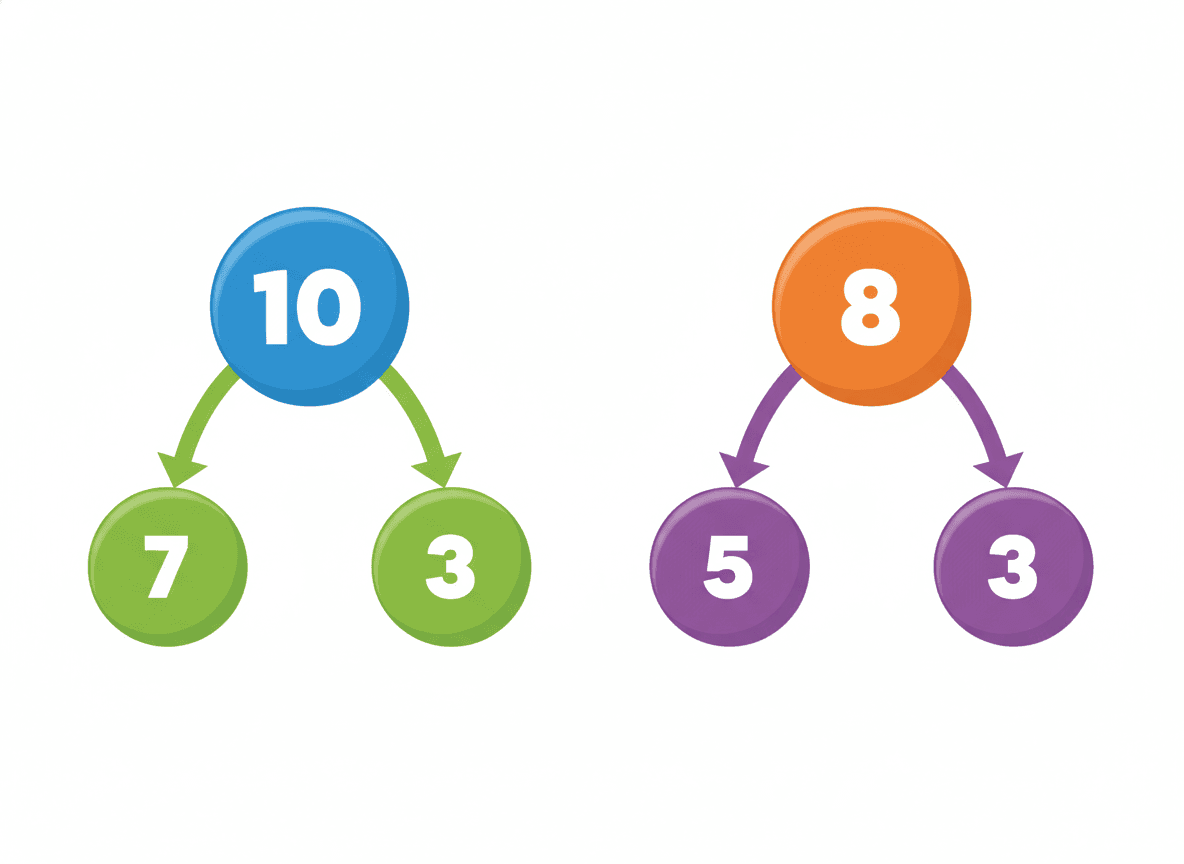
A number bond is a visual model showing a whole number split into two parts.
The diagram: a circle on top (the whole) connected by lines to two circles below (the parts).
If the whole is 8 and one part is 3, the other part must be 5.
This one bond generates four equations:
- 3 + 5 = 8
- 5 + 3 = 8
- 8 – 3 = 5
- 8 – 5 = 3
Number Bonds to 10
The most important number bonds to master are bonds to 10 - all pairs of numbers that sum to 10:
0: + - 10 - = - 10
1: + - 9 - = - 10
2: + - 8 - = - 10
3: + - 7 - = - 10
4: + - 6 - = - 10
5: + - 5 - = - 10 These six bonds (each with its commutative pair) underpin the "making ten" strategy - the most efficient mental math technique for single-digit addition.
What Grade Do Kids Learn Number Bonds?
Kindergarten: Number bonds within 5, then within 10. Using objects and drawings. Understanding that numbers can be split into parts in different ways. Number bonds to 5 as a starting benchmark.
1st Grade: Fluency with all number bonds to 10. Number bonds to 20. Using bonds to support mental addition and subtraction strategies.
2nd Grade: Applying number bond thinking to larger numbers. Using bonds to decompose numbers for mental addition (37 + 25: think 37 + 3 = 40, then + 22 = 62).
Why Number Bonds Matter
They make the inverse relationship between addition and subtraction concrete and visual. A child who can "see" that 8 is made of 3 and 5 doesn't need to relearn that 8–3=5 - it's the same bond, viewed differently.
They're also the foundation for place value understanding. Every two-digit number can be shown as a bond: 37 = 30 + 7. The tens and ones structure is a number bond.
How to Teach Number Bonds
Build with physical objects first. Place 6 counters on the table. Put 2 in one group, 4 in another. Write the bond. Rearrange: 1 and 5. 3 and 3. How many different ways?
Focus on bonds to 10 before anything else. Use ten frames to make bonds to 10 visual. Five frames help with bonds to 5. The ten frame is the perfect scaffold.
Connect to subtraction from the start. Every time you show a bond, write all four equations. "The bond is the same - just look at it from a different angle."
Make bonds to 10 automatic. Flash 6 on a card, kids call out 4. Flash 3, kids call out 7. Speed and automaticity with bonds to 10 is the end goal.
Practice Activities
-
Ten frame bonds: Fill a ten frame with two colors of counters. Record the bond. Swap colors. Record again.
-
Number bond flip: Show the whole and one part. Students find the missing part. Use cards, whiteboards, or manipulatives.
-
Bonds to 10 speed drill: Flash one part; students respond with the other. Build toward instant recall.
-
Part-part-whole mats: Laminated mat with sections for whole and two parts. Fill with counters in various configurations.
-
Story problem pairs: Write an addition story and its subtraction counterpart using the same three numbers. Discuss how they're related.
Frequently Asked Questions
What does a number bond look like?
A number bond diagram has three circles connected by lines: a large circle on top (the whole) and two smaller circles below (the parts). If the whole is 8 and one part is 3, the other part is 5. The diagram generates four equations: 3+5=8, 5+3=8, 8-3=5, 8-5=3. Some teachers draw it as a part-part-whole mat instead - a rectangle divided into two sections with a box above for the whole.
What are number bonds to 10, and why are they important?
Number bonds to 10 are all pairs of numbers that add to exactly 10: 0+10, 1+9, 2+8, 3+7, 4+6, 5+5, 6+4, 7+3, 8+2, 9+1, 10+0. These are foundational because our number system is base 10. Knowing these bonds automatically supports the 'making ten' addition strategy, mental math, and understanding place value. Most kindergarten and 1st grade programs specifically target fluency with number bonds to 10.
What is the difference between number bonds and fact families?
They represent the same concept but with different visual formats. A fact family lists all four related equations: 3+5=8, 5+3=8, 8-3=5, 8-5=3. A number bond uses the part-part-whole diagram to show the same relationships. Fact families are more common in American curricula; number bonds are more common in Singapore Math and UK curricula. Both accomplish the same goal: showing how addition and subtraction are inverse operations.
What are number bonds to 20?
Number bonds to 20 extend the same concept: all pairs of numbers that add to 20. Once kids have bonds to 10 solid, bonds to 20 follow the same pattern with teen numbers. For example: 13+7=20, 14+6=20, 15+5=20. These are important for mental math with teen numbers and form part of 1st grade addition fluency expectations.
How do number bonds support mental math?
When a child knows that 7+3=10, they can quickly calculate 7+5 by thinking: '7 needs 3 to make 10, I have 5, so that's 10+2=12.' This 'bridging through 10' strategy uses number bond knowledge automatically. Kids with solid number bonds to 10 have a fast mental math toolkit that other kids lack - and this advantage compounds through every later arithmetic operation.
Free Number Bonds Worksheets
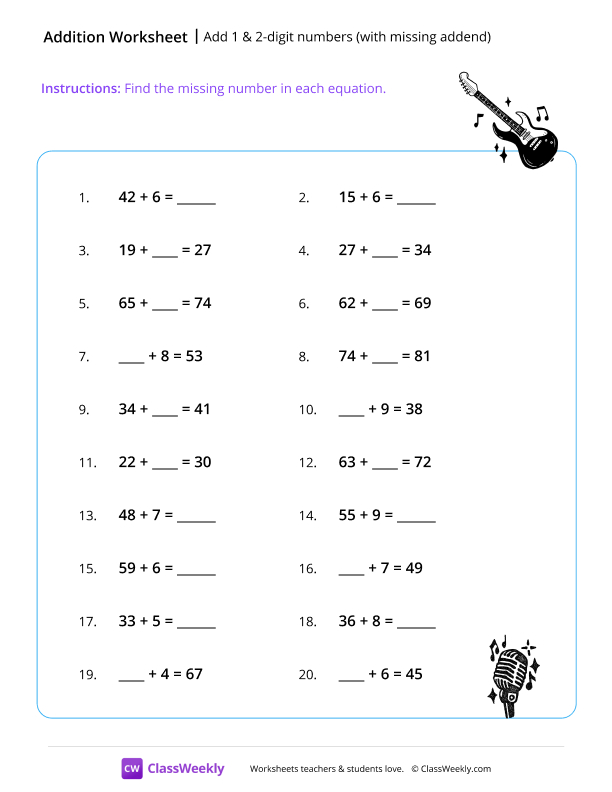
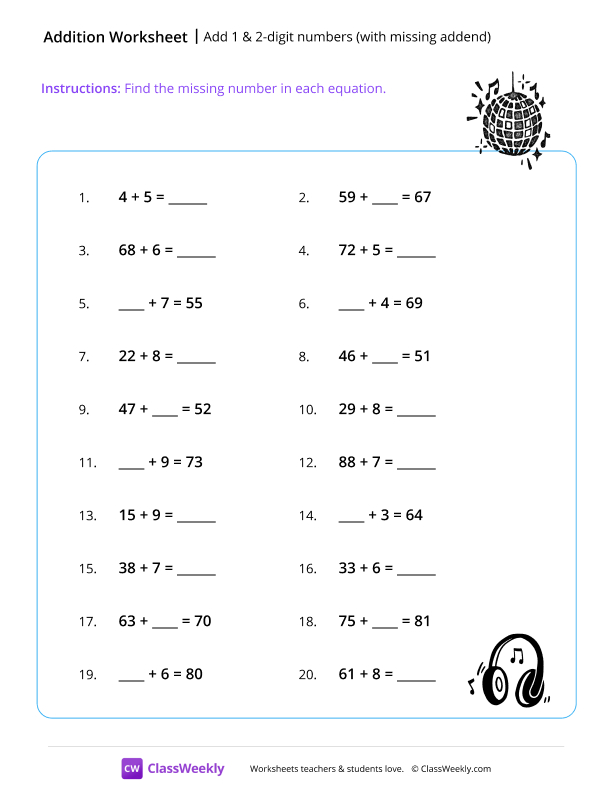
Curriculum-aligned printable worksheets for Kindergarten – 2nd Grade. Download free.