What Is Subtraction?
Taught in US schools
Key Takeaways
- Subtraction has three distinct meanings: taking away, finding the difference, and comparing.
- The inverse relationship between addition and subtraction is a key insight - 5+3=8 means 8-3=5.
- Kids often find subtraction harder than addition because the contexts are less intuitive.
- Regrouping (borrowing) is the trickiest step and requires solid place value understanding first.
Subtraction is the operation kids most often describe as "the hard one." And honestly, they're not wrong - subtraction is conceptually richer than it looks, and the word problems are sneakier. But it's also the operation that most directly builds algebraic thinking, because subtraction is really about finding unknowns.
What Is Subtraction?
Subtraction is the operation of finding what remains after removing part of a quantity, or finding the difference between two quantities.
The formal vocabulary:
-
Minuend: the starting number (what you're subtracting from)
-
Subtrahend: the number being subtracted
-
Difference: the result
-
Minus sign (-): the operation symbol
Example: 12 - 4 = 8. The minuend is 12, the subtrahend is 4, and the difference is 8.
The Three Meanings of Subtraction
Here's something teachers know that's worth making explicit: subtraction means different things in different contexts.
Take away: You have 10 grapes and eat 3. How many are left? (10 - 3 = 7)
Find the difference: Maria has 8 crayons and James has 5. How many more does Maria have? (8 - 5 = 3)
Find a missing part: You need 9 cups of flour for a recipe. You already have 4 cups. How much more do you need? (9 - 4 = ?)
Kids who only understand subtraction as "take away" get tripped up by comparison and missing-part problems. All three types show up in word problems from 1st grade onward.
What Grade Do Kids Learn Subtraction?
Kindergarten: Subtracting within 10 using objects and pictures. Understanding subtraction as "taking away." Simple word problems.
1st Grade: Subtracting within 20, strategies for subtraction facts (counting back, counting up, using the relationship to addition), understanding subtraction as the inverse of addition. Fact families.
2nd Grade: Fluency with subtraction within 20, two-digit subtraction with and without regrouping, three-digit subtraction, multi-step word problems.
3rd Grade: Multi-digit subtraction, applying subtraction to real-world problems, understanding subtraction as it relates to multiplication and division (fact families with all four operations).
Common Misconceptions
"Subtraction always means taking away." As covered above, subtraction has three distinct meanings. Teaching only "take away" leaves kids unprepared for comparison problems and missing-value situations.
"Subtraction makes numbers smaller." True for positive integers - but kids who develop this as a rule get confused when they encounter subtracting negative numbers, or when the result is the same (5 - 0 = 5).
"You always subtract the smaller number from the larger one." In whole number arithmetic for K-3, this is usually true. But accepting it as a rule creates confusion later when kids encounter situations where the result can be negative.
"Regrouping is just a mechanical procedure." Kids who learn the steps of regrouping without understanding the place value logic behind it apply the procedure inconsistently and can't troubleshoot errors. The "why" matters.
How to Teach Subtraction
Tie it explicitly to addition. From the very beginning, show the connection: 5 + 3 = 8 lives in the same fact family as 8 - 3 = 5. Thinking of subtraction as "adding up" is often more accessible than "counting back."
Use all three problem types. Give kids word problems that require taking away, comparing, and finding a missing part. Mix them in from the start.
Teach fact families together. Rather than drilling addition separately and then subtraction separately, teach related facts as a family. Seeing 4+7=11, 7+4=11, 11-7=4, 11-4=7 together reinforces the inverse relationship.
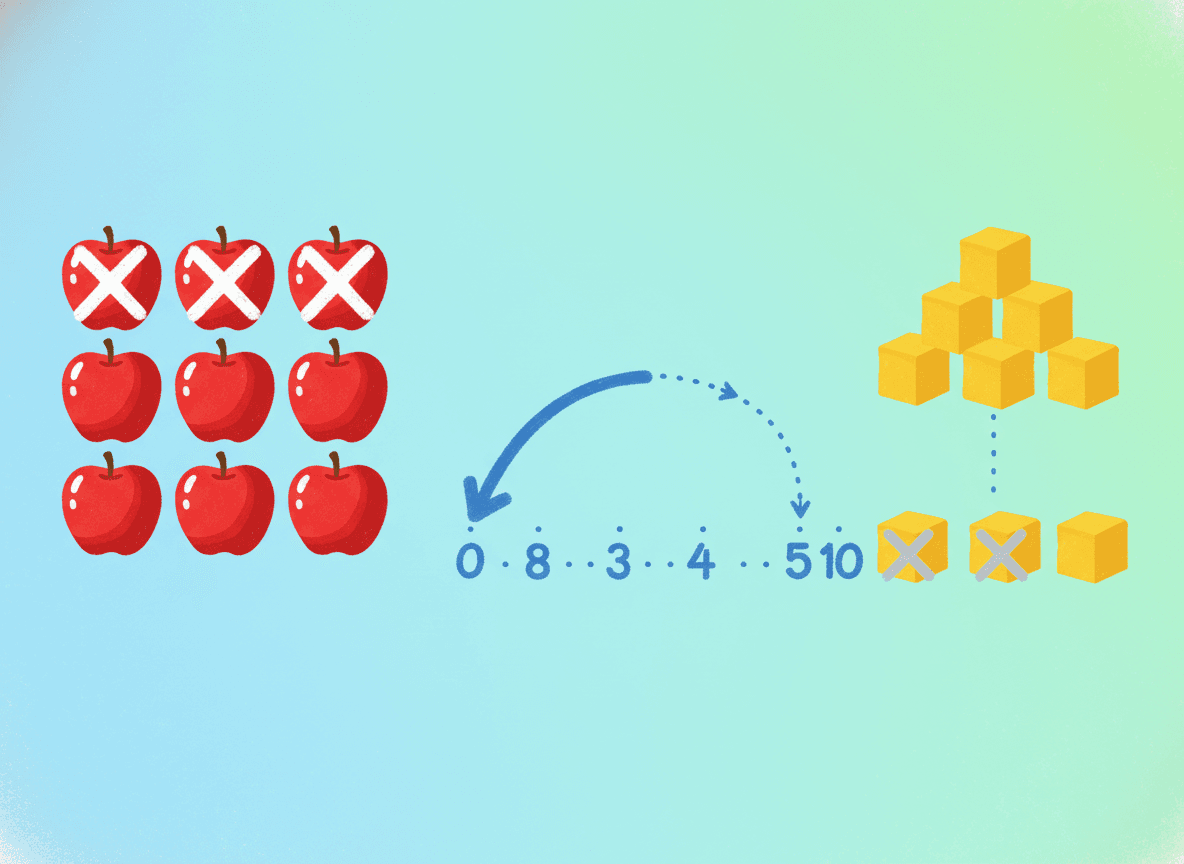
Use number lines. Number lines make "count back" and "count up" strategies concrete. Physically hopping backward (or forward, for counting up) builds intuition.
Build place value before regrouping. Don't introduce regrouping until kids can fluently name how many tens and ones are in any two-digit number, and can decompose numbers flexibly (52 = 5 tens and 2 ones = 4 tens and 12 ones).
Make word problems varied and real. Kids need practice with each of the three subtraction meanings. Don't let any one type dominate.
Practice Activities
-
Fact family triangles: Write three numbers at the corners of a triangle. Kids write all four equations (two addition, two subtraction) using those numbers.
-
Number line hops: Start at the minuend, count back to find the difference. Visible on a number line hung in the classroom for reference.
-
Story problems with objects: Act it out. Put 9 counters on the desk, remove 4, count what's left. Physical acting out anchors the abstract.
-
"What's missing?" problems: Write 13 - ? = 8 and have kids figure out the missing subtrahend. This builds the connection between subtraction and unknown quantities.
-
Subtraction war (card game): Each player flips two cards; larger minus smaller. Highest difference wins both cards. Quick, no materials needed beyond a deck.
Frequently Asked Questions
Why do kids find subtraction harder than addition?
A few reasons. Subtraction has more varied real-world meanings (taking away, comparing, finding a missing part) than addition, which usually just means 'combining.' Subtraction is also not commutative - 8-3 is not the same as 3-8 - so you can't swap numbers freely. And regrouping (borrowing) requires a solid grasp of place value that many kids are still building. Starting with subtraction as 'thinking addition' (what do I add to 3 to get 8?) can ease the difficulty.
What does 'regrouping' mean in subtraction?
Regrouping (sometimes called 'borrowing') is what you do when the top digit in a column is smaller than the bottom digit. For example: 52 - 37. In the ones column, 2 is less than 7, so you 'borrow' a ten from the tens place (52 becomes 4 tens and 12 ones), then subtract: 12 - 7 = 5, 4 - 3 = 1, giving 15. Regrouping requires understanding that 52 can be thought of as 4 tens and 12 ones - which is pure place value.
What strategies help kids learn subtraction facts?
The most powerful strategy is using the inverse relationship with addition: to solve 13 - 5, think '5 + ? = 13.' Other strategies include counting back (start at 13, count back 5), counting up (start at 5, count up to 13), making ten (13-5: take away 3 to get 10, then take away 2 more = 8), and fact families (if you know 5+8=13, you know 13-8=5 and 13-5=8).
When should kids know subtraction facts automatically?
Common Core expects fluency with subtraction within 10 by end of 1st grade and within 20 by end of 2nd grade. Automaticity means instant recall - under 3 seconds - without counting. Most kids reach this with single-digit facts by mid-2nd grade with regular practice.
What is a fact family?
A fact family is a group of related addition and subtraction facts that use the same three numbers. For example, with 5, 8, and 13: 5+8=13, 8+5=13, 13-5=8, 13-8=5. Understanding fact families shows kids how addition and subtraction are inverses of each other, and cuts the memory load in half.
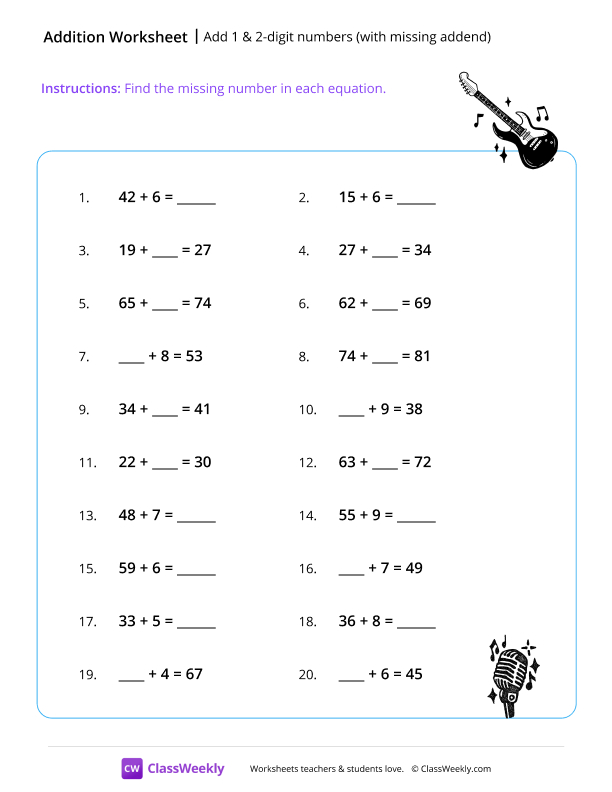
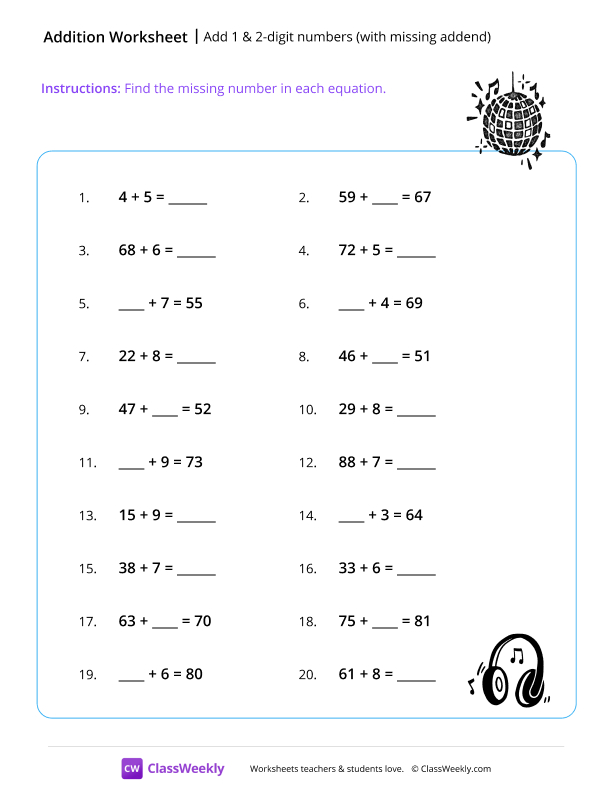
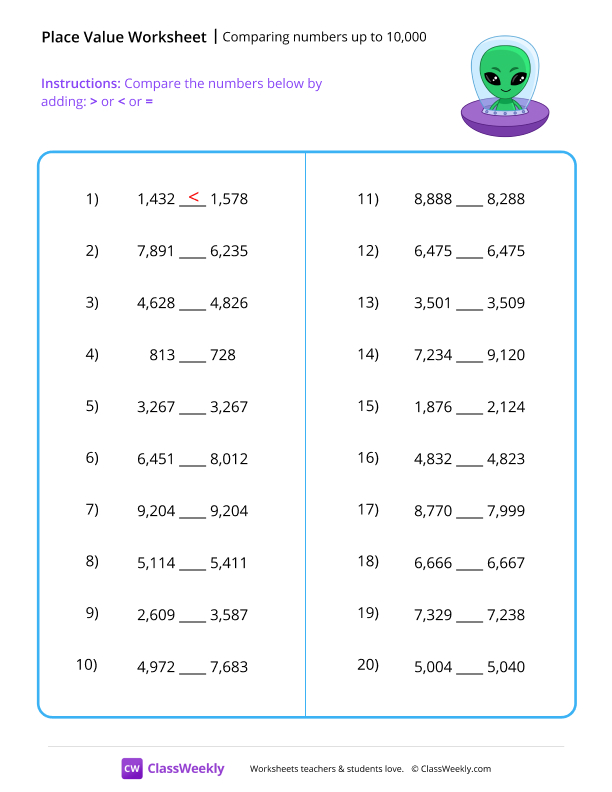
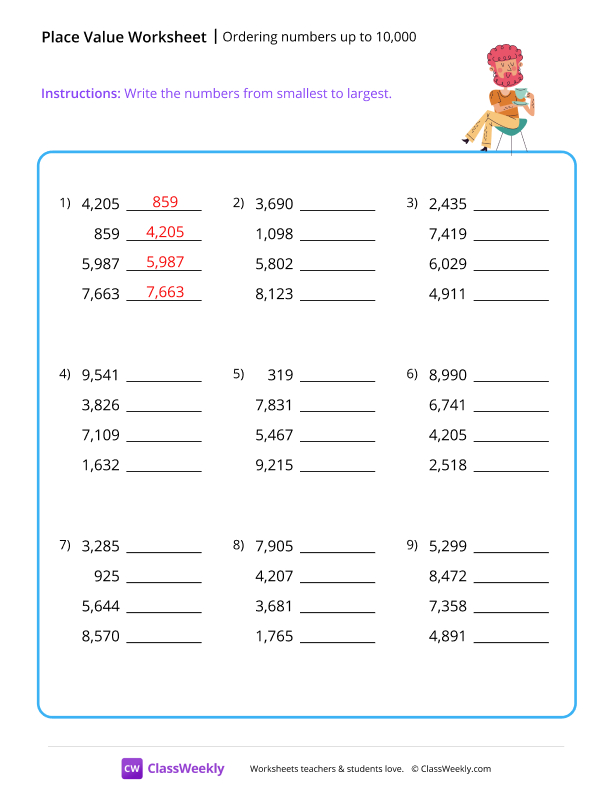
Free Subtraction Worksheets
Curriculum-aligned printable worksheets for Kindergarten – 3rd Grade. Download free.