What Is a Number Talk?
Taught in US schools

Key Takeaways
- A number talk is a brief (5-15 minute) daily routine where students mentally solve a problem and share multiple strategies - the focus is on HOW they solved it, not just the answer.
- The teacher records all student strategies on the board without evaluating them, which shows students that there are many valid paths to one answer.
- Number talks build number sense, mental computation, and mathematical communication - they are a warm-up routine, not a full lesson.
What Is a Number Talk?
A number talk is a brief, structured classroom routine in which students mentally solve a computation problem and then share and discuss the strategies they used. Unlike traditional math practice, the focus is not on getting the answer quickly - it is on how students solved the problem and what strategies they used.
Number talks were popularized by Sherry Parrish through her book Number Talks: Helping Children Build Mental Math and Computation Strategies (2010). They have become a widely adopted daily math routine in elementary classrooms.
What Happens in a Number Talk
1. Teacher Poses a Problem
The teacher writes a problem on the board - no procedure, no hint about strategy. Common number talk problems:
- Single-digit: 8 × 7 (Grades 2-3)
- Multi-digit: 16 + 27 or 38 × 5 (Grades 3-5)
- Number strings: a related sequence like 5 × 4, 10 × 4, 15 × 4 (builds patterns)
- K-1: "How many dots?" using dot cards or ten frames
2. Wait Time and Silent Signal
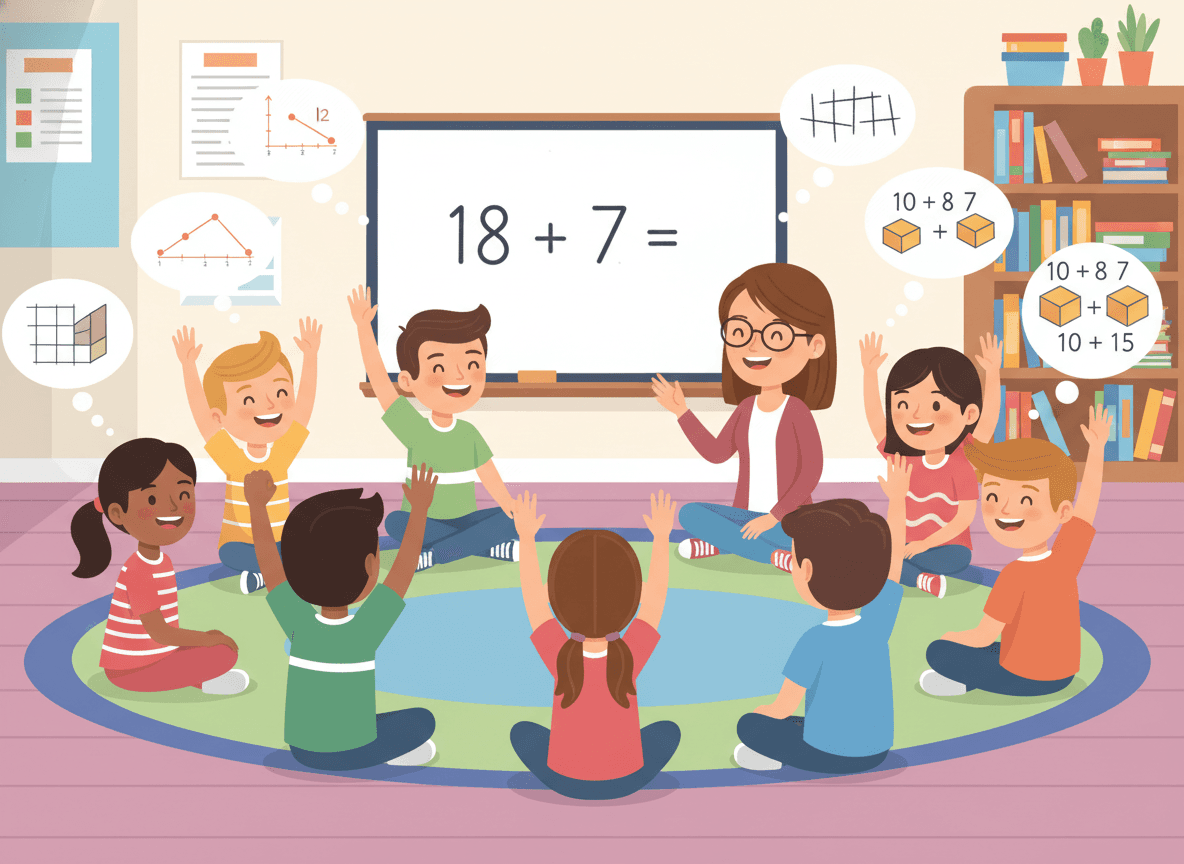
Students solve the problem mentally - no pencil, no paper. When ready, they show a quiet thumb against their chest (not a raised hand). This ensures all students have time to think before anyone shares.
3. Students Share Strategies
The teacher calls on several students: "How did you solve it? Tell me your thinking." The teacher records each strategy on the board using the student's exact language and mathematical notation.
Example strategies for 28 + 37:
- "I added 30 + 37 = 67, then subtracted 2 to get 65."
- "I added 28 + 30 = 58, then 58 + 7 = 65."
- "I made 25 + 40 = 65 by moving 3 from 28 to 37."
4. Discussion
The teacher facilitates discussion:
- "Did anyone do it differently?"
- "How are these two strategies similar?"
- "Which strategy seems most efficient for this problem?"
- "Does this strategy always work?"
Why Number Talks Work
Number talks build number sense - the ability to think flexibly and fluently about numbers. Over time, exposure to many strategies:
-
Expands students' strategy repertoire - they see 10+ ways to solve addition
-
Builds mental computation - students no longer need paper for every calculation
-
Develops mathematical language - students practice explaining reasoning precisely
-
Creates a culture of mathematical discourse - wrong answers are learning opportunities, not failures
-
Empowers quiet students - there is no hand-raising race; all thinking is valued
The Teacher's Role: Facilitator, Not Evaluator
The most important rule of number talks: the teacher does not evaluate strategies. All strategies are recorded on the board. The teacher does NOT say "Good method!" or "That's the easiest way." Students learn to evaluate strategies themselves through discussion.
This shifts the authority from the teacher to the mathematics and the community.
Sequence by Grade Level
K: Dot cards, subitizing, small addition
1: Adding within 20, number bonds
2: Two-digit addition and subtraction
3: Multiplication with strategies (arrays, distributive property)
4–5: Multi-digit multiplication, fraction and decimal reasoning
Practice Activities
- Launch a daily number talk routine for one week - use the same operation each day (addition) but vary the numbers. After the week, discuss with students: "What strategies did we discover? Which do you prefer?"
- Create a "Strategy Museum" on the classroom wall - document each new strategy students share with a name and example.
- Record a number talk on video and analyze: how long was wait time? How many different strategies were shared? Who spoke?
- Give teachers a number talk "problem set" and have them practice solving using at least three different strategies before facilitating.
- Use a number string (related sequence of problems) to guide students toward discovering a pattern or property (e.g., doubling and halving in multiplication).
Frequently Asked Questions
What is the difference between a number talk and a math lesson?
A number talk is a short warm-up routine - typically 5 to 15 minutes - that happens at the start of math class (or any time of day). It is not a lesson with new content; it is a practice routine for building fluency and strategy flexibility. The teacher poses one problem, students solve it mentally, and the class discusses strategies. A full math lesson follows separately.
How does a number talk build number sense?
Number sense is the ability to think flexibly about numbers - to see relationships, estimate, and choose efficient strategies. In a number talk, when a student explains that 8 × 7 = (8 × 5) + (8 × 2) = 40 + 16 = 56, they are demonstrating and strengthening number sense. When they hear classmates use different strategies (e.g., 8 × 7 = (10 × 7) - (2 × 7) = 70 - 14 = 56), they expand their repertoire. This exposure to multiple strategies - over hundreds of number talks - builds deep number sense.
What does the teacher do during a number talk?
The teacher's role in a number talk is deliberately restrained: (1) Pose a problem without showing a procedure. (2) Give wait time - students signal with a quiet thumb-up when ready, not a raised hand. (3) Call on several students to share strategies. (4) Record each strategy on the board using the student's words, without evaluating or ranking them. (5) Ask questions like 'Did anyone do it differently?' and 'How are these two strategies similar?' The teacher does NOT tell students which strategy is 'best.'
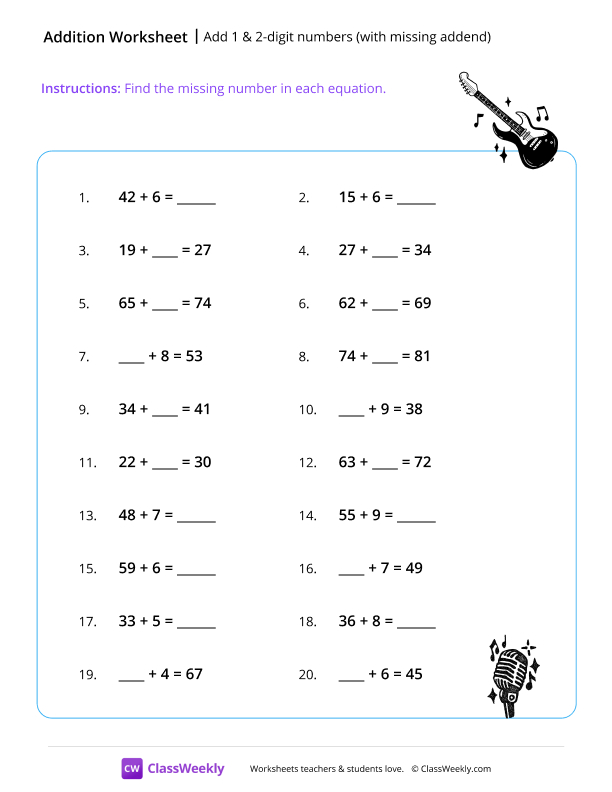
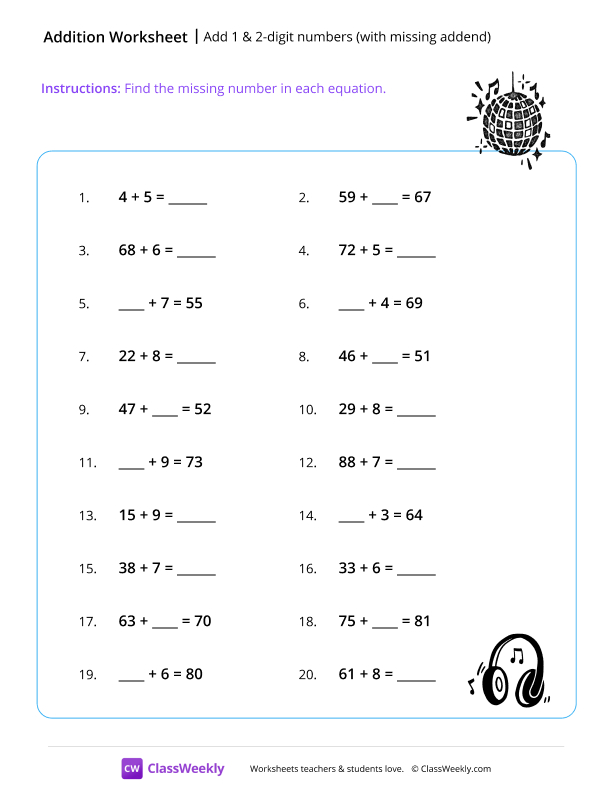
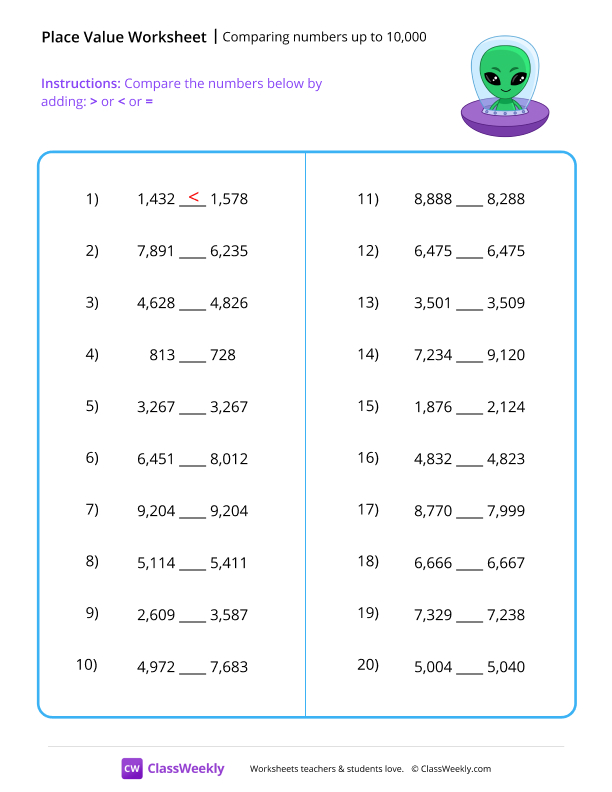
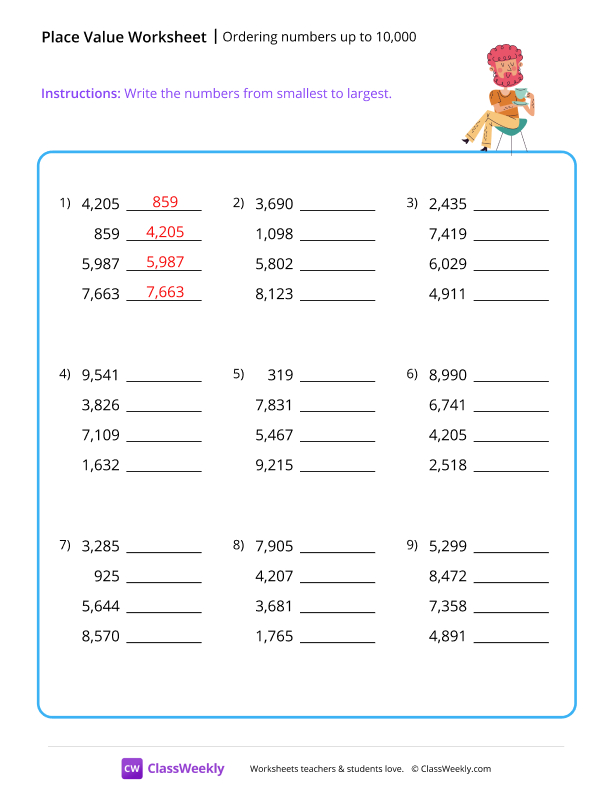
Free Number Talk Worksheets
Curriculum-aligned printable worksheets for Kindergarten – 5th Grade. Download free.