What Are Simple Machines?
Taught in US schools
Key Takeaways
- Simple machines make work easier by changing the direction or size of a force.
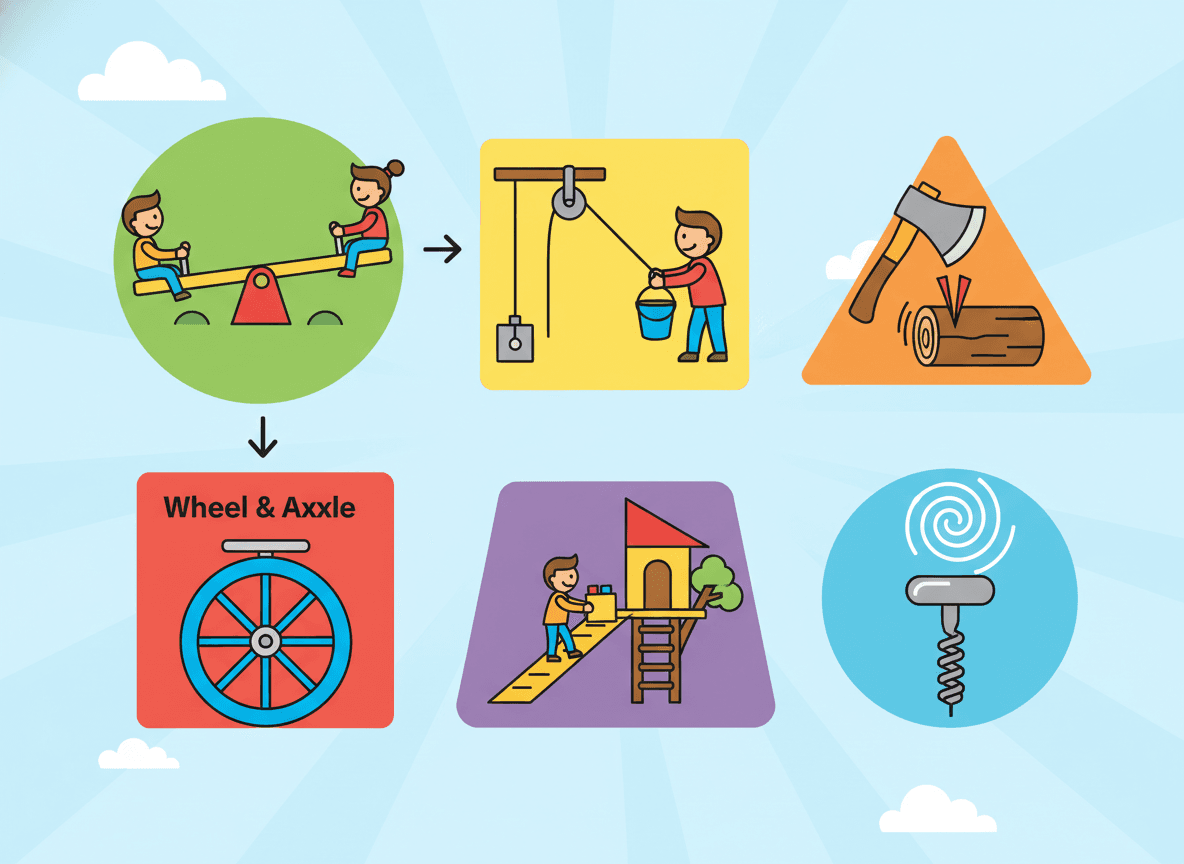
- The six simple machines are the lever, wheel and axle, pulley, inclined plane, wedge, and screw.
- Mechanical advantage means using a simple machine to multiply the force you apply.
What Are Simple Machines?
A simple machine is a basic device that changes how a force is applied to do work. Simple machines don't reduce the total amount of work - they make it easier by changing the direction of force, spreading force over a longer distance, or multiplying force.
Work in science means using a force to move an object a distance. All complex machines - cars, cranes, bicycles - are built from combinations of simple machines.
The Six Simple Machines
1. Lever
A lever is a rigid bar that rests on a fulcrum (pivot point). Pushing one end down lifts the other end up. There are three classes of levers depending on where the fulcrum is.
Examples: seesaw, scissors, hammer claw, wheelbarrow, baseball bat
2. Wheel and Axle
A wheel and axle is a large wheel attached to a smaller rod (axle). Turning the wheel makes the axle turn with more force, or vice versa.
Examples: doorknob, steering wheel, bicycle wheel, rolling pin, Ferris wheel
3. Pulley
A pulley is a wheel with a groove for a rope or chain. It changes the direction of a force. Multiple pulleys working together (a compound pulley) also reduce the force needed.
Examples: flagpole, window blinds, crane, elevator
4. Inclined Plane
An inclined plane is a flat surface raised at an angle - a ramp. It lets you move a heavy object to a higher position with less force, but you travel a longer distance.
Examples: ramp, skateboard ramp, stairs, wheelchair ramp, loading dock
5. Wedge
A wedge is made of two inclined planes joined back to back. It converts force applied to its thick end into a splitting or cutting force at its thin end.
Examples: knife, axe, nail, zipper, doorstop, plow
6. Screw
A screw is an inclined plane wrapped in a spiral around a cylinder. Each turn moves the screw forward a short distance with a large amount of force.
Examples: screw, bolt, jar lid, drill bit, spiral staircase
Simple Machines at a Glance
Lever: Changes force direction - Seesaw
Wheel and Axle: Reduces friction - Bicycle
Pulley: Changes direction of pull - Flagpole
Inclined Plane: Reduces force needed to lift - Ramp
Wedge: Splits or separates - Axe
Screw: Holds things together - Bolt
Mechanical Advantage
Mechanical advantage is the ratio of the output force to the input force. A machine with a mechanical advantage greater than 1 multiplies your force - you push or pull less hard to achieve the same result.
The trade-off: you usually have to move farther. A long ramp is easier to climb than a short steep one, but it's a longer walk. Nature balances force and distance.
Practice Activities
-
Simple machine scavenger hunt: Students find and photograph five simple machines in their home or school.
-
Design a compound machine: Challenge students to draw a machine that uses at least three simple machines working together.
-
Build a lever: Use a ruler and an eraser as a fulcrum; experiment with moving the fulcrum to see how it changes lifting effort.
-
Ramp experiment: Roll a toy car down ramps of different angles; measure how far it travels at the bottom.
-
Simple machine matching: Match pictures of simple machines to their type with a sorting worksheet.
Frequently Asked Questions
What are the six types of simple machines?
The six simple machines are the lever (a bar on a fulcrum), wheel and axle (a wheel attached to a rod), pulley (a wheel with a rope), inclined plane (a ramp), wedge (two inclined planes), and screw (an inclined plane wrapped in a spiral).
What is mechanical advantage?
Mechanical advantage is when a simple machine lets you do the same amount of work with less force. A ramp, for example, lets you push a heavy object up with less effort than lifting it straight up - but you travel a longer distance.
Can you find simple machines in everyday objects?
Yes! Scissors use a lever and a wedge. A doorknob uses a wheel and axle. A flag pole uses a pulley. Stairs are an inclined plane. A knife is a wedge. A screw in wood is - a screw!
Free Simple Machines Worksheets
Curriculum-aligned printable worksheets for 2nd – 4th Grade. Download free.


