What Is the Scientific Method?
Taught in US schools

Key Takeaways
- The scientific method is a process for asking and answering questions using observation and evidence.
- A hypothesis is a testable prediction - an educated guess about what you think will happen and why.
- Fair experiments change only one variable at a time (the independent variable) while keeping everything else the same (controlled variables).
What Is the Scientific Method?
The scientific method is a systematic, logical process that scientists - and students - use to investigate questions about the natural world. Rather than guessing or going by opinion, the scientific method relies on evidence and observation to find reliable answers.
Scientists have used this process for hundreds of years to make discoveries from gravity to DNA. Every experiment you do in class follows these same basic steps.
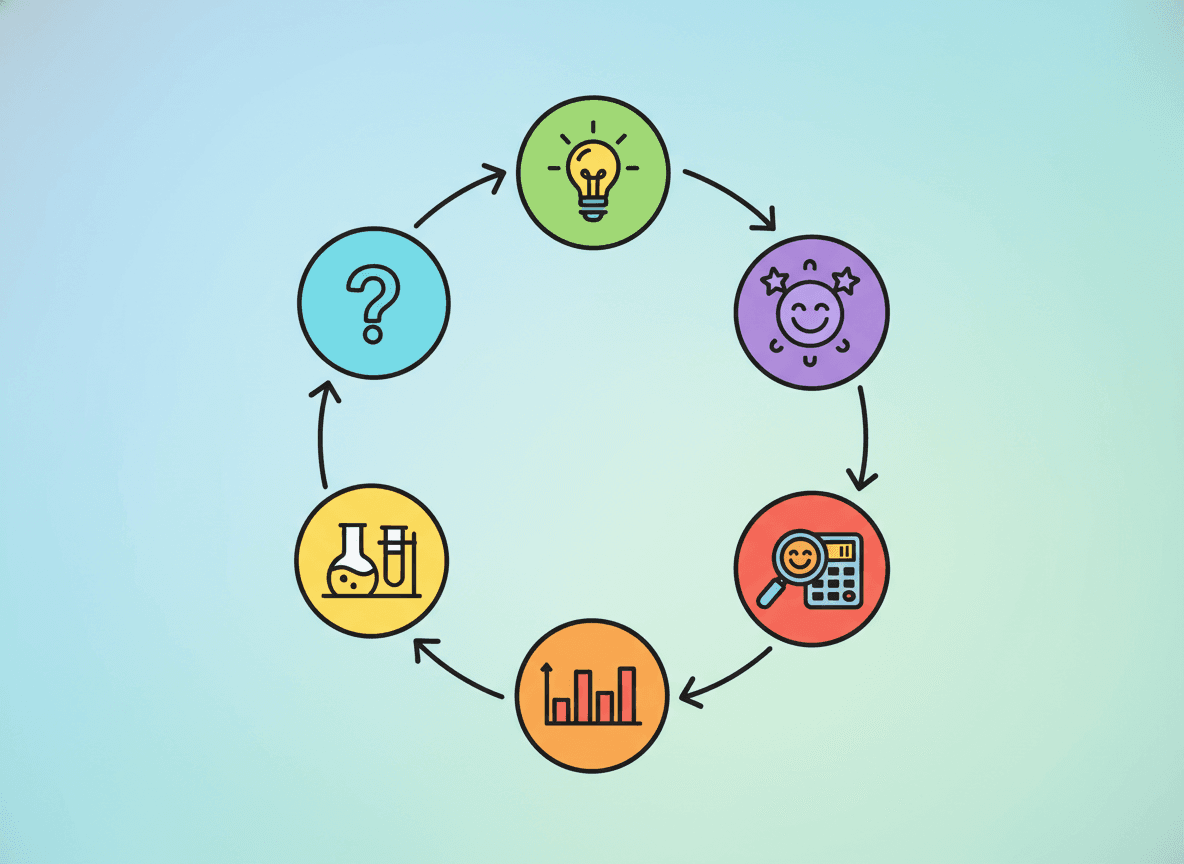
The Steps of the Scientific Method
Step 1: Observe and Ask a Question
All science starts with curiosity. You notice something interesting in the world and ask a question that can be tested:
"Why do some plants grow faster than others?" or "Does the color of a surface affect how quickly it heats up?"
Step 2: Background Research
Before jumping to an experiment, gather existing information. What do scientists already know about this topic? Research helps you make a better prediction.
Step 3: Form a Hypothesis
A hypothesis is a testable, educated prediction - your best guess about what will happen and why. Write it as an if-then statement:
"If a plant gets more sunlight, then it will grow taller because plants use light for photosynthesis."
Step 4: Design and Conduct the Experiment
Your experiment should test only one thing at a time to be fair.
Three types of variables:
Independent variable: What you change on purpose - Amount of sunlight
Dependent variable: What you measure - Plant height
Controlled variables: Everything kept the same - Soil, water, temperature
Repeated trials - running your experiment multiple times - give more reliable results and reduce the chance that one strange result skews your conclusion.
Step 5: Collect and Analyze Data
Record all your measurements carefully in a data table. Then analyze the data: look for patterns, calculate averages, and create graphs.
Step 6: Draw a Conclusion
Did your results support your hypothesis, or did they disprove it? A conclusion that contradicts your hypothesis is not a failure - it is valuable scientific information. State what you found and why.
Step 7: Communicate Results
Real scientists share their findings through papers, presentations, and peer review. In class, students share through lab reports, posters, or presentations.
Why Repeated Trials Matter
One result can be a fluke. If you run an experiment three, five, or ten times and get the same result, you can be more confident your conclusion is correct.
Science Practices vs. Steps
Modern science education emphasizes science practices over rigid steps:
- Asking questions
- Planning investigations
- Analyzing and interpreting data
- Constructing explanations
- Communicating information
The traditional 6-step method is a simplified model of this broader practice.
Practice Activities
-
Design a fair test: Give students a question (e.g., "Which paper towel absorbs the most water?") and have them identify the independent, dependent, and controlled variables before experimenting.
-
Hypothesis practice: Give students observations and ask them to write if-then hypothesis statements.
-
Lab report template: Students use a structured template to record each step of the scientific method after a class experiment.
-
Data table and graph: Record class experiment results in a table, then graph them on a bar or line graph.
-
Famous scientists research: Students research a scientist and present how they used the scientific method in a famous discovery.
Frequently Asked Questions
What are the steps of the scientific method?
The steps are: (1) Observe and ask a question, (2) Research background information, (3) Form a hypothesis, (4) Design and conduct an experiment, (5) Collect and analyze data, (6) Draw a conclusion, (7) Communicate results.
What is a hypothesis?
A hypothesis is a testable prediction that answers your question before you experiment. It is usually written as an if-then statement: 'If I add more salt to water, then it will take longer to boil.' A hypothesis must be something you can test with an experiment.
What are the three types of variables in an experiment?
The independent variable is what you change on purpose. The dependent variable is what you measure - it depends on the independent variable. Control variables (or constants) are everything you keep the same so they don't affect your results. A fair test changes only one variable at a time.
Free Scientific Method Worksheets
Curriculum-aligned printable worksheets for 2nd – 5th Grade. Download free.


