What Is an Ecosystem?
Taught in US schools
Key Takeaways
- An ecosystem includes all the living things (biotic factors) and nonliving things (abiotic factors) in an area interacting together.
- Producers make their own food, consumers eat other organisms, and decomposers break down dead matter and return nutrients to the soil.
- A food web shows all the feeding relationships in an ecosystem - it is more accurate than a simple food chain.
What Is an Ecosystem?
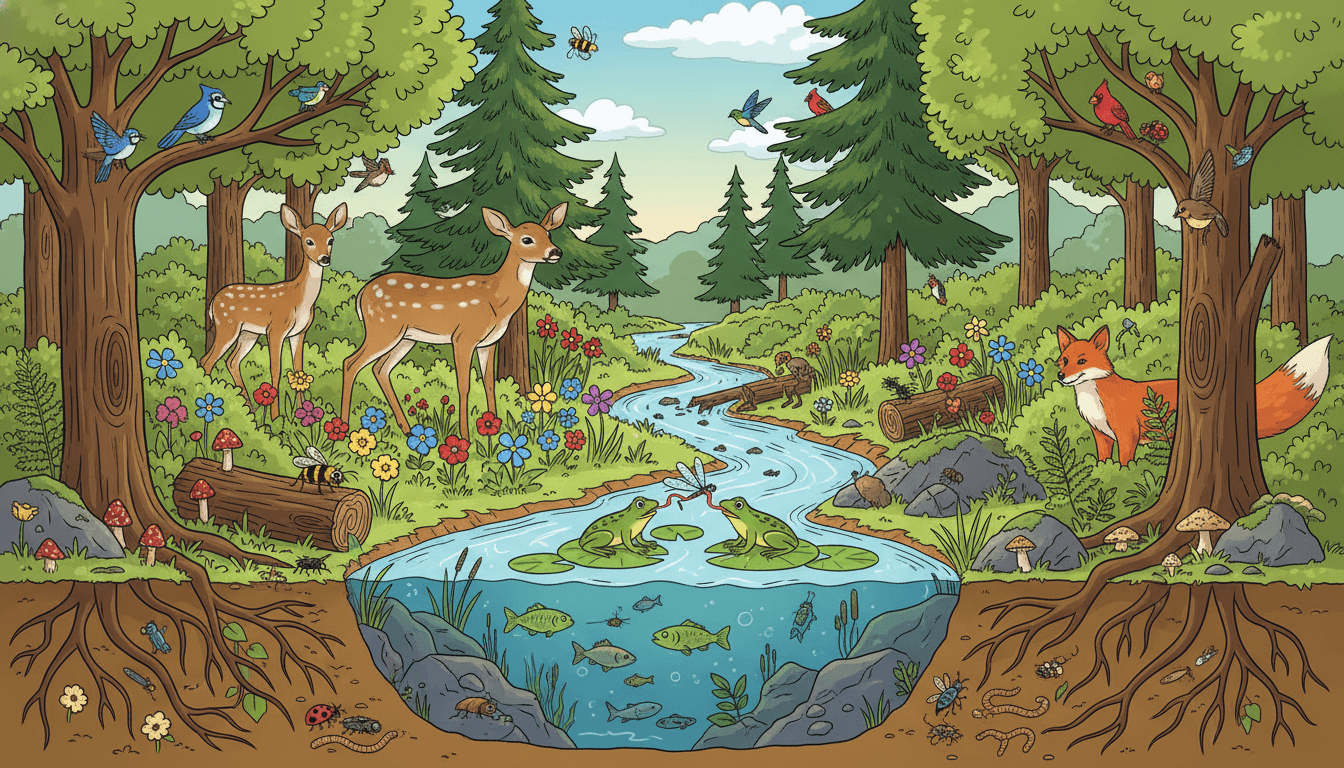
An ecosystem is a community of all the living things in an area - along with all the nonliving things - working together as a system. The word comes from eco (home) and system (a set of interacting parts).
Ecosystems come in every size: a puddle, a forest, a coral reef, the entire Amazon rainforest, or even a rotting log. What makes something an ecosystem is not its size, but that its living and nonliving components interact and depend on each other.
Biotic and Abiotic Factors
Every ecosystem has two types of components:
Biotic (living): All organisms in the ecosystem - Trees, deer, bacteria, fungi, birds
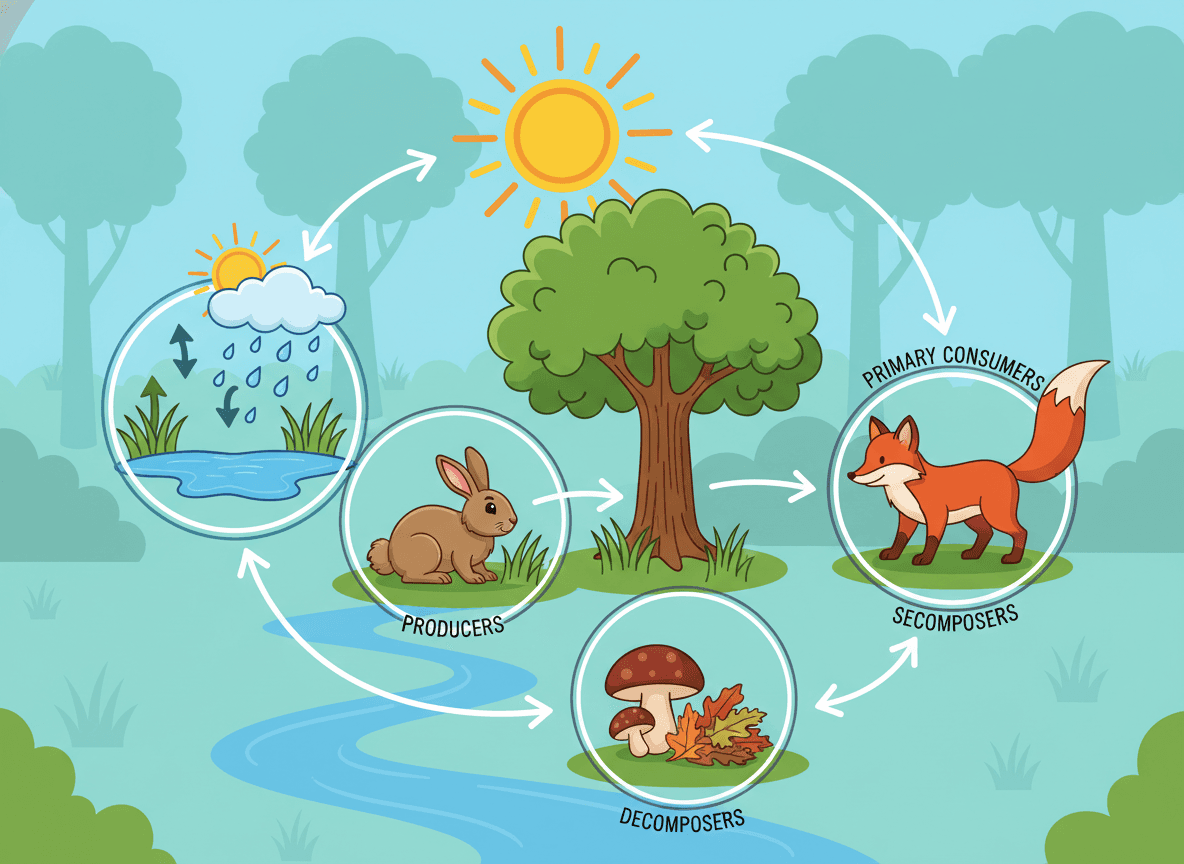
Abiotic (nonliving): Physical and chemical environment - Sunlight, temperature, water, soil, air Changes in abiotic factors directly affect biotic factors. A drought (abiotic) reduces plant growth (biotic), which reduces food for herbivores, which reduces prey for carnivores - a cascade through the whole ecosystem.
Roles in the Ecosystem
Producers
Producers (mostly plants and algae) use sunlight to make their own food through photosynthesis. They form the base of every food chain and are the primary source of energy in the ecosystem.
Consumers
Consumers cannot make their own food - they eat other organisms.
-
Primary consumers (herbivores): eat plants - rabbits, deer, caterpillars
-
Secondary consumers: eat primary consumers - frogs, small fish, foxes
-
Tertiary consumers / apex predators: top of the food chain - eagles, sharks, lions
Decomposers
Decomposers break down dead plants and animals, returning nutrients to the soil. Without decomposers, dead matter would pile up and ecosystems would run out of nutrients.
Examples: mushrooms, bacteria, earthworms, beetles
Food Chains vs. Food Webs
A food chain shows a single straight path of energy. A food web shows all the interconnected feeding relationships in an ecosystem - which is much closer to reality, because most animals eat more than one thing and are eaten by more than one predator.
Energy Flow in Ecosystems
Energy enters an ecosystem through producers capturing sunlight. At each level of the food chain, about 90% of energy is lost as heat - only 10% passes to the next level. This is why ecosystems support far more plant mass than animal mass, and more herbivores than carnivores.
Types of Ecosystems
-
Terrestrial: forest, grassland, desert, tundra
-
Freshwater: ponds, rivers, lakes, wetlands
-
Marine: coral reefs, open ocean, kelp forests, estuaries
Ecosystem Health and Threats
A healthy ecosystem has biodiversity - many different species filling many different roles. Threats to ecosystems include:
- Habitat destruction (deforestation, development)
- Pollution (air, water, soil)
- Invasive species (non-native organisms that outcompete native ones)
- Climate change (shifts in temperature and precipitation patterns)
Practice Activities
-
Build a food web: Give students organism cards from a local ecosystem and have them draw arrows showing who eats whom.
-
Biotic vs. abiotic sort: Students sort pictures of ecosystem components into living and nonliving categories.
-
Ecosystem diorama: In groups, students build a 3D model of a specific ecosystem with labeled organisms and abiotic factors.
-
Ecosystem collapse simulation: Remove one organism from a classroom food web (on paper) and trace the effects through the ecosystem.
-
Backyard ecosystem survey: Students record every living and nonliving thing they can observe in a small outdoor area.
Frequently Asked Questions
What is the difference between biotic and abiotic factors?
Biotic factors are the living parts of an ecosystem - plants, animals, fungi, bacteria. Abiotic factors are the nonliving parts - sunlight, water, temperature, soil, and air. Both are essential; changing one affects the other.
What happens to an ecosystem when one species disappears?
When one species is removed, it can trigger a chain reaction called a trophic cascade. For example, if wolves are removed, deer populations explode and overgraze vegetation, which harms the entire ecosystem. Every species plays a role.
What is the difference between an ecosystem and a biome?
An ecosystem is a specific community of organisms in a particular place (like a pond or a coral reef). A biome is a large geographic region defined by its climate and the types of plants and animals that live there (like a tropical rainforest or a desert). One biome can contain many ecosystems.
Free Ecosystem Worksheets
Curriculum-aligned printable worksheets for 3rd – 5th Grade. Download free.


