What Is Adaptation?
Taught in US schools
Key Takeaways
- An adaptation is a feature or behavior that helps a living thing survive in its environment.
- There are three types of adaptations: structural (body features), behavioral (actions), and physiological (internal processes).
- Adaptations develop slowly over many generations through natural selection.
What Is an Adaptation?
An adaptation is any trait - physical, behavioral, or internal - that helps a living organism survive, find food, avoid predators, and reproduce in its specific environment. Adaptations are not learned; they are inherited features that develop over thousands or millions of years through a process called natural selection.
The key idea: organisms with helpful traits survive longer, reproduce more, and pass those traits to their offspring. Over time, the whole species changes.
Three Types of Adaptations
1. Structural Adaptations
Structural adaptations are physical features of the body.
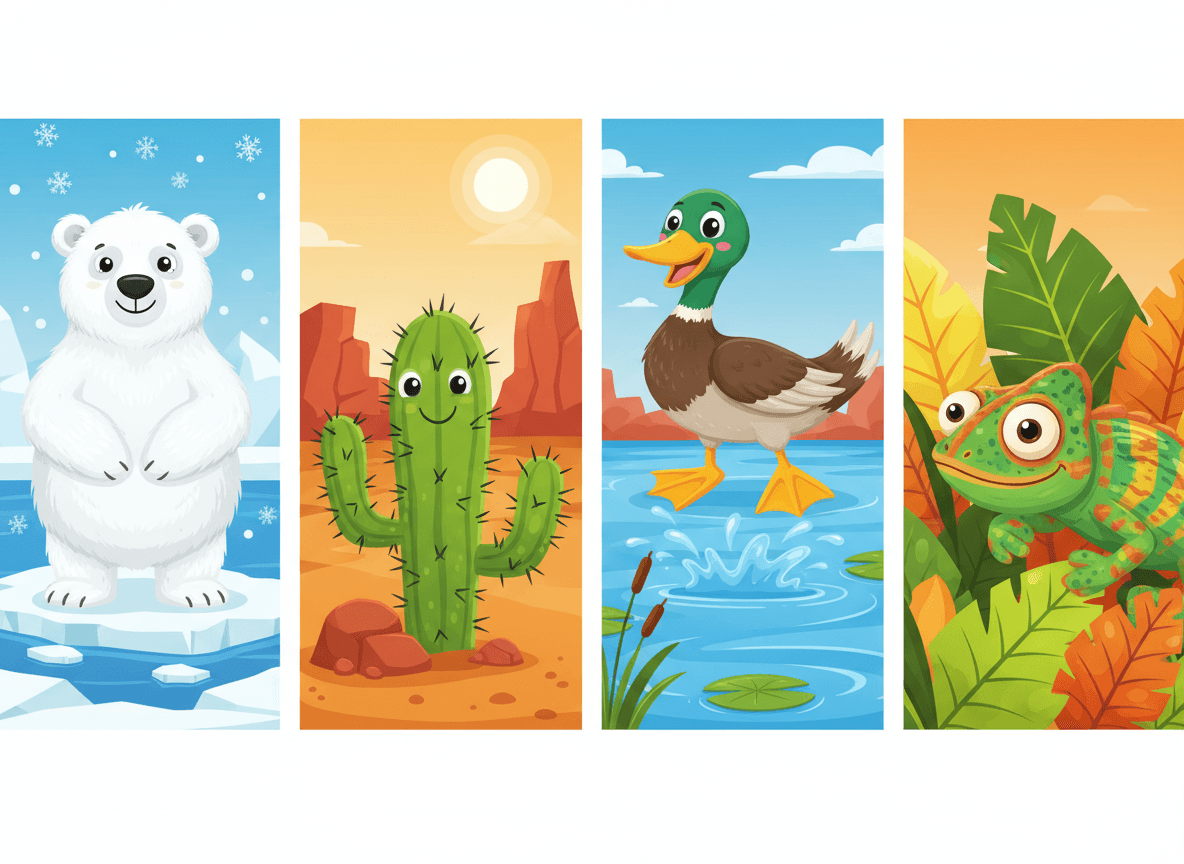
Polar bear: White fur - Camouflage in snow
Duck: Webbed feet - Swimming efficiently
Giraffe: Long neck - Reaching high leaves
Cactus: Thick, waxy stem - Storing water in desert
Arctic fox: Thick fur layers - Insulation from cold
Camouflage - blending into surroundings - is one of the most common structural adaptations. The stick insect looks like a twig; the flounder fish matches the ocean floor; the Arctic hare turns white in winter.
2. Behavioral Adaptations
Behavioral adaptations are actions animals take to survive.
-
Hibernation - bears, groundhogs, and bats slow their metabolism and sleep through winter to survive food shortages.
-
Migration - birds, whales, and monarch butterflies travel thousands of miles to find food, warmth, or breeding grounds.
-
Nocturnal behavior - owls and bats hunt at night to avoid daytime predators or to find prey that is active at night.
-
Schooling - fish swim in tight groups to confuse predators.
3. Physiological Adaptations
Physiological adaptations are internal body processes.
- A camel produces very concentrated urine to conserve water.
- Arctic animals produce antifreeze proteins in their blood to prevent ice crystals from forming.
- Some animals enter torpor (a light version of hibernation) during heat or cold.
- Blubber (thick fat layers) in whales and seals insulates them from freezing water.
Adaptations and Habitats
Every major habitat has produced remarkable adaptations:
-
Desert: Camels store fat (not water) in humps for energy; cacti have shallow, widespread roots to capture rainfall.
-
Ocean: Fish have gills to extract oxygen from water; dolphins have smooth bodies for fast swimming.
-
Arctic: Penguins huddle together to stay warm; polar bears have black skin under white fur to absorb heat.
-
Rainforest: Poison dart frogs have bright colors to warn predators they are toxic (warning coloration).
Practice Activities
-
Adaptation research cards: Students research one animal and identify one structural, one behavioral, and one physiological adaptation.
-
Design your own animal: Students invent a creature for a specific habitat and explain what adaptations it would need.
-
Sort the adaptations: Give students a list of animal traits and have them sort them into structural, behavioral, and physiological columns.
-
Migration map: Track the migration route of a monarch butterfly or Arctic tern on a world map.
-
Compare habitats: Compare two very different habitats and list which adaptations are useful in one but would be harmful in the other.
Frequently Asked Questions
What are the three types of adaptations?
Structural adaptations are physical body features (like a duck's webbed feet). Behavioral adaptations are actions or habits (like a bear hibernating in winter). Physiological adaptations are internal body processes (like a camel producing very concentrated urine to conserve water).
What is camouflage and why is it an adaptation?
Camouflage is when an animal's coloring or pattern matches its surroundings, making it hard for predators to spot it. It is a structural adaptation because it involves the animal's physical appearance. Examples include the stick insect, Arctic hare, and flounder fish.
How do adaptations develop?
Adaptations develop through natural selection over many generations. Animals born with traits that help them survive are more likely to live long enough to reproduce and pass those traits to offspring. Over time, helpful traits become more common in the population.
Free Adaptation Worksheets
Curriculum-aligned printable worksheets for 2nd – 5th Grade. Download free.


