What Is a Habitat?
Taught in US schools
Key Takeaways
- A habitat provides an organism with the four things it needs to survive: food, water, shelter, and space.
- Major habitat types include forest, desert, ocean, grassland, wetland, and arctic.
- Animals and plants are specially adapted to survive in their specific habitat.
What Is a Habitat?
A habitat is the natural place where an organism - a plant, animal, or other living thing - lives. Think of a habitat as an organism's home. Just like your home provides you with shelter, food, and comfort, a habitat provides wild animals and plants with everything they need to stay alive.
Every habitat must supply four basic needs:
-
Food - enough to eat
-
Water - fresh or salt water, depending on the species
-
Shelter - a safe place to rest, hide, or raise young
-
Space - enough room to find food and reproduce
Major Habitat Types
Forest
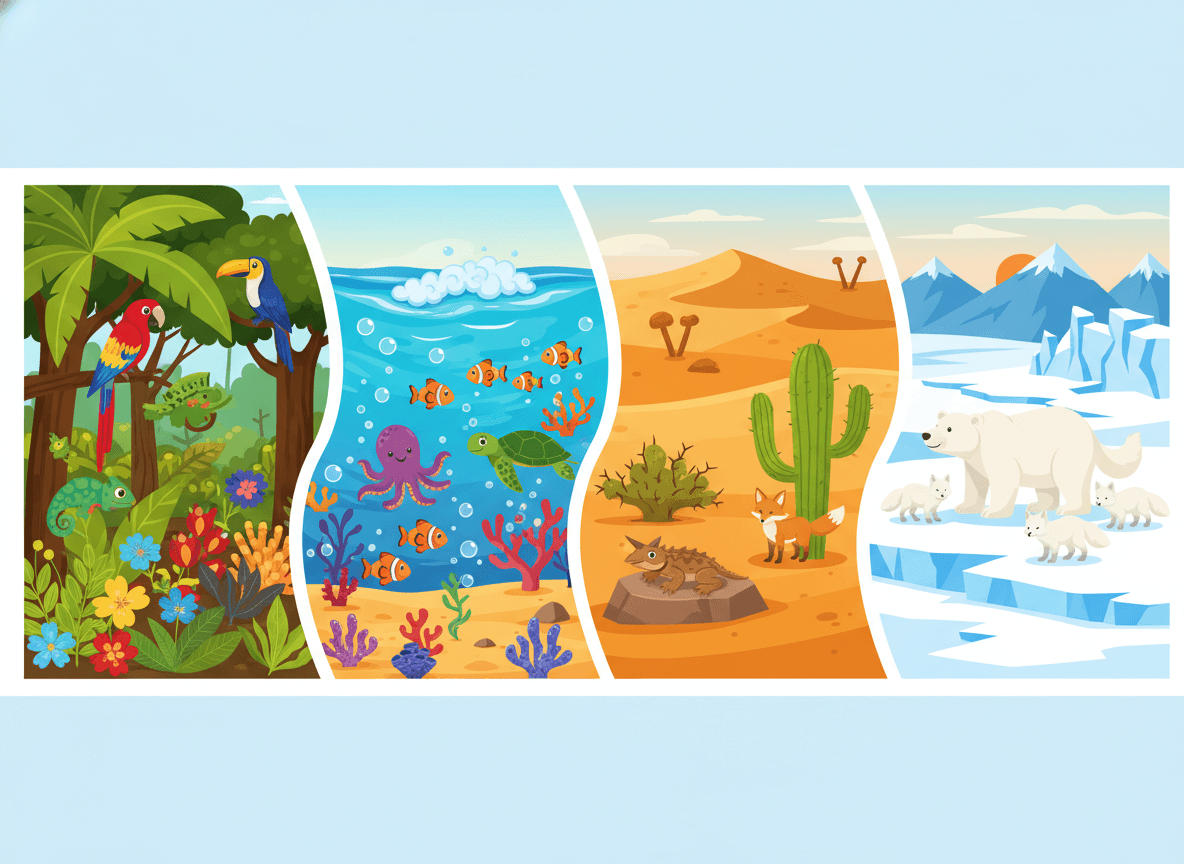
Forests are filled with trees and receive moderate to high rainfall. Animals like deer, owls, foxes, and bears live here. Forests can be tropical (warm and wet, like rainforests) or temperate (with four seasons).
Desert
Deserts are dry with very little rainfall. Plants like cacti store water in their thick stems. Animals such as lizards, snakes, and camels have adapted to survive with very little water.
Ocean
The ocean is the world's largest habitat, covering over 70% of Earth's surface. It includes both shallow coastal areas and the deep, dark ocean floor. Fish, whales, sharks, dolphins, and millions of other species call it home.
Grassland
Grasslands (also called prairies or savannas) are flat, open areas covered with grasses. They support large herds of animals like bison, zebras, and wildebeest, along with predators like lions and wolves.
Wetland
Wetlands - including swamps, marshes, and bogs - are areas where water covers the soil much of the time. They are home to frogs, alligators, herons, and many fish species.
Arctic / Tundra
The arctic is bitterly cold with very little plant life. Animals like polar bears, arctic foxes, and walruses have thick fur and fat layers to stay warm.
Matching Animals to Their Habitats
Polar bear: Arctic - Thick blubber and white fur
Camel: Desert - Stores fat in hump; conserves water
Clownfish: Ocean - Lives among anemone tentacles
Eagle: Forest/Mountains - Sharp talons for hunting
Frog: Wetland - Permeable skin absorbs water
Why Habitats Matter
When a habitat is destroyed - by deforestation, pollution, or climate change - the animals and plants that live there can be pushed toward extinction. Protecting habitats is one of the most important things we can do to preserve Earth's biodiversity.
Practice Activities
-
Habitat sorting game: Give students pictures of animals and habitats and have them match each animal to where it lives.
-
Build a diorama: Create a shoebox habitat for a chosen animal, including food, water, shelter, and space elements.
-
Research report: Each student picks one habitat and researches 3 animals that live there.
-
Venn diagram: Compare two habitats (e.g., desert vs. ocean) using a Venn diagram to find similarities and differences.
-
Class habitat map: Using a world map, mark where each major habitat type is found and label representative animals.
Frequently Asked Questions
What four things does a habitat provide?
A habitat provides food, water, shelter, and space. These four things are called the basic needs of survival, and a habitat must supply all of them for an animal to live there.
What is the difference between a habitat and an ecosystem?
A habitat is the physical place where an organism lives. An ecosystem is broader - it includes all the living things (plants, animals, fungi) and nonliving things (water, air, soil) in an area interacting together.
Can animals survive in more than one habitat?
Some animals can live in multiple habitats, but most are specially adapted to one. For example, polar bears are built for the arctic and would not survive in a hot desert.
Free Habitat Worksheets
Curriculum-aligned printable worksheets for Kindergarten – 3rd Grade. Download free.


