What Is Photosynthesis?
Taught in US schools
Key Takeaways
- Photosynthesis is the process by which plants use sunlight, water, and carbon dioxide to produce glucose (sugar) and oxygen.
- Chlorophyll is the green pigment in plant leaves that captures light energy for photosynthesis.
- Photosynthesis takes place inside chloroplasts, which are found in plant cells.
What Is Photosynthesis?
Photosynthesis is the process plants, algae, and some bacteria use to make their own food using energy from sunlight. The word comes from Greek: photo means light, and synthesis means putting together.
Photosynthesis is one of the most important chemical processes on Earth. It produces the oxygen in our atmosphere and is the starting point for almost every food chain. Without photosynthesis, there would be almost no life on land or in the ocean.
The Photosynthesis Equation
Here is the basic equation for photosynthesis:
Sunlight + Water + Carbon Dioxide → Glucose + Oxygen
Written with chemical symbols (for upper grades):
6CO₂ + 6H₂O + light energy → C₆H₁₂O₆ + 6O₂
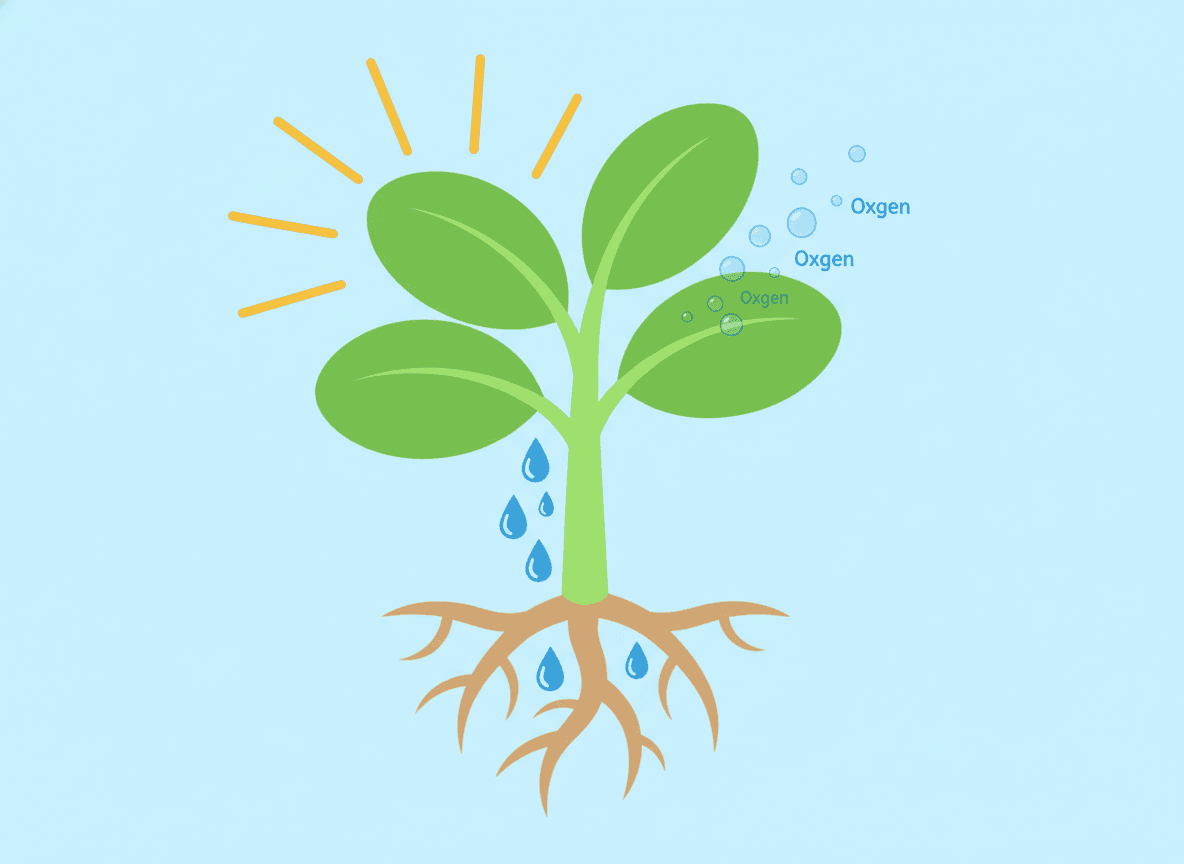
In plain language: plants absorb water through their roots, take in carbon dioxide (CO₂) through tiny pores in their leaves called stomata, and use sunlight to convert these ingredients into glucose (a sugar) and oxygen.
Where Does Photosynthesis Happen?
Photosynthesis takes place inside chloroplasts, which are tiny structures found in plant cells - mostly in the leaves.
Chloroplasts contain a green pigment called chlorophyll. Chlorophyll is what makes plants green, and it is the molecule that actually captures light energy from the sun to power the chemical reaction.
The Role of Each Ingredient
Sunlight: The sun - Energy to drive the reaction
Water (H₂O): Soil, absorbed by roots - Provides hydrogen atoms
Carbon Dioxide (CO₂): Air, absorbed through stomata - Provides carbon atoms
Chlorophyll: Inside chloroplasts - Captures light energy
What Plants Do With Glucose
The glucose produced by photosynthesis is the plant's food. Plants use glucose to:
-
Grow new cells and tissues
-
Reproduce by making flowers, fruit, and seeds
-
Store energy in roots, stems, and fruit (starch is stored glucose)
-
Respire - burn glucose for energy when needed
Photosynthesis and the Food Chain
Because plants make their own food from sunlight, they are called autotrophs (self-feeders) or producers. All animals are heterotrophs (other-feeders) - they must eat other organisms to get energy. This means:
- Herbivores eat plants → they get glucose energy from photosynthesis
- Carnivores eat herbivores → that energy traces back to photosynthesis
- All energy in a food chain ultimately comes from the sun through photosynthesis.
Practice Activities
-
Leaf chromatography: Use coffee filter paper and rubbing alcohol to separate the pigments in a leaf and see chlorophyll up close.
-
Bubble experiment: Place aquatic plants (like Elodea) in light vs. dark conditions and count oxygen bubbles produced.
-
Label the plant cell: Give students a plant cell diagram to label, focusing on chloroplasts and their role in photosynthesis.
-
Food chain connection: Draw a food chain and label where photosynthesis provides the energy at the base.
-
Photosynthesis equation art: Have students illustrate the inputs and outputs of photosynthesis as a visual diagram with arrows.
Frequently Asked Questions
What are the inputs and outputs of photosynthesis?
Photosynthesis takes in three inputs: sunlight (energy), water (absorbed through roots), and carbon dioxide (absorbed through tiny pores called stomata in leaves). It produces two outputs: glucose (sugar for food) and oxygen (released into the air).
Why are plant leaves green?
Plant leaves are green because of a pigment called chlorophyll. Chlorophyll absorbs red and blue light from the sun and reflects green light - which is the color we see. Chlorophyll is found inside chloroplasts in plant cells.
Why is photosynthesis important for humans and animals?
Almost all food on Earth traces back to photosynthesis. Plants make glucose using sunlight, and animals (including humans) eat plants - or eat animals that ate plants - to get that energy. Photosynthesis also produces the oxygen we breathe.
Free Photosynthesis Worksheets
Curriculum-aligned printable worksheets for 3rd – 5th Grade. Download free.


