What Are States of Matter?
Taught in US schools

Key Takeaways
- The three main states of matter are solid, liquid, and gas - each defined by how tightly particles are packed and how freely they move.
- Matter can change between states through processes like melting, freezing, evaporation, condensation, and sublimation.
- Plasma is a fourth state of matter found in stars, lightning, and neon signs.
What Are States of Matter?
Matter is anything that has mass and takes up space - and that includes everything you can see, touch, smell, and taste. Matter can exist in different states (also called phases), which describe how the particles that make up a substance are arranged and how they move.
The Three Main States
Solid
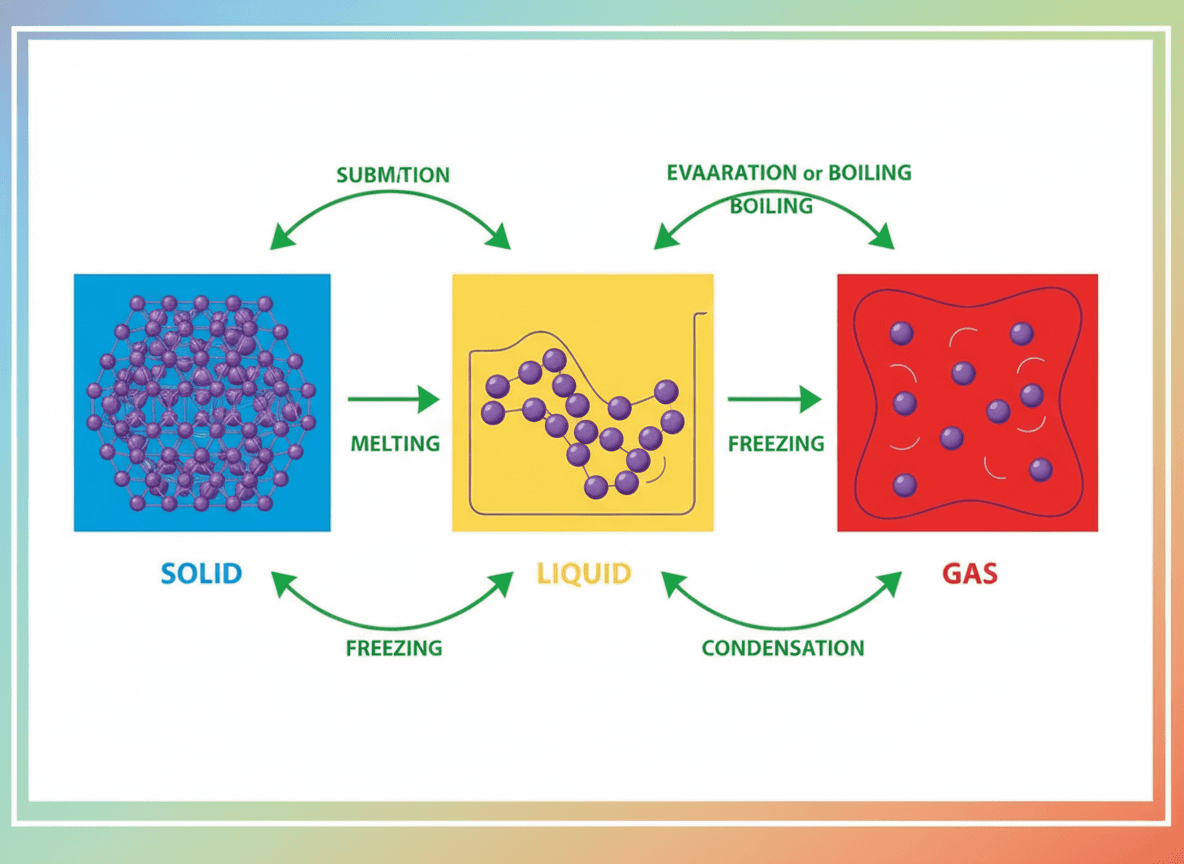
In a solid, particles are packed very close together and vibrate in fixed positions. Solids have a definite shape and a definite volume (they don't change size or shape on their own).
Examples: ice, rock, wood, metal, sugar
Liquid
In a liquid, particles are close together but can flow past each other. Liquids have a definite volume but no fixed shape - they take the shape of whatever container they're in.
Examples: water, juice, mercury, honey, lava
Gas
In a gas, particles are spread far apart and move quickly in all directions. Gases have no fixed shape and no fixed volume - they expand to fill any container.
Examples: oxygen, steam, carbon dioxide, helium, the air we breathe
Plasma (Upper Grades)
Plasma is a fourth state of matter made of charged particles at extremely high temperatures. It's found in stars (including the sun), lightning bolts, and neon signs.
Phase Changes
Matter can change from one state to another when heat is added or removed:
Solid → Liquid: Melting - Ice melting into water
Liquid → Solid: Freezing - Water turning to ice
Liquid → Gas: Evaporation / Boiling - Water evaporating from a puddle
Gas → Liquid: Condensation - Water vapor forming dew
Solid → Gas: Sublimation - Dry ice turning directly to gas
Gas → Solid: Deposition - Frost forming on a cold window
Particles and Energy
The key to understanding states of matter is particle energy:
-
Low energy → particles stay close and still → solid
-
More energy → particles move around each other → liquid
-
High energy → particles zoom apart → gas
Adding heat gives particles more energy and can cause matter to change to a higher-energy state (melting, evaporating). Removing heat takes energy away and causes matter to change to a lower-energy state (freezing, condensing).
Grade-by-Grade Breakdown
2nd Grade: Identify solids, liquids, and gases; observe simple phase changes
3rd Grade: Compare properties of states; heating and cooling effects
4th Grade: Particle model; energy and phase change; mixtures
5th Grade: Conservation of matter; physical vs. chemical change; plasma
Practice Activities
-
States of matter sort: Students sort pictures of objects into three categories: solid, liquid, or gas.
-
Melting ice experiment: Place ice cubes on a tray and observe as they melt from solid to liquid - record temperature and time.
-
Matter hunt: Students walk around the classroom and find three examples of each state of matter.
-
Particle dance: Use students as particles - they stand still (solid), shuffle slowly (liquid), or run freely (gas).
-
Phase change diagram: Draw and label all six phase changes in a diagram using arrows between solid, liquid, and gas.
Frequently Asked Questions
What are the three main states of matter?
The three main states of matter are solid (definite shape and volume), liquid (definite volume but no fixed shape), and gas (no fixed shape or volume). A fourth state, plasma, is studied at upper grade levels.
What happens to particles when matter melts?
When a solid melts, heat energy causes its particles to vibrate faster and move apart, breaking the bonds that hold them in a fixed shape. The particles flow freely, which is why the substance becomes a liquid.
What is the difference between evaporation and boiling?
Evaporation happens slowly at the surface of a liquid at any temperature. Boiling is rapid evaporation that happens throughout the entire liquid when it reaches its boiling point - 100°C (212°F) for water.
Free States of Matter Worksheets
Curriculum-aligned printable worksheets for 2nd – 5th Grade. Download free.


