What Is the Water Cycle?
Taught in US schools
Key Takeaways
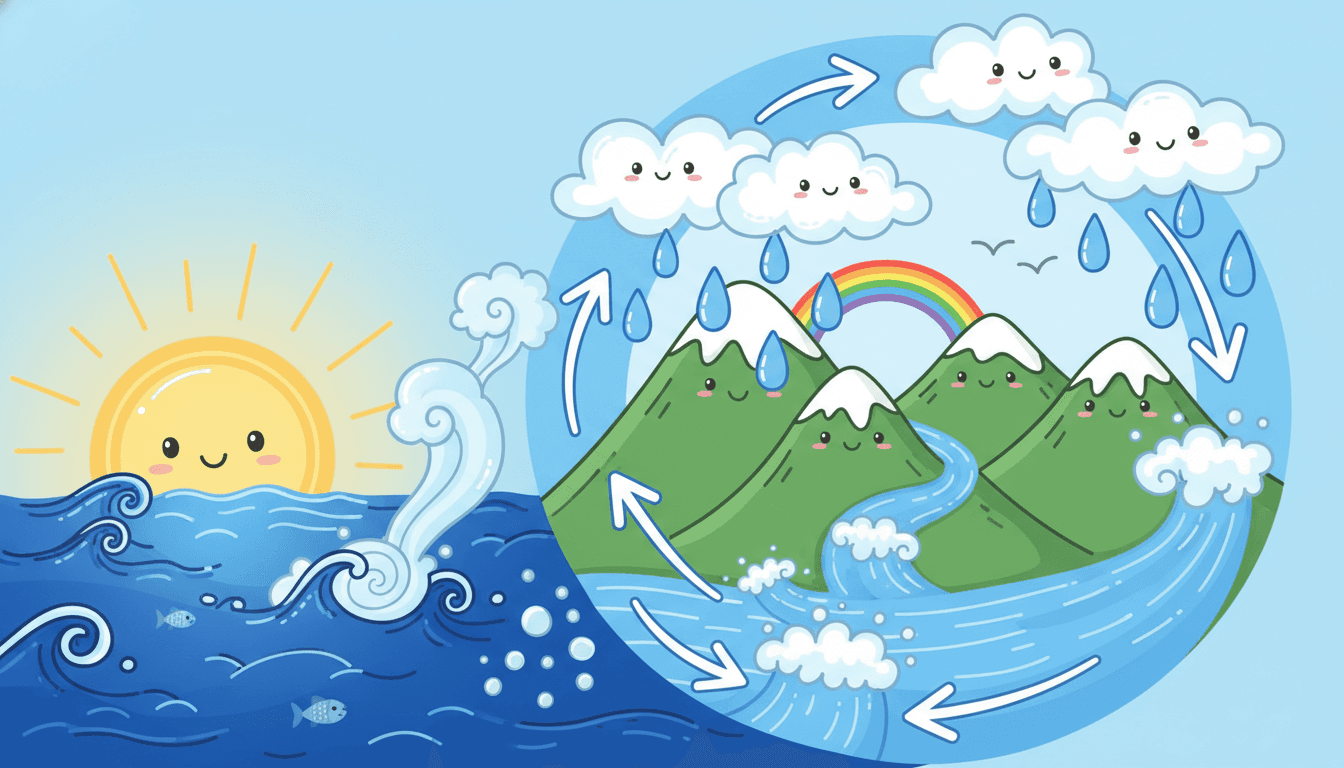
- The water cycle has four main stages: evaporation, condensation, precipitation, and collection (runoff).
- The sun powers evaporation by heating water, and gravity pulls precipitation back down to Earth.
- The water cycle continuously recycles the same water that has existed on Earth for billions of years.
What Is the Water Cycle?
The water cycle (also called the hydrological cycle) is the continuous movement of water on, above, and below Earth's surface. Water is constantly changing form - from liquid to vapor to solid - and moving between the oceans, atmosphere, land, and living things.
The water on Earth today is the same water that existed millions of years ago. There is no new water - it just keeps cycling.
The Four Main Stages
1. Evaporation
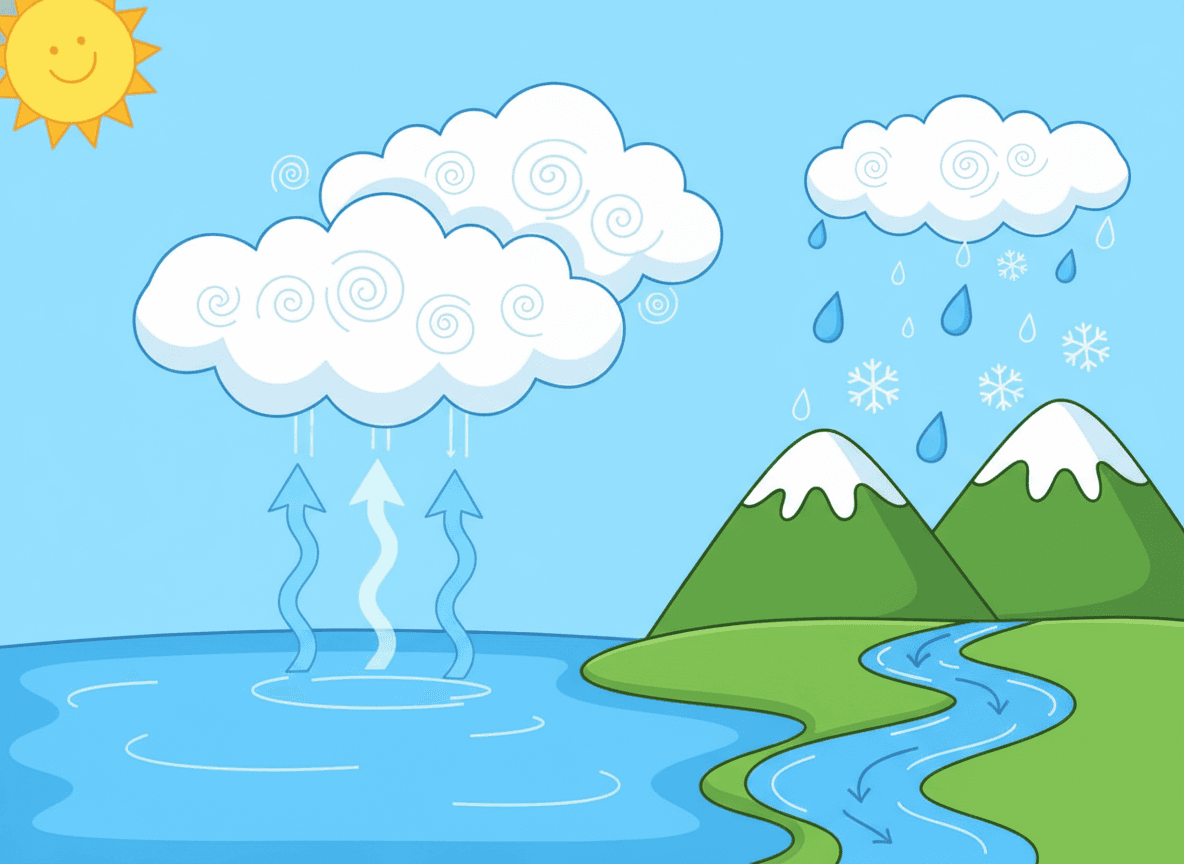
Evaporation happens when the sun heats water in oceans, lakes, rivers, and puddles, causing liquid water to turn into water vapor (an invisible gas). This vapor rises into the atmosphere. Evaporation is most intense near the equator where sunlight is strongest.
2. Condensation
As water vapor rises, it cools down. Cool air cannot hold as much water vapor as warm air, so the vapor condenses - turning back into tiny liquid water droplets that cling to dust particles. Billions of these tiny droplets cluster together to form clouds and fog.
3. Precipitation
When water droplets in clouds combine and become heavy enough, they fall back to Earth as precipitation: rain, snow, sleet, or hail. The type of precipitation depends on air temperature.
4. Collection (Runoff)
Precipitation collects in oceans, lakes, rivers, and streams - or soaks into the ground to become groundwater. Some of it is absorbed by plants. Eventually, collected water evaporates again and the cycle restarts.
The Complete Cycle
Sun heats water → Evaporation → Water vapor rises
→ Condensation → Clouds form → Precipitation
→ Collection/Runoff → Back to evaporation
Transpiration: Plants Join the Cycle
Plants also contribute to the water cycle through transpiration - releasing water vapor through tiny pores (stomata) in their leaves. In rainforests, transpiration is so significant that it creates its own local rainfall.
The Water Cycle and Weather
The water cycle is deeply connected to weather:
-
Evaporation removes heat from surfaces, cooling them down
-
Condensation releases heat into the atmosphere, warming it
-
Precipitation can cause flooding, or replenish drought-stricken areas
-
Clouds are visible evidence of condensation happening in the sky
How Energy Powers the Cycle
Sun (solar energy): Heats water to cause evaporation
Gravity: Pulls precipitation back down to Earth
Wind: Moves water vapor around the globe
Temperature difference: Drives condensation
Practice Activities
-
Water cycle in a bag: Seal water and a few drops of blue food coloring in a plastic bag; tape it to a sunny window and watch evaporation and condensation happen.
-
Diagram labeling: Give students a water cycle diagram and have them label and color each stage.
-
Cloud observation journal: Students observe and sketch clouds each day for a week and predict weather.
-
Water cycle chain story: Each student writes one stage of the water cycle in first person ("I am a water droplet, and today I...").
-
Terrarium observation: Build a closed terrarium and observe the mini water cycle inside over several weeks.
Frequently Asked Questions
What are the four stages of the water cycle?
The four stages are evaporation (water turns to vapor and rises), condensation (vapor cools and forms clouds), precipitation (water falls as rain, snow, sleet, or hail), and collection (water gathers in oceans, rivers, and groundwater, where evaporation begins again).
What role does the sun play in the water cycle?
The sun provides the heat energy that causes evaporation - turning liquid water into water vapor that rises into the atmosphere. Without the sun, the water cycle would stop because there would be no energy to lift water into the air.
What is transpiration?
Transpiration is when plants release water vapor through tiny pores in their leaves called stomata. It contributes to the water cycle along with evaporation from lakes, rivers, and oceans. Together they are sometimes called evapotranspiration.
Free Water Cycle Worksheets
Curriculum-aligned printable worksheets for 2nd – 4th Grade. Download free.


