What Is the Solar System?
Taught in US schools
Key Takeaways
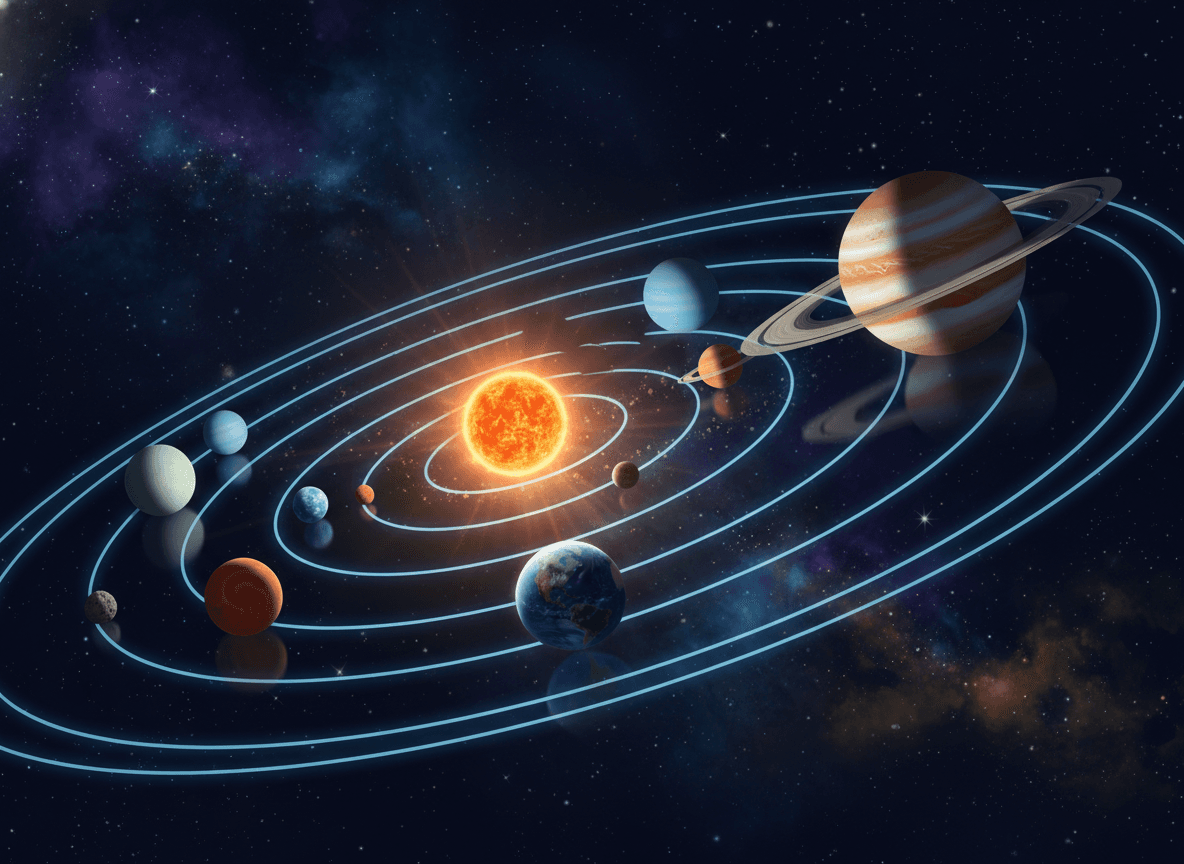
- Our solar system has one star (the sun) and eight planets: Mercury, Venus, Earth, Mars, Jupiter, Saturn, Uranus, and Neptune.
- Planets orbit the sun because of gravity, and each planet also rotates on its own axis.
- The inner planets (Mercury–Mars) are small and rocky; the outer planets (Jupiter–Neptune) are large gas or ice giants.
What Is the Solar System?
Our solar system is the sun and everything bound to it by gravity - eight planets, dozens of moons, hundreds of thousands of asteroids, billions of comets, and vast clouds of gas and dust. It sits in the outer arm of the Milky Way galaxy, about 26,000 light-years from the galactic center.
The solar system formed about 4.6 billion years ago when a giant cloud of gas and dust (a nebula) collapsed under its own gravity.
The Sun
The sun is a medium-sized star at the center of our solar system. It accounts for 99.8% of all the mass in the solar system. The sun's gravity holds all the planets in their orbits, and its energy - produced by nuclear fusion in its core - gives us light and heat.
The Eight Planets
Mercury: Rocky - Closest - Extreme temperatures; no atmosphere
Venus: Rocky - 2nd - Hottest planet; spins backward
Earth: Rocky - 3rd - Only known planet with life
Mars: Rocky - 4th - Red planet; largest volcano in solar system
Jupiter: Gas Giant - 5th - Largest planet; Great Red Spot storm
Saturn: Gas Giant - 6th - Famous rings made of ice and rock
Uranus: Ice Giant - 7th - Rotates on its side
Neptune: Ice Giant - 8th - Strongest winds; 16-hour day
Mnemonic: My Very Excellent Mother Just Served Us Nachos
Inner vs. Outer Planets
The asteroid belt separates the solar system into two zones:
-
Inner planets (Mercury, Venus, Earth, Mars): small, rocky, and relatively close to the sun
-
Outer planets (Jupiter, Saturn, Uranus, Neptune): much larger; made mostly of gas or ice
Rotation and Revolution
-
Rotation - a planet spinning on its own axis. Earth's rotation creates day and night (one full rotation = 24 hours).
-
Revolution - a planet traveling around the sun in its orbit. Earth's revolution creates one year (one revolution = 365.25 days).
Other Objects in the Solar System
-
Moons - natural satellites that orbit planets. Earth has 1; Jupiter has 95.
-
Asteroids - rocky objects mostly found in the asteroid belt between Mars and Jupiter.
-
Comets - icy bodies that develop a glowing tail when they come near the sun.
-
Dwarf planets - Pluto, Ceres, Eris, and others that are round but haven't cleared their orbit.
Grade-by-Grade Breakdown
K–2: Name the sun and planets; day/night cycle
3rd–4th: Planet order, rotation vs. revolution, moons
5th: Gravity, inner/outer planets, asteroid belt, scale
Practice Activities
-
Planet order song or mnemonic: Practice the My Very Excellent Mother mnemonic until all 8 planets are memorized.
-
Scale model: Use balls of different sizes to represent the planets and lay them out to show relative distances.
-
Planet research cards: Each student picks one planet and creates a fact card with size, moons, and one interesting fact.
-
Day and night model: Shine a flashlight on a globe in a dark room and rotate it to demonstrate day and night.
-
Solar system mobile: Create a hanging mobile with all 8 planets labeled at the correct relative distances.
Frequently Asked Questions
What is the difference between rotation and revolution?
Rotation is when a planet spins on its own axis - Earth's rotation creates day and night (one rotation = 24 hours). Revolution is when a planet travels around the sun - Earth's revolution creates one year (one revolution = 365.25 days).
What is a mnemonic to remember the order of the planets?
A popular mnemonic is: My Very Excellent Mother Just Served Us Nachos - representing Mercury, Venus, Earth, Mars, Jupiter, Saturn, Uranus, and Neptune in order from the sun.
Why is Pluto no longer called a planet?
In 2006, the International Astronomical Union reclassified Pluto as a dwarf planet because it has not cleared other objects from its orbital path. A true planet must orbit the sun, have enough gravity to be round, and have cleared its orbital neighborhood.
Free Solar System Worksheets
Curriculum-aligned printable worksheets for Kindergarten – 5th Grade. Download free.


