What Are Sound and Light?
Taught in US schools
Key Takeaways
- Sound is caused by vibrations that travel through matter (solid, liquid, or gas) as waves - sound cannot travel through a vacuum.
- Light travels in straight lines and can be reflected (bounced back), refracted (bent), or absorbed depending on the material it hits.
- White light is made up of all the colors of the visible spectrum - a prism or water droplets can separate white light into a rainbow.
What Are Sound and Light?
Sound and light are two different forms of energy that travel as waves. They are central topics in 1st through 3rd grade science and connect directly to everyday experiences.
Sound: What It Is and How It Works
Sound Is Vibration
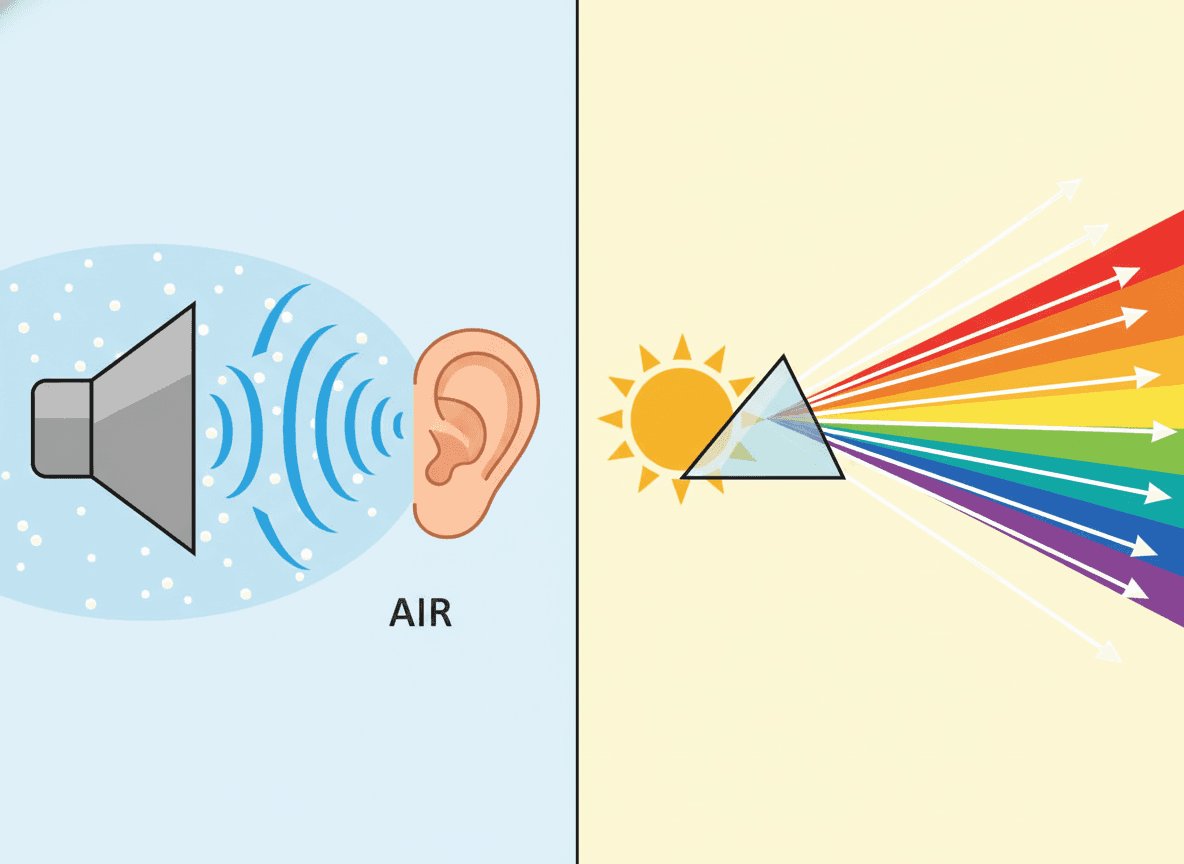
Sound is created when an object vibrates - moves rapidly back and forth. These vibrations push and pull the particles in the surrounding material, creating a sound wave that travels outward.
Example: When you pluck a guitar string, the string vibrates. Those vibrations travel through the air to your ear, where they are detected as sound.
Sound Needs a Medium
Sound is a mechanical wave - it needs a medium (matter) to travel through. It can travel through:
-
Gases (air - most common medium for everyday sound)
-
Liquids (water - sound travels faster in water than air)
-
Solids (walls, metal - sound travels fastest through solids)
Sound cannot travel through a vacuum (empty space). That is why outer space is silent.
Pitch and Volume
Pitch: How high or low a sound is - Frequency (vibrations per second)
Volume: How loud or soft a sound is - Amplitude (size of the vibration) Higher frequency = higher pitch. Greater amplitude = louder sound.
Light: What It Is and How It Works
Light Is Electromagnetic Radiation
Light is an electromagnetic wave - it does not need a medium to travel. Light can travel through a vacuum (which is why we receive light from the Sun through the vacuum of space).
Light travels at about 186,000 miles per second - the fastest speed in the universe.
Light Travels in Straight Lines
Light always moves in straight lines called rays. This explains why shadows form - light cannot bend around solid objects (unless a special medium bends it).
What Happens When Light Hits Different Materials?
Reflection: Light bounces back - Mirror, still water
Refraction: Light bends as it enters a new medium - Straw appearing "broken" in water
Absorption: Light is taken in and turned to heat - Dark-colored objects feel warmer
Transmission: Light passes through - Clear glass, water
The Visible Spectrum and Rainbows
White light is actually made up of all the colors of the visible spectrum:
Red, Orange, Yellow, Green, Blue, Indigo, Violet
A prism or water droplets (like in a rainbow) can separate white light into its component colors by refracting each wavelength at a slightly different angle. Each color in the rainbow has a different wavelength of light.
Connecting Sound and Light: Waves
Both sound and light travel as waves, but they are different types:
Wave type: Mechanical
****Needs medium?: Yes
Speed: ~767 mph in air
Example source: Drum, voice, thunder
Practice Activities
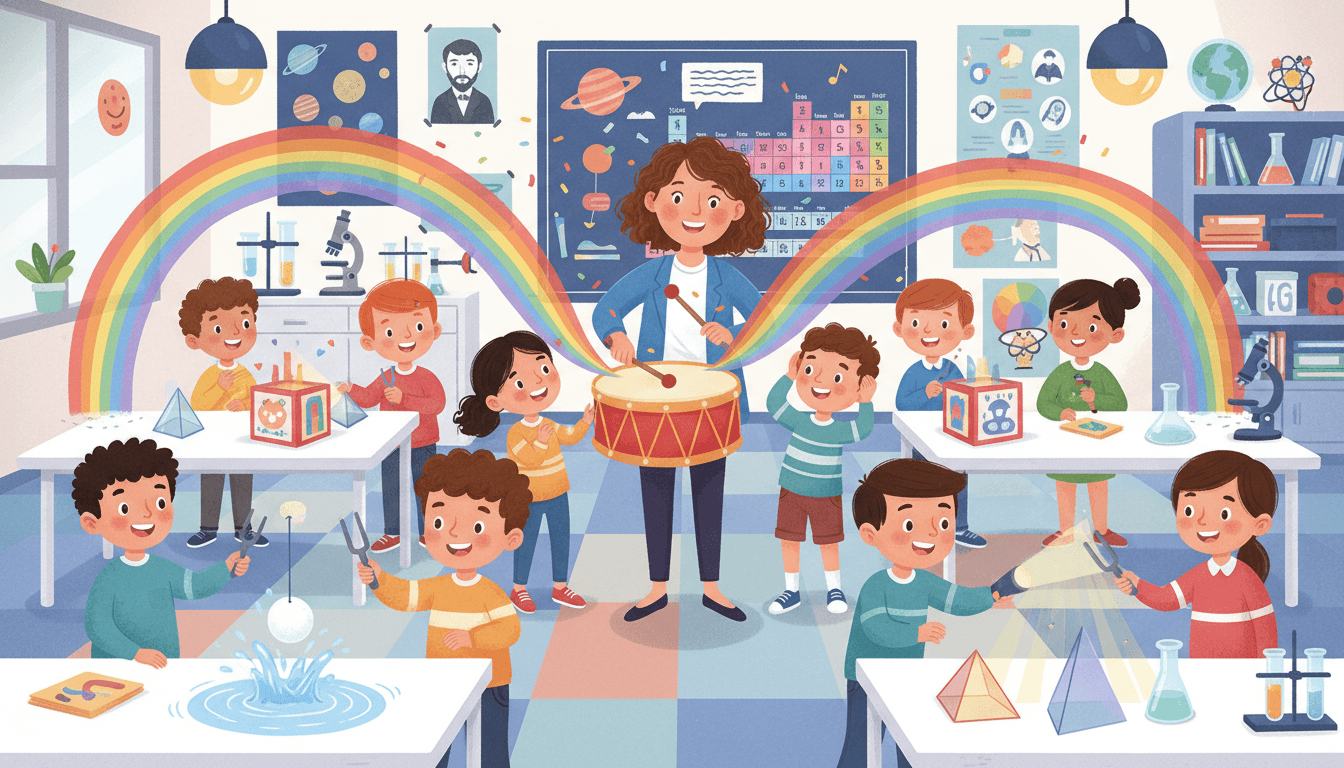
- String telephone experiment: connect two paper cups with a taut string to demonstrate that sound travels through solids.
- Tuning fork and water: touch a vibrating tuning fork to a bowl of water - students observe the ripples caused by the vibrations.
- Rainbow prism: shine a flashlight through a glass of water onto white paper to separate light into colors.
- Shadow investigation: use a flashlight and objects of different shapes to explore how shadows form when light is blocked.
- Pitch exploration: fill glasses with different amounts of water and tap with a spoon - compare the pitch when water levels change.
Frequently Asked Questions
Why can't sound travel through space?
Sound needs a medium - matter (a solid, liquid, or gas) - to travel through. In space, there is a near-perfect vacuum with no matter. Without particles to vibrate, sound waves cannot move. That is why space is silent. Light, however, can travel through a vacuum because it is an electromagnetic wave, not a mechanical wave.
What is pitch and what causes it?
Pitch is how high or low a sound is. It is determined by the frequency of the sound wave - how many vibrations occur per second (measured in hertz). High-frequency vibrations produce high-pitched sounds (like a whistle). Low-frequency vibrations produce low-pitched sounds (like a bass drum). Students can explore pitch by comparing sounds from short vs. long rubber bands or by plucking different strings on a guitar.
What happens when light hits a mirror?
When light hits a smooth, shiny surface like a mirror, it bounces back - this is called reflection. The angle at which light hits the mirror (the angle of incidence) equals the angle at which it bounces back (the angle of reflection). Reflection is why we can see our reflection in still water or a mirror.
Free Sound and Light Worksheets
Curriculum-aligned printable worksheets for 1st – 3rd Grade. Download free.


