
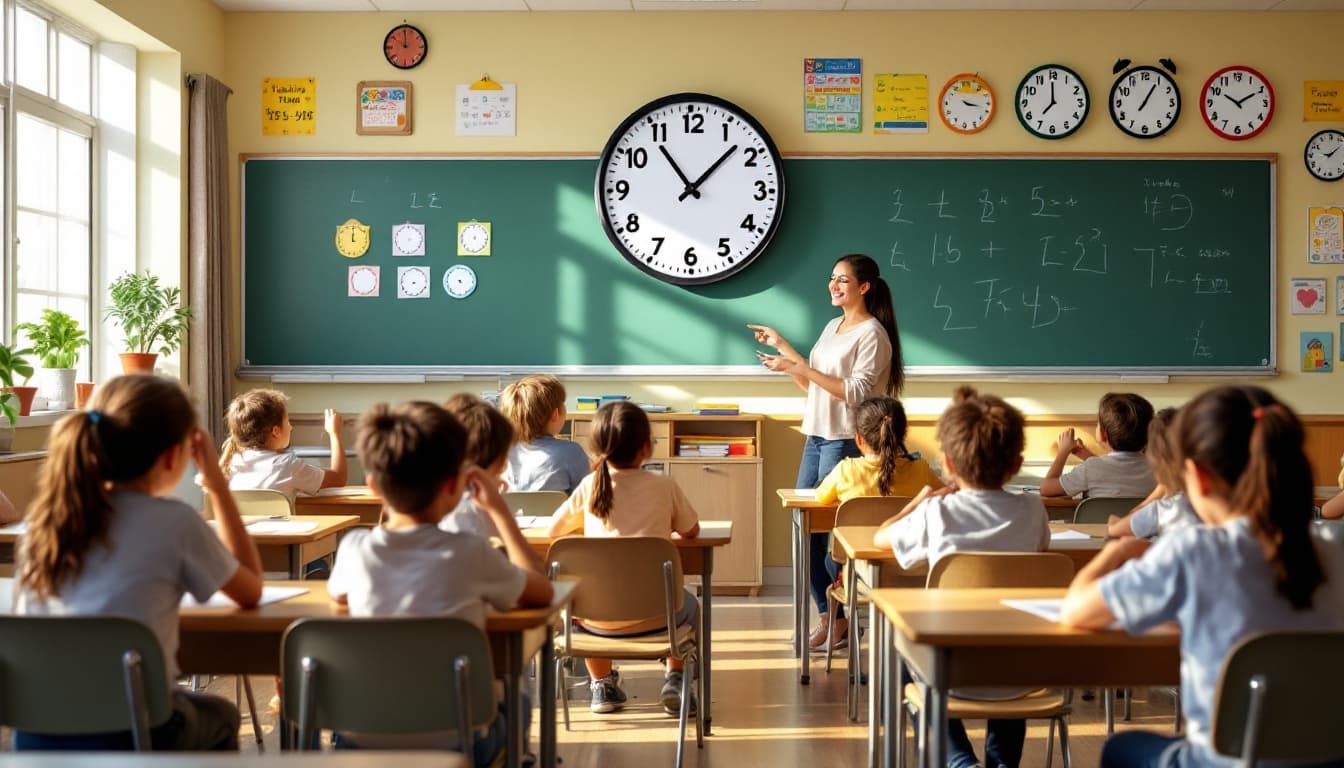
Free Telling Time Worksheets: Kindergarten to 3rd Grade
Get 30 days of free worksheet downloads
Key Takeaways
- Analog clock instruction follows a clear grade-band progression: time awareness in Kindergarten, hours and half hours in 1st grade, 5-minute intervals in 2nd grade, and elapsed time to the minute in 3rd grade.
- The half hour is the hardest concept for 1st graders because it requires understanding that the minute hand pointing to 6 means 30 minutes have passed, not 6, while the hour hand sits between two numbers rather than on one.
- Teaching analog before digital is the recommended sequence - students who learn digital first can read a display but lack the conceptual understanding of why the hour hand moves gradually between numbers.
- Elapsed time in 3rd grade is best taught with the number line method: hop from start time to the next hour, count full hours forward, then add remaining minutes to find the duration.
- Daily analog clock exposure - asking 'what time is it?' and pointing to a wall clock instead of a phone - is the most effective home practice strategy for building fluency.

Telling time on an analog clock is a skill fewer kids practice today than a generation ago. Most devices show digital time. But the Common Core still includes it, and for good reason: analog clocks teach the relationship between hours and minutes in a way that digital displays don't.
Here's how the skill develops across grades and which worksheets to use at each level.
Kindergarten Telling Time Worksheets
Kindergartners aren't expected to read clocks, but they do start building time awareness.
Skills at this level:
- Vocabulary: morning, afternoon, evening, night
- Sequencing events in time: "First we eat breakfast. Then we go to school. Then we come home."
- Recognizing that clocks tell time and that clocks have hands
- Associating some times with daily events: "Lunch is at 12 o'clock."
Good worksheet formats:
- Cut and paste: sequence the daily routine images
- Match the event to the time of day (morning, afternoon, evening)
- Look at a clock showing an o'clock time and write the hour
Explore our kindergarten telling time worksheets for age-appropriate activities.
1st Grade Telling Time Worksheets
First graders learn to tell time to the hour and half hour. This is the first year of reading actual clock faces.
Telling time to the hour. The minute hand points to 12. The hour hand points to a number. Read the hour.
Telling time to the half hour. The minute hand points to 6 (the "halfway" point). The hour hand is between two numbers. Students write "3:30" or "half past 3."
Drawing hands on a clock. Given a time like 4:00 or 7:30, draw the hour and minute hands.
The hardest part for most 1st graders is the half hour. They need to understand that when the minute hand points to 6, it means 30 minutes have passed, not 6 minutes. And the hour hand has moved halfway between two numbers, not landed on the next one yet.
Free 1st Grade Telling Time Worksheets


Worksheet formats that work:
- Read the clock and write the time: match the image to the written time
- Draw the hands: show 8:00, show 2:30
- Match the clock to the digital time
- Circle the clock that shows ___
Explore our 1st grade telling time worksheets for structured printables.
2nd Grade Telling Time Worksheets
Second graders extend to the nearest 5 minutes and connect analog and digital time.
When the minute hand points to 1, that's 5 minutes. To 2, that's 10 minutes. To 3, that's 15 minutes. Students practice counting by 5s around the clock face.
AM and PM. Students learn to distinguish morning and afternoon times and write them correctly.
Quarter hours. Quarter past (15 minutes after), half past (30 minutes after), quarter to (15 minutes before the next hour).
Skills:
- Read analog clock to the nearest 5 minutes
- Write the time in digital format
- Match analog and digital
- Use AM/PM correctly
Free 2nd Grade Telling Time Worksheets


Explore our 2nd grade telling time worksheets.
3rd Grade Telling Time Worksheets
Third graders tell time to the minute and work with elapsed time.
Telling time to the minute. Every minute on the clock, not just every 5.
Elapsed time. "The movie started at 1:15 and ended at 3:40. How long was the movie?" This requires students to count forward in time, which is harder than it sounds because of the irregular structure of time (60 minutes in an hour, not 100).
The most common approach is the number line method: place the start time, hop to the next hour, count the hours until you're near the end time, then count the remaining minutes.
Elapsed time word problems come in three forms:
- Start time + duration = end time
- End time - duration = start time
- End time - start time = duration
All three are worth practicing.
Explore our 3rd grade telling time worksheets.
Tips for Practicing Time at Home
Keep an analog clock in a visible spot. The more your child sees and reads an analog clock as part of daily life, the more natural it becomes. Ask "what time is it?" and point to the analog clock instead of the phone.
Connect to real events. "We need to leave at 4:30. What time is it now? How many minutes until we leave?" Real deadlines make elapsed time concrete.
Draw clock worksheets together. For drawing practice, call out a time, both draw it, then compare. Kids love catching adult mistakes.
Keep Reading

Adi Ackerman
Head Teacher
Adi is the Head Teacher at ClassWeekly, with years of experience teaching elementary students. She designs our curriculum-aligned worksheets and writes practical guides for teachers and parents.
Keep Reading
Ready to download? Try ClassWeekly free for 30 days.
Unlimited worksheets for PreK through 5th grade. Cancel anytime.