
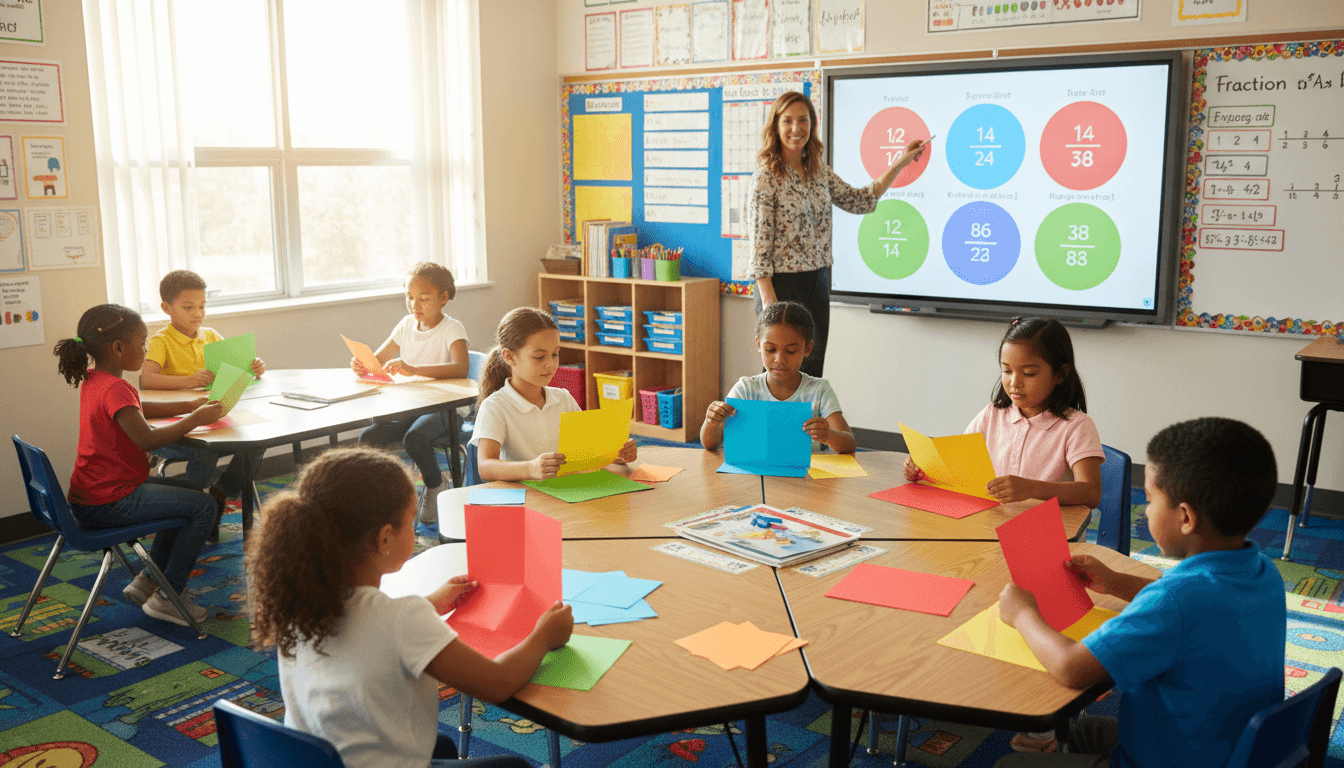
2nd Grade Fractions: When and How to Introduce Them
Get 30 days of free worksheet downloads
Key Takeaways
- Second graders only need to partition shapes into 2, 3, or 4 equal shares and name them using words like halves, thirds, and fourths - no fraction notation required at this grade level.
- The most critical concept to reinforce is that fractions must be equal shares - unequal parts are the number one misconception at this level.
- Hands-on activities like folding paper, cutting playdough, and finding fractions in the classroom should come before any worksheet practice, ideally for at least two weeks.
- Equal shares do not need to look the same shape - two triangles and two rectangles can both be halves of the same square, which is exactly what Common Core 2.G.A.3 targets.
- Embedding fraction vocabulary into daily classroom routines ('about a third of the class', 'half our recess time') builds familiarity without extra lesson time.

Fractions are one of those topics that makes second graders (and their teachers) a little nervous. But here's a secret: second graders only need to understand a few basic ideas about fractions. And those ideas are way simpler than you might think.
Let's break it down.
What Second Graders Actually Need to Know
According to Common Core standard 2.G.A.3, second graders should be able to:
- Partition circles and rectangles into 2, 3, or 4 equal shares
- Describe the shares using the words halves, thirds, and fourths (or quarters)
- Understand that equal shares of identical wholes don't need to have the same shape
That's it. No fraction notation (no 1/2 or 3/4). No adding fractions. No comparing fractions with different denominators. Just: can you split something into equal parts and name them?
Way less scary now, right?
Free 2nd Grade Fraction Worksheets


Start With Food (Seriously)
Nothing teaches "equal parts" like sharing food fairly.
Pizza day. Draw a circle on paper (or use a real paper plate). "I need to share this pizza between 2 friends. How do I cut it so it's fair?" Kids draw the line. Boom. Halves.
Sandwich halving. Bring in a piece of bread. Cut it in half. Then ask: "What if 4 people need to share?" Cut each half in half. Fourths.
The unfair share. Intentionally cut something unequally. "Is this fair? Does each person get the same amount?" Kids will immediately protest. That's the lesson: fractions have to be equal shares.
The Key Vocabulary
Keep it simple and consistent:
- Halves: 2 equal parts ("We cut it in half")
- Thirds: 3 equal parts ("Each person gets a third")
- Fourths/Quarters: 4 equal parts ("A quarter of the pizza")
Use these words every day. "We've used half our recess time." "About a third of the class brought lunch today." "A quarter of the crayons are broken."
When kids hear fraction words in real life, the concept sticks.
Hands-On Activities That Work
1. Folding Paper
Give each student a piece of paper. Fold it in half. Open it. "How many parts? Are they equal? What do we call each part?"
Now fold in half again. "How many parts now?" Fourths.
Fold a new piece into thirds (trickier, but great for motor skills). Compare all three papers side by side.
2. Fraction Bars With Playdough
Roll a playdough snake. Use a plastic knife to cut it into equal pieces.
- Cut into 2 pieces: halves
- Cut into 3 pieces: thirds
- Cut into 4 pieces: fourths
Then ask the magic question: "Which piece is bigger, a half or a fourth?" Let them see it with their own eyes.
3. Shape Partitioning
Draw large shapes (circles, squares, rectangles) on paper. Students use a ruler to divide them into equal parts. Color each part a different color.
This is exactly what our worksheets focus on. Simple shapes, clear divisions, colorful and engaging.
4. Fraction Walk
Walk around the school. Find things divided into equal parts:
- Windows (panes)
- Floor tiles
- Bookshelves (shelves)
- Clock face (quarters)
Take photos. Make a class "Fractions Are Everywhere" poster.
The Biggest Misconception
Here's what trips kids up the most: the parts have to be equal.
A child will draw a circle, make a line through the middle (not quite centered), and say "halves." But the two parts are clearly different sizes.
This is THE most important thing to reinforce at this level. Equal shares means equal size. If one piece is bigger, it's not halves.
Practice this constantly:
- "Are these halves? How do you know?"
- "Is this fair? Would you take either piece?"
- Show examples and non-examples side by side
Another Common Confusion
"Same shape" doesn't always mean "equal share." And "different shape" doesn't mean "unequal."
A square cut diagonally into two triangles AND a square cut vertically into two rectangles both show halves. The pieces look different, but they're the same size. This is what standard 2.G.A.3 is specifically addressing.
Use area comparisons: "Could you fit this piece exactly on top of that piece?" If yes, they're equal.
What NOT to Do in Second Grade
- Don't introduce fraction notation (1/2, 1/3, 1/4) yet. That's a 3rd grade standard. Use words only.
- Don't compare fractions with different denominators. Just compare pieces from the same shape.
- Don't rush to worksheets. Spend at least 2 weeks on hands-on activities before moving to paper practice.
How Parents Can Help
Fractions are everywhere at home. Look for them:
- Cutting a sandwich in half
- Sharing snacks equally between siblings
- Baking ("We need half a cup")
- Telling time ("It's quarter past three")
Just name them: "Look, you ate about a third of your dinner." Casual exposure builds familiarity.
Keep Reading
- How to Teach Word Problems in Second Grade
- Second Grade Math: Key Skills and How to Practice at Home
- Teaching Place Value to Second Graders
- Fractions in Elementary: Where Kids Get Stuck
The Simplest Next Step
Tomorrow, bring in a piece of paper and fold it. That's literally all it takes to start teaching fractions. Fold, count the parts, name them. Build from there.
For structured practice at exactly the right level, try our 2nd grade fraction worksheets. They focus on partitioning shapes and naming equal shares, with clear visuals and no unnecessary complexity.
Fractions don't have to be the hard part of second grade math. When you keep it hands-on and concrete, kids get it. They really do.

Adi Ackerman
Head Teacher
Adi is the Head Teacher at ClassWeekly, with years of experience teaching elementary students. She designs our curriculum-aligned worksheets and writes practical guides for teachers and parents.
Keep Reading
Ready to download? Try ClassWeekly free for 30 days.
Unlimited worksheets for PreK through 5th grade. Cancel anytime.