
How to Teach Syllables to Kids: Clapping, Sorting, and More
Get 30 days of free worksheet downloads
Key Takeaways
- A syllable is a beat in a word, and every syllable contains exactly one vowel sound - not one vowel letter, which helps kids understand why 'cake' is one syllable even with two vowel letters.
- The clapping method and chin method are complementary tools: clapping works for rhythmic, active learners, while the chin method gives kids a precise self-check they can use independently at any time.
- Starting syllable practice with students' own names dramatically increases engagement because kids are always more motivated when the content involves them personally.
- First graders ready to move beyond counting can learn open and closed syllables as a decoding strategy - closed syllables end in a consonant and have a short vowel, open syllables end in a vowel and have a long vowel.
- Common errors like adding a schwa sound to consonant endings ('do-guh' for 'dog') or confusing phonemes with syllables are fixable with targeted modeling and clarification.
Syllables are one of those things that adults take for granted. We hear them without thinking. But for a five or six-year-old, learning to break a word into its beats is a real skill, and it opens the door to so much.
Kids who can count syllables read longer words more confidently. They spell better. They understand word patterns. It's probably one of the most useful phonological skills you can teach early on, and the good news is that most kids find it fun.
Here's how to teach syllables in a way that sticks.
What Is a Syllable (A Simple Explanation for Kids)
Keep it simple. A syllable is a beat in a word. Every beat has a vowel sound.
"Cat" has one beat. "Rab-bit" has two beats. "But-ter-fly" has three beats.
That's the kid-friendly explanation. You don't need to get into vowel nuclei or sonority hierarchies with kindergartners. Beats. That's the word.
For the teacher brain, though, here's the technical bit: a syllable is a unit of pronunciation that contains exactly one vowel sound (not one vowel letter, one vowel sound). The word "cake" has two vowel letters but one vowel sound, so it's one syllable. The word "lion" has two vowel sounds, so it's two syllables. This distinction matters when kids start applying syllable rules to spelling later on.
A quick way to check: say the word and count how many times your mouth opens wide for a vowel sound. That's your syllable count.
Free Syllable Practice Pages for Kindergarten


The Clapping Method and Chin Method
These are your two go-to strategies, and honestly, you'll use them all year.
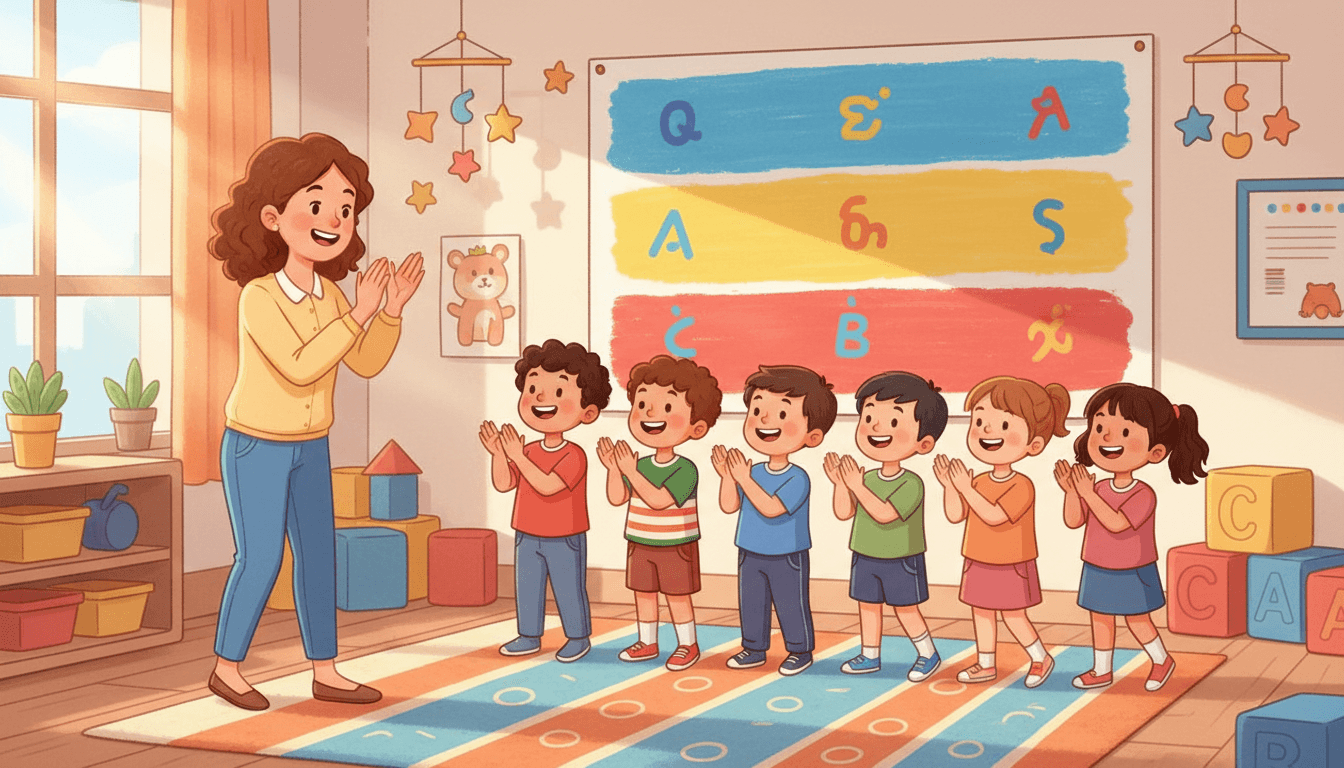
Clapping. Say a word. Clap once for each beat. "Wa-ter" gets two claps. "El-e-phant" gets three. Start with students' names. Kids are always more engaged when the content involves them. "Ma-ya" (two claps), "Chris-to-pher" (three claps), "Jade" (one clap).
Practice with the whole class first. Say the word together, clap together. Then give individual students a word and let them clap it out solo. You'll quickly see who's got it and who's clapping randomly.
Chin method. This one feels like a magic trick to kids. Place your hand flat under your chin. Say a word slowly. Every time your chin drops and touches your hand, that's a syllable. Try it with "di-no-saur." Your chin drops three times. Three syllables.
Why does this work? Because your jaw drops for every vowel sound. It's a built-in syllable counter that lives in their own face. Kids love the novelty of it, and it gives them a self-check tool they can use independently.
Which method is better? Neither. Some kids respond more to clapping (it's active and rhythmic). Others like the chin method (it feels more precise). Teach both and let students use whichever one clicks for them.
Stomping, tapping, jumping. Any rhythmic body movement works. Stomp syllables. Tap them on the table. Jump once per syllable. The motor cortex and the language centers in the brain are closely linked in young children. Use that connection.
Syllable Sorting Activities
Once your students can count syllables in a word, it's time to sort.
Picture sort. Give students a stack of picture cards. Set up three columns labeled 1, 2, and 3 (or use baskets/mats). Students say the name of each picture, count the syllables, and place it in the correct column. A picture of a dog goes in the 1 column. A picture of a tiger goes in the 2 column. A picture of an umbrella goes in the 3 column.
Start with very clear examples. Avoid tricky words where students might disagree on syllable count ("fire" is famously debatable). Use concrete, familiar nouns.
Name graph. Make a class graph where each student places their name card in the column matching their syllable count. One-syllable names: Jack, Claire. Two-syllable names: Emma, Lucas. Three-syllable names: Olivia, Sebastian. Kids will check and recheck each other's names. It's self-correcting and social.
Syllable hopscotch. Draw a hopscotch grid with numbers 1 through 4. Call out a word. The student hops to the number that matches the syllable count. Then they say the word broken into syllables before hopping back.
Magazine hunt. For slightly older kids (late kindergarten, early first grade), give them old magazines. They cut out pictures and sort them by syllable count onto a poster or chart. This makes a great bulletin board display.
Open and Closed Syllables for Older Students
This section is for first graders who are ready for the next step. If your students are still working on basic syllable counting, save this for later.
Once kids are solid on counting syllables, you can start teaching syllable types. There are six types total, but the two your first graders need are open and closed.
Closed syllable: ends with a consonant. The vowel says its short sound. Examples: "cat," "nap," "bed," "hop." The consonant at the end "closes the door" on the vowel, keeping it short.
Open syllable: ends with a vowel. The vowel says its long sound. Examples: the first syllable of "mo-ment," "ti-ger," "mu-sic." The vowel is "free" at the end, so it says its name.
This is useful because it gives students a decoding strategy for longer words. When they encounter a two-syllable word they've never seen before, knowing syllable types helps them figure out the vowel sounds.
A simple way to practice: write a two-syllable word on the board. Draw a line between the syllables. Look at each syllable separately. Does it end in a consonant (closed) or a vowel (open)? What sound does the vowel make?
Don't over-formalize this with kindergartners. But for first graders who are reading multisyllabic words, this knowledge is genuinely powerful.
Syllable Games for the Classroom
Games keep syllable practice from feeling like a chore. Here are some that work well in a whole-group or center setting:
Syllable robot. One student is the robot. The teacher whispers a word to the robot. The robot says the word broken into syllables in a robotic voice: "EL. E. PHANT." The rest of the class has to guess the word and hold up fingers for the syllable count.
Musical syllables. Play music. When the music stops, hold up a picture card. Students clap the syllables. If they get it right, the music plays again. If not, practice the word together and try again.
Syllable bingo. Create bingo cards with numbers 1, 2, 3, and 4 in the squares (duplicated to fill the card). Call out words. Students place a marker on the number matching the syllable count. First to get a line wins.
Four corners. Label four corners of the room with 1, 2, 3, and 4. Say a word. Students walk to the corner that matches the syllable count. Anyone in the wrong corner sits down. Last one standing wins.
Compound word split. This works nicely for first graders learning compound words. Give students a compound word like "sunshine." They clap the syllables (two), then tell you the two smaller words inside: "sun" and "shine." This connects syllable awareness to vocabulary and spelling.
Common Mistakes Kids Make With Syllables
Watch for these. They're all fixable, but they need your attention.
Adding extra syllables. Some kids will clap "dog" as two syllables: "do-guh." They're adding a schwa sound to the end of consonants. This is especially common with words ending in hard consonant sounds. Fix: model the word clearly and slowly. Emphasize that the final sound is just /g/, not /guh/.
Confusing syllables with sounds. A student might say "cat" has three syllables because it has three sounds. They're mixing up phoneme counting with syllable counting. Fix: clarify that syllables are beats, not individual sounds. "Cat" has three sounds but only one beat. Clap it. One clap.
Struggling with words where syllable breaks aren't obvious. "Crayon" is a classic. Is it one syllable or two? Honestly, it depends on your regional dialect. Some people say it as one syllable (crahn). Others say two (cray-on). When this happens, just acknowledge it. "Some people say it with one beat, some with two. Both are okay."
Rushing through multisyllabic words. Some kids will clap "watermelon" as two syllables because they smoosh the middle. Slow them down. Have them put their hand under their chin and say it very slowly. The chin doesn't lie.
Keep Reading
- How to Teach Phonics to Kids: A Complete Guide for Parents
- How to Teach Decoding Skills to Beginning Readers
- Teaching Rhyming Words to Kids: Games and Activities That Work
Practice Pages for Syllable Skills
Daily syllable practice can be quick. Two to three minutes during your phonological awareness block is plenty.
Here's what a good weekly progression looks like:
Week 1-2: Clapping syllables in students' names and familiar words. Whole group only.
Week 3-4: Sorting pictures by syllable count (1 vs 2). Introduce the chin method.
Week 5-6: Expand sorting to include 3-syllable words. Add partner practice.
Week 7-8: Syllable games (bingo, four corners). Printable practice pages for independent work.
Ongoing: Weave syllable awareness into daily routines. When you introduce a new vocabulary word, clap it out. When you're lining up for lunch, have each student clap the syllables in the day of the week.
Printable practice pages are especially helpful at the sorting stage. Pages where students look at pictures, count the syllables, and write the number (or color-code by syllable count) give you concrete evidence of who understands the concept. They also give students a chance to practice independently, which frees you up to work with small groups who need more support.
Syllables are a building block. Your kiddos who master syllable awareness in kindergarten and first grade will have an easier time with multisyllabic decoding, spelling patterns, and even writing rhythm in the years ahead. It's one of those investments that keeps paying off.

Adi Ackerman
Head Teacher
Adi is the Head Teacher at ClassWeekly, with years of experience teaching elementary students. She designs our curriculum-aligned worksheets and writes practical guides for teachers and parents.
Keep Reading
Ready to download? Try ClassWeekly free for 30 days.
Unlimited worksheets for PreK through 5th grade. Cancel anytime.