What Are 3D Shapes?
Taught in US schools

Key Takeaways
- 3D shapes have three dimensions: length, width, and depth. Unlike 2D shapes, they take up space.
- The three key properties of 3D shapes are faces (flat surfaces), edges (where faces meet), and vertices (corners).
- Real-world objects can be matched to 3D shapes - a soup can is a cylinder, a dice is a cube, a party hat is a cone.
What Are 3D Shapes?
A 3D shape (three-dimensional shape) is a solid figure that has three dimensions: length, width, and depth. Unlike flat 2D shapes, 3D shapes take up space in the real world - you can pick them up, stack them, and look at them from different angles. Every object around you has a 3D shape.
Key Properties of 3D Shapes
Face: A flat (or curved) surface on the outside of the shape
Edge: The line where two faces meet
****Vertex (Vertices): A corner where three or more edges meet
Example: A rectangular prism (like a cereal box) has 6 faces, 12 edges, and 8 vertices.
Common 3D Shapes
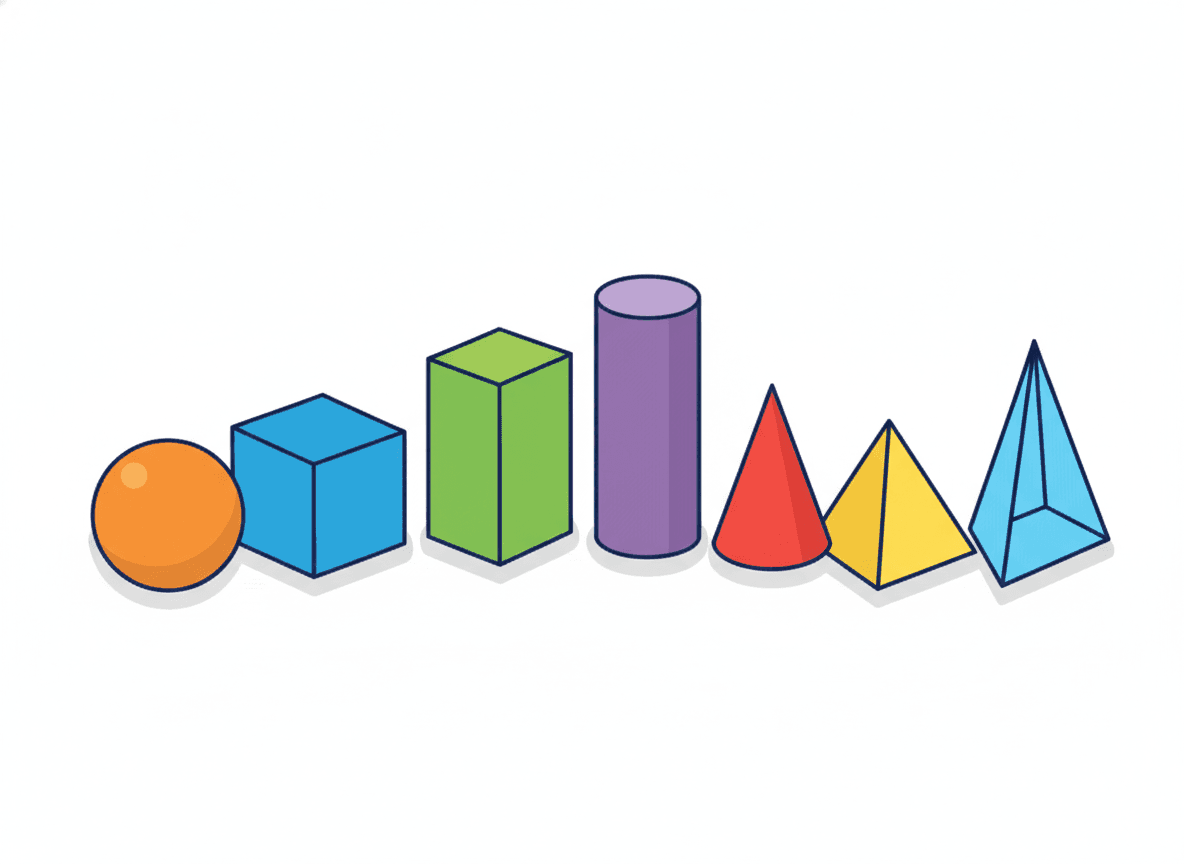
Cube: 6 (squares) - 12 - 8 - Dice, building blocks
Rectangular Prism: 6 (rectangles) - 12 - 8 - Cereal box, brick
Sphere: 1 curved - 0 - 0 - Basketball, globe
Cylinder: 2 flat + 1 curved - 2 - 0 - Soup can, paper towel roll
Cone: 1 flat + 1 curved - 1 - 1 - Party hat, ice cream cone
Pyramid: 4–5 - 6–8 - 4–5 - Egyptian pyramids, tent
Triangular Prism: 5 - 9 - 6 - Tent, Toblerone box
The Connection Between 2D and 3D Shapes
Every face of a 3D shape is a 2D shape. This connection is powerful for students:
- A cube has 6 square faces.
- A rectangular prism has rectangular and/or square faces.
- A pyramid has a square base and triangular sides.
Classroom activity: If you could unfold a 3D shape and lay it flat, you'd get its net - a 2D pattern that folds back into the 3D shape. Exploring nets builds deep understanding of how flat and solid shapes relate.
3D Shapes in the Real World
Connecting 3D shapes to everyday objects makes them concrete and memorable:
-
Sphere: basketball, orange, globe
-
Cube: dice, sugar cube, Rubik's cube
-
Cylinder: can of soup, drum, rolling pin
-
Cone: ice cream cone, party hat, traffic cone
-
Rectangular Prism: book, shoebox, refrigerator
-
Pyramid: Egyptian pyramids, roof of a house
Sorting and Comparing 3D Shapes
Students can sort 3D shapes by:
-
Ability to roll (sphere, cylinder, cone) vs. ability to slide (cube, rectangular prism)
-
Number of flat faces vs. shapes with curved surfaces
-
Number of vertices (0, 1, 4, 5, 8…)
Practice Activities
- Go on a 3D shape hunt around the home or classroom, matching real objects to shape names.
- Use clay or playdough to sculpt a cube, sphere, cylinder, and cone - feel the faces, edges, and vertices.
- Match 2D nets to their 3D shapes by folding paper cutouts.
- Sort a collection of solids into a T-chart: "Can roll" vs. "Cannot roll."
- Count faces, edges, and vertices on each shape and record them in a class chart to look for patterns.
Frequently Asked Questions
What is the difference between 2D and 3D shapes?
2D shapes are flat and have only length and width. 3D shapes are solid and also have depth, meaning they take up space in the real world.
What are the faces of a 3D shape?
Faces are the flat surfaces of a 3D shape. A cube has 6 square faces. Some 3D shapes like spheres and cylinders have curved surfaces instead of (or in addition to) flat faces.
How many faces, edges, and vertices does a cube have?
A cube has 6 faces, 12 edges, and 8 vertices.
Free 3D Shapes Worksheets
Curriculum-aligned printable worksheets for Kindergarten – 3rd Grade. Download free.