What Is Volume?
Taught in US schools

Key Takeaways
- Volume measures how much space a 3D object occupies, expressed in cubic units (cu in, cu cm, cu ft).
- Volume of a rectangular prism = length × width × height (or base area × height).
- Volume can also be found by counting unit cubes packed inside a shape.
- Understanding volume builds on area concepts and prepares students for middle school geometry.
What Is Volume?
Volume is the measurement of the three-dimensional space that an object occupies. While area measures flat surfaces, volume measures the interior of 3D solids. Volume is expressed in cubic units: cubic inches (in³), cubic feet (ft³), cubic centimeters (cm³), and cubic meters (m³).
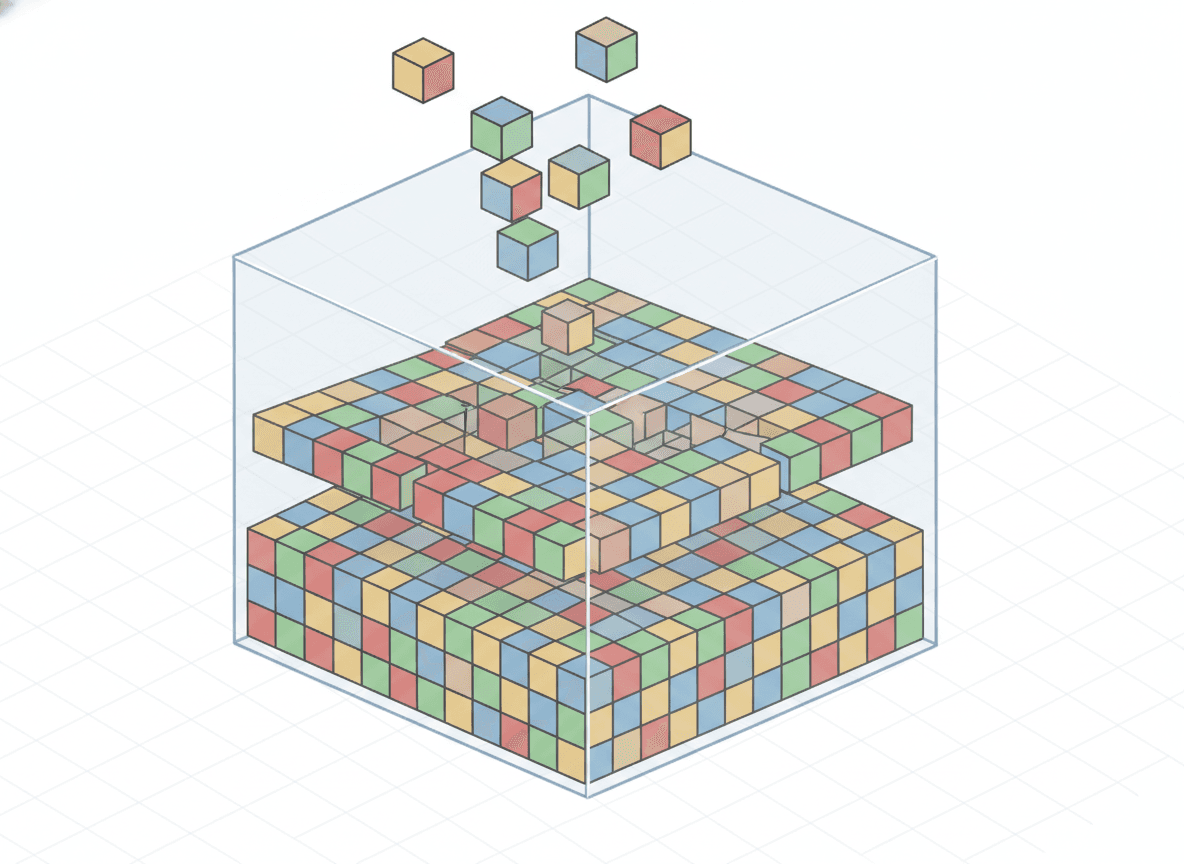
Think of filling a box with 1-inch cubes. The number of cubes that fit perfectly inside the box - without gaps or overlaps - is the box's volume.
Formula for Rectangular Prisms
V = l × w × h (length × width × height)
Or equivalently: V = B × h (area of the base × height)
Example: A rectangular prism 5 cm long, 3 cm wide, and 4 cm tall. V = 5 × 3 × 4 = 60 cm³
Students can also verify this by visualizing 4 layers, each layer being a 5 × 3 = 15 cm² grid of unit cubes, stacked four high: 15 × 4 = 60 unit cubes.
Counting Unit Cubes
Before applying formulas, students count unit cubes packed inside a 3D figure. This builds intuition: a shape that holds more cubes has more volume. Students often start with physical cube manipulatives or drawn diagrams showing stacked layers.
Composite Volumes
In 5th grade, students also find the volume of figures made up of two non-overlapping rectangular prisms by adding the volumes together (5.MD.C.5b). For example, an L-shaped structure can be split into two boxes, each measured separately.
What Grade Do Kids Learn Volume?
5th grade: Volume is a 5th-grade focus (5.MD.C.3–5). Students understand volume conceptually through unit cubes, then apply the formula to rectangular prisms and composite figures.
Earlier grades build background through area, multiplication, and 3D shape exploration.
Common Misconceptions
Confusing volume and surface area: Volume is the space inside; surface area is the total area of all outer faces. A box can have large volume but small surface area, or vice versa.
Confusing volume and capacity: Volume refers to 3D space occupied. Capacity (measured in liters or gallons) refers to how much liquid a container holds. They are related but distinct.
Forgetting the third dimension: Students familiar with area may apply l × w and forget to multiply by height, getting the base area instead of volume.
Practice Activities
-
Build with unit cubes: Use connecting cubes to build prisms and count the total cubes used.
-
Volume formula practice: Find the volume of classroom objects (tissue box, pencil box) by measuring and applying V = l × w × h.
-
Layered thinking: Draw a 4 × 3 × 5 prism and show it as 5 layers, each 4 × 3.
-
Composite figures: Split L-shaped drawings into two prisms, find each volume, and add.
-
Real-world problem solving: How many 1-inch cubes fit in a shoebox? Measure and calculate.
Frequently Asked Questions
What is volume in math?
Volume is the amount of three-dimensional space enclosed by an object. While area measures a flat (2D) surface in square units, volume measures a solid (3D) object in cubic units. For example, a box that is 3 cm × 4 cm × 5 cm has a volume of 60 cubic centimeters.
How do you calculate the volume of a rectangular prism?
Volume = length × width × height. Alternatively, you can think of it as the area of the base times the height: V = B × h. For a box that is 6 inches long, 4 inches wide, and 2 inches tall, V = 6 × 4 × 2 = 48 cubic inches.
What are cubic units?
Cubic units represent a cube with sides 1 unit long. One cubic centimeter (cm³) is a cube 1 cm × 1 cm × 1 cm. Volume is expressed in cubic units because it measures three dimensions: cubic inches (in³), cubic feet (ft³), cubic centimeters (cm³), and cubic meters (m³) are all common units.
How is volume different from area?
Area measures the flat surface of a 2D shape in square units. Volume measures the interior space of a 3D solid in cubic units. A square is 2D and has area. A cube is 3D and has both surface area (the total area of all its faces) and volume (the space inside it).
What real-world situations use volume?
Volume is used whenever we measure capacity or space: how many boxes fit in a truck, how much soil fills a planter box, how much water a fish tank holds, and how many items fit in a storage container. Engineers, architects, and manufacturers use volume constantly in their work.
Free Volume Worksheets
Curriculum-aligned printable worksheets for 5th Grade. Download free.
Common Core Standards