What Is Measurement?
Taught in US schools
Key Takeaways
- Measurement assigns a number to a quantity using a standard unit.
- US elementary students learn both customary (inches, pounds, cups) and metric (centimeters, grams, liters) units.
- The concept of a unit is fundamental - measurement only makes sense when you specify what unit you're using.
- Estimation is a critical measurement skill alongside precise measurement.
Measurement is where math meets the physical world. It answers the questions kids are always asking: How big? How heavy? How far? How long? Learning to measure well requires both conceptual understanding (what does a unit mean?) and procedural skill (how do you use a ruler correctly?).
What Is Measurement?
Measurement is the process of assigning a numerical value to a physical quantity using a standard unit.
"The book is 9 inches long" tells you something precise because inches is a defined, consistent unit. "The book is longer than my pencil" is a comparison, not a measurement - it depends on the pencil.
The key components of any measurement:
- A quantity to measure (length, weight, temperature, time)
- A unit to measure it in (inches, pounds, degrees, minutes)
- A number that expresses how many of those units
Types of Measurement in Elementary School
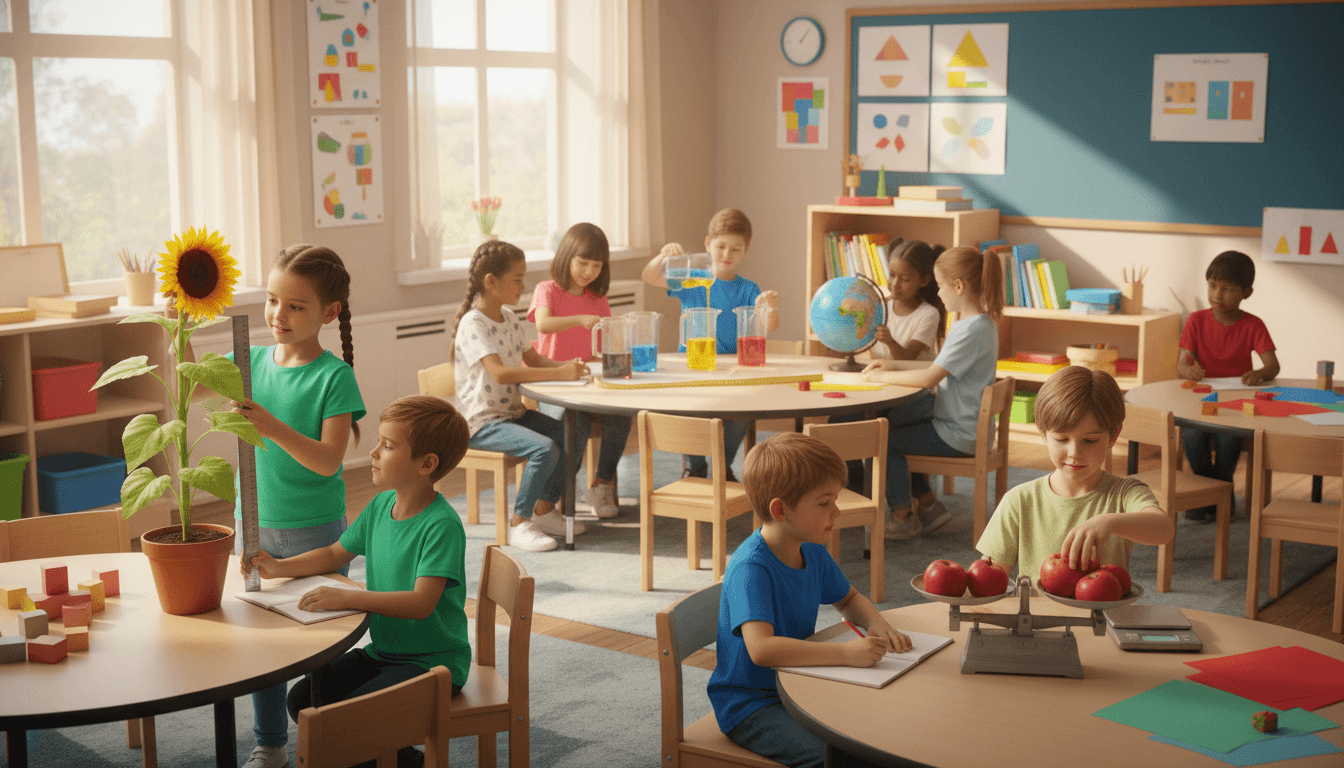
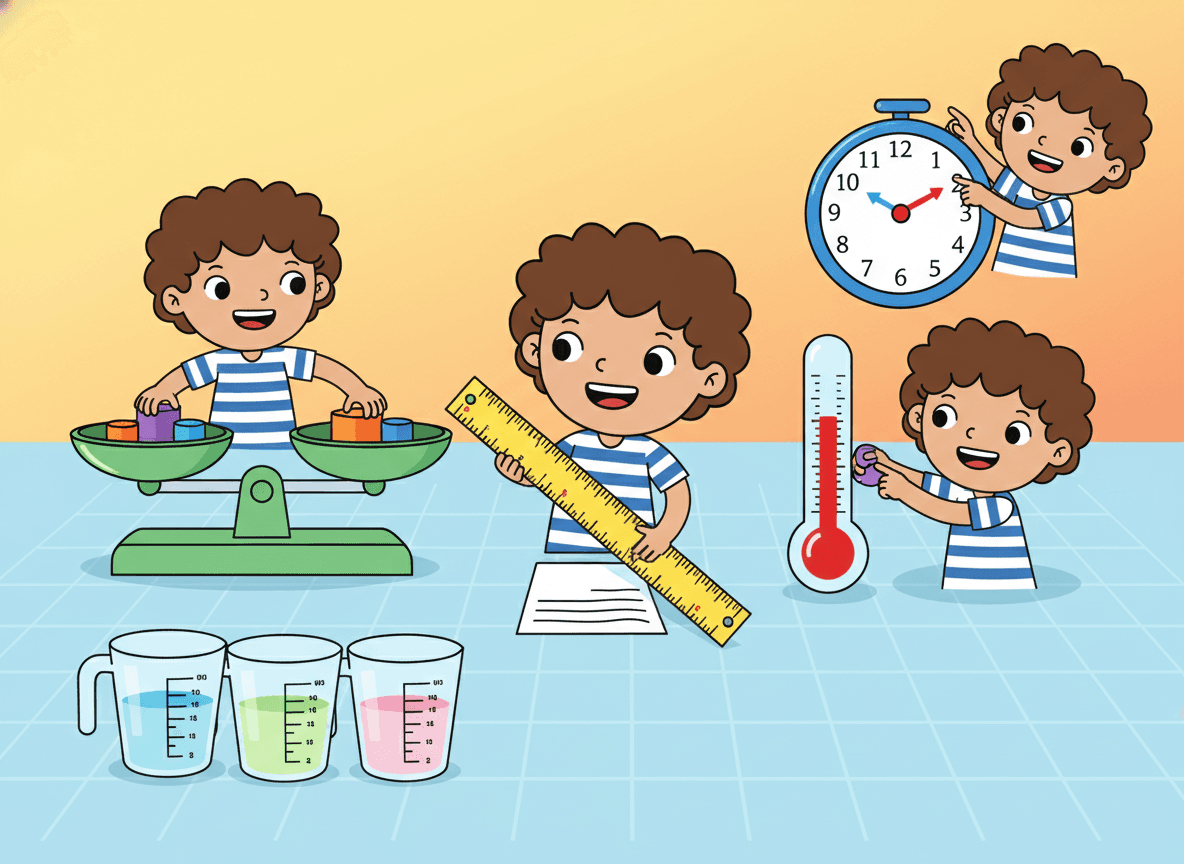
Length and distance: Measuring how long, tall, wide, or far. Tools: rulers, measuring tapes, yardsticks. Units: inches, feet, yards (customary); centimeters, meters (metric).
Weight and mass: How heavy something is. Tools: balance scales, bathroom scales. Units: ounces, pounds (customary); grams, kilograms (metric).
Capacity and volume: How much liquid a container holds. Tools: measuring cups, graduated cylinders. Units: cups, pints, quarts, gallons; milliliters, liters.
Temperature: How hot or cold. Tools: thermometer. Units: degrees Fahrenheit (°F) and Celsius (°C).
Time: Duration and sequence of events. Tools: clocks, calendars, stopwatches. Units: seconds, minutes, hours, days, weeks, months, years.
Area and perimeter (3rd–4th grade): How much space a flat shape covers, and the distance around its edge.
What Grade Do Kids Learn Measurement?
Kindergarten: Describe and compare measurable attributes (longer, shorter, heavier). Order three objects by size.
1st Grade: Order three objects by length. Express length in whole units using non-standard and standard units. Tell and write time to the hour and half-hour.
2nd Grade: Measure length to the nearest inch, foot, centimeter, and meter using rulers. Estimate lengths. Tell time to the nearest five minutes. Solve word problems involving dollar bills, quarters, dimes, nickels, and pennies.
3rd Grade: Measure and estimate liquid volumes and masses. Solve one-step word problems involving measurement. Tell and write time to the nearest minute.
4th Grade: Convert between units within the same system (feet to inches, kilograms to grams). Solve measurement word problems involving fractions and decimals.
Common Misconceptions
"Line up the ruler with the end of the object." Many kids line up the end of the ruler (which is often not at the zero mark) rather than the zero. Teaching kids to find the 0 mark and align it to the start of the object is a basic but essential procedural step.
"Bigger units always give bigger numbers." The opposite is true. A book that is 9 inches long is only about 23 centimeters - bigger unit (inch vs. centimeter) gives smaller number. This counterintuitive relationship needs explicit attention.
"Measurement has to be exact." Estimation is a legitimate and valuable measurement skill. Real-world measurement always involves some degree of approximation.
How to Teach Measurement
Start with non-standard units. Measure the desk with paper clips, the hallway with footsteps. This builds the concept of a unit before introducing standard tools.
Use real rulers with real objects. Kids need extensive hands-on practice measuring actual objects - not just worksheets with pre-drawn line segments.
Build benchmark awareness. "Find something in the room that is about 1 inch long. About 1 foot. About 1 meter." Benchmarks support estimation and measurement sense.
Estimate before measuring. Every measurement activity should include an estimate first. "How long do you think this book is? Now measure and check." This builds judgment.
Connect to real-world contexts. Cooking, building, comparing distances on maps. Measurement is one of the most immediately practical math skills.
Practice Activities
-
Measurement scavenger hunt: Find 5 objects longer than 6 inches, 5 shorter. Measure and record each.
-
Estimate-then-measure: List 8 objects. Estimate length, then measure. How close were the estimates?
-
Non-standard unit comparison: Measure the same object with different non-standard units (paperclips, cubes, hands). Discuss why the numbers differ.
-
Recipe math: Adjust a simple recipe for more or fewer servings - involves multiplying measurement quantities.
-
Benchmark body measures: How many of your hand spans equal one meter? How many of your steps equal one yard?
Frequently Asked Questions
What are the main types of measurement kids learn in elementary school?
Length/distance (inches, feet, yards, miles; centimeters, meters, kilometers). Weight/mass (ounces, pounds; grams, kilograms). Capacity/volume (cups, pints, quarts, gallons; milliliters, liters). Temperature (Fahrenheit and Celsius). Time (seconds, minutes, hours, days, weeks, months, years). Area and perimeter are introduced in 3rd grade as extensions of length measurement.
What is the difference between customary and metric units?
The US customary system uses units like inches, feet, pounds, and cups. The metric system uses units that increase by powers of 10: centimeters to meters (×100), grams to kilograms (×1000). Common Core requires students to learn both systems and convert between units within each system. Cross-system conversions (inches to centimeters) are not a K-5 standard.
Why is estimation important in measurement?
Estimation develops measurement sense - the ability to judge sizes and quantities without a measuring tool. A student who estimates before measuring learns to catch errors, develop spatial reasoning, and apply measurement flexibly. An answer of '47 feet' for the height of a classroom wall is a sign that a student measured incorrectly and lacked the estimation skill to notice.
What is a benchmark in measurement?
A benchmark is a familiar reference object or quantity used for estimation. Examples: a fingernail is about 1 centimeter wide. A doorway is about 2 meters tall. A paperclip weighs about 1 gram. A liter is close to a quart. Kids who build a library of benchmarks can estimate in real-world contexts without a ruler.
When do kids learn to convert units?
Unit conversion within the same system begins in 4th grade. Students convert larger units to smaller (feet to inches: multiply by 12) and smaller to larger (centimeters to meters: divide by 100). 5th grade extends this. For context, the focus in K-3 is on measuring accurately and understanding what units mean - not converting between them.
Free Measurement Worksheets
Curriculum-aligned printable worksheets for Kindergarten – 4th Grade. Download free.