What Is Area?
Taught in US schools
Key Takeaways
- Area measures the flat space inside a shape, always expressed in square units.
- Area of a rectangle = length × width. This is the foundational formula.
- Area is deeply connected to multiplication - an array model of multiplication is the same as finding area.
- Irregular shapes can be found by decomposing into rectangles.
Area is one of those concepts where the formula (length × width) is easy to memorize but the understanding often stays shallow. Kids who truly get area can find it without a formula, recognize why the formula works, and connect it to multiplication. That depth is worth the instructional investment.
What Is Area?
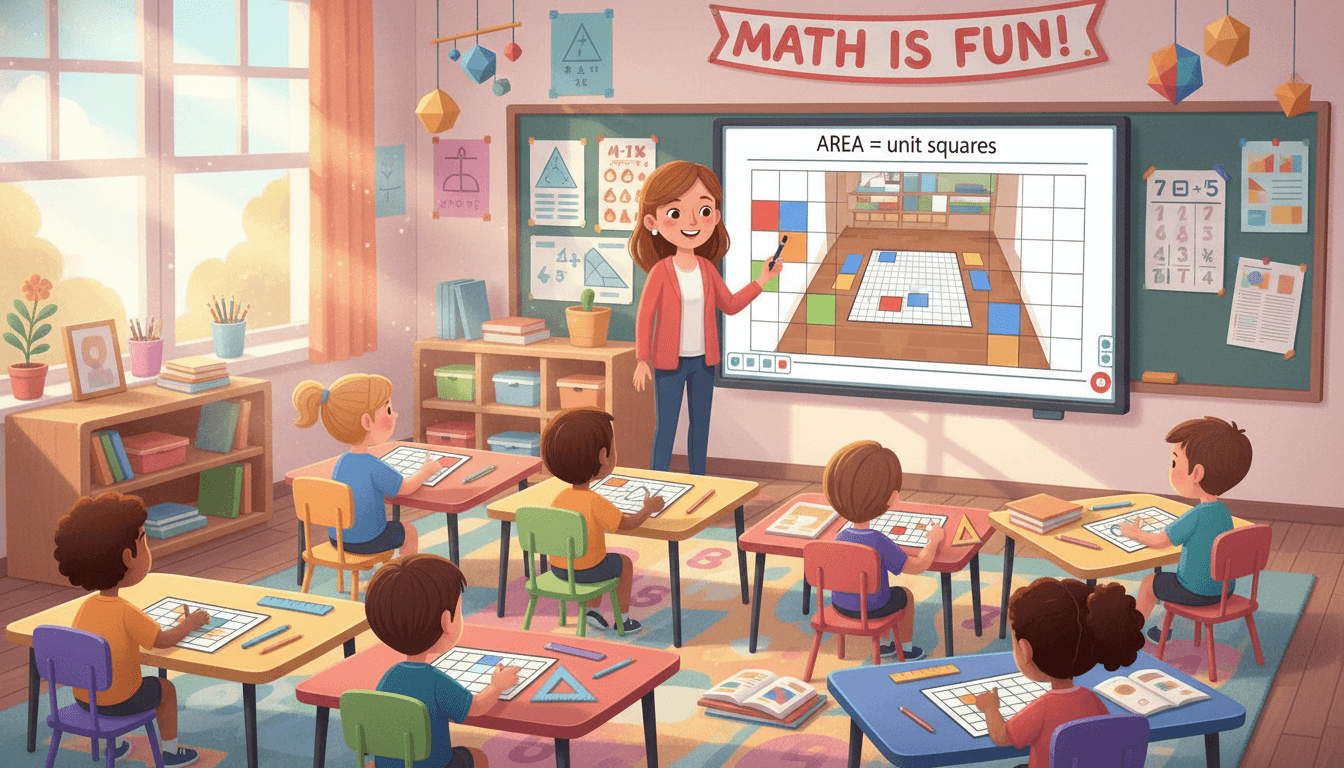
Area is the amount of flat space inside a two-dimensional shape, measured in square units.
Think of it as covering a floor with tiles. If your kitchen floor is 8 feet by 6 feet, and you cover it with 1-foot square tiles, you need 48 tiles. The area is 48 square feet.
Key vocabulary:
-
Square units: the unit of area - square inches, square feet, square centimeters, square meters
-
Length and width: the two dimensions of a rectangle
-
Decompose: break an irregular shape into smaller rectangles to find each piece's area
Area of a Rectangle
The formula: Area = length × width
A rectangle 7 cm long and 4 cm wide: Area = 7 × 4 = 28 square centimeters (written as 28 cm²).
Why does this formula work? Picture the rectangle as an array. 7 columns of 4 squares each = 28 squares total. The formula is just a compact way to count the unit squares filling the shape.
This connection to multiplication is why Common Core introduces area in the same year as multiplication (3rd grade) - they reinforce each other.
What Grade Do Kids Learn Area?
3rd Grade: Concept of area as unit-square coverage. Count unit squares to find area. Area of rectangles using l×w. Relate area to multiplication.
4th Grade: Apply A = l×w to solve real-world problems. Find area of rectilinear figures (irregular shapes made of right angles) by decomposing into rectangles.
5th Grade: Area of rectangles with fractional side lengths. Find area of figures on a coordinate plane.
Common Misconceptions
"Area and perimeter are the same thing." They're measuring entirely different things. Area = inside (square units). Perimeter = distance around (linear units). A 3×12 rectangle and a 6×6 square both have a perimeter of 30, but their areas are 36 vs. 36 - wait, those are equal too in this case. Give kids examples where both differ to break the assumption.
"Forgetting the 'square' in the unit." "The area is 15" is incomplete. "The area is 15 square inches" is correct. The square unit is not optional notation.
"You can only use area for rectangles." Any closed shape has area. Other shapes require other formulas (or decomposition), but the concept applies everywhere.
How to Teach Area
Cover before calculating. Have kids physically cover shapes with unit squares (sticky notes, tiles, graph paper). Counting squares before using the formula grounds the concept.
Draw arrays. Show that a 4×6 rectangle filled with a grid is the same as the 4×6 multiplication array. Area and multiplication are the same structure.
Decompose irregular shapes. Draw an L-shaped room. "How do we find the area?" Split into two rectangles, find each area, add. This is how area works in real buildings.
Compare area and perimeter explicitly. Give students a set of rectangles with equal perimeters but different areas (and vice versa). The contrast clarifies both concepts.
Practice Activities
-
Tile a shape: Use 1-inch square tiles or graph paper to cover a given shape. Count the tiles. Then verify with multiplication.
-
Design a room: Given an area budget (no more than 24 square units), design as many different rectangular rooms as possible. Compare dimensions.
-
Area vs. perimeter sort: Cards showing rectangles with their measurements - sort by whether the area or perimeter is larger (or which student would want for a given purpose).
-
L-shape area: Draw irregular shapes on grid paper. Find the area by decomposing into rectangles.
-
Real-world measurement: Measure a rug, a table, or a window and calculate its area.
Frequently Asked Questions
What are square units and why do we use them?
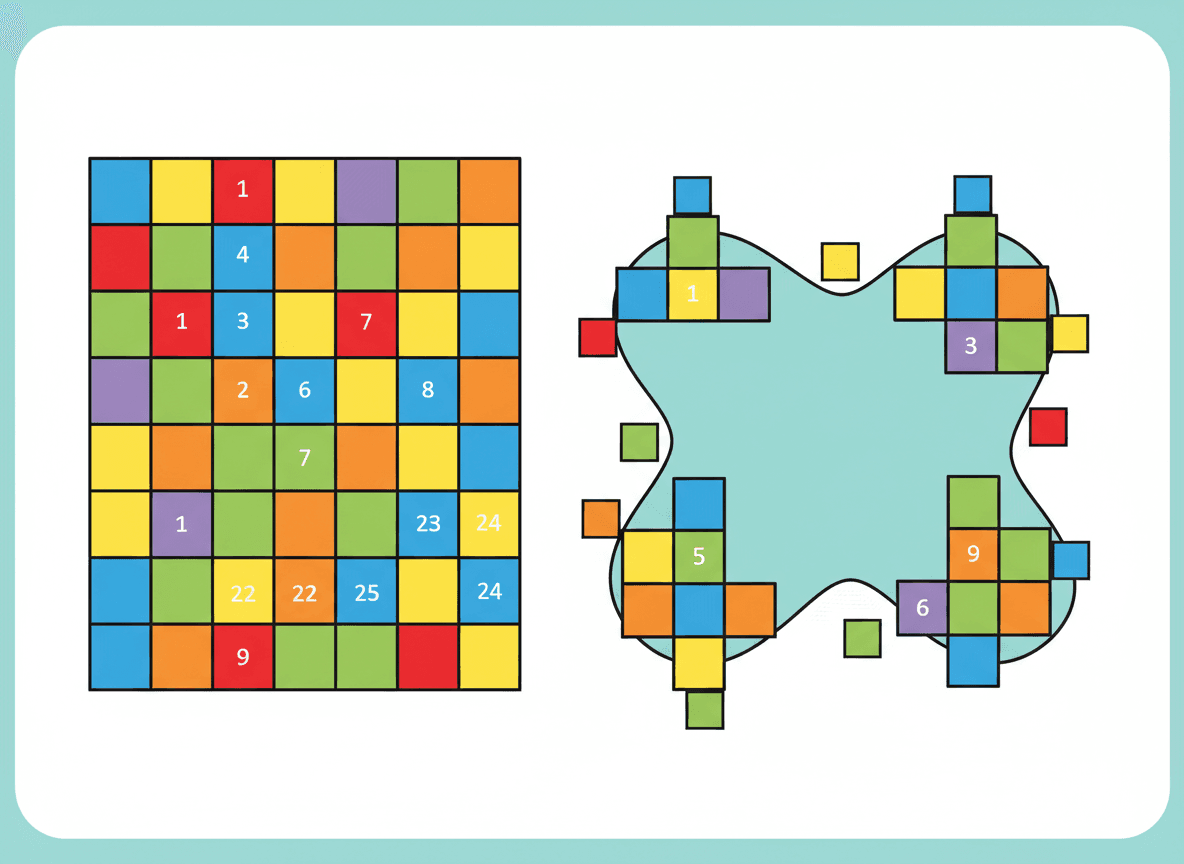
Area is measured in square units because we're covering a flat surface with unit squares. A square inch is a 1×1 inch square. A square centimeter is a 1×1 cm square. If 12 unit squares exactly cover a shape, its area is 12 square units. The word 'square' isn't optional - 12 inches is a length, but 12 square inches is an area. Many students forget the 'square' and need repeated reminders.
What is the formula for the area of a rectangle?
Area = length × width (A = l × w). A rectangle 5 units long and 3 units wide has an area of 15 square units. This formula is connected to multiplication: a 5×3 rectangle is a 5×3 array - the same visual used to teach multiplication in 2nd and 3rd grade. Common Core introduces area in 3rd grade, right alongside multiplication, to reinforce this connection.
What's the difference between area and perimeter?
Area is the space inside a shape (measured in square units). Perimeter is the total distance around the outside of a shape (measured in regular units like inches or centimeters). Common confusion: kids think bigger perimeter always means bigger area. It doesn't - a long, thin rectangle can have a large perimeter and small area, while a compact square with the same perimeter has a larger area. This counterintuitive relationship is worth exploring explicitly.
How do you find the area of irregular shapes?
Decompose the shape into rectangles, find the area of each, then add. A staircase shape can be split into two or three rectangles. More advanced: use the 'grid counting' method - overlay a grid and count full squares plus estimate partial squares. In 5th grade, students find the area of shapes with fractional side lengths using the same l×w formula.
When do kids learn other area formulas (triangles, circles)?
The triangle area formula (A = ½bh) and parallelogram formula (A = bh) are typically 6th grade standards. Circles (A = πr²) are also middle school. K-5 focuses almost entirely on rectangles and rectilinear figures (shapes made of right angles). The conceptual work done in 3rd-5th grade prepares students for these formulas by grounding area in the idea of square unit coverage.
Free Area Worksheets
Curriculum-aligned printable worksheets for 3rd – 5th Grade. Download free.