What Is Perimeter?
Taught in US schools
Key Takeaways
- Perimeter is the distance around the outside of a shape - add up all the side lengths.
- For a rectangle: P = 2l + 2w (or P = 2(l+w)).
- Perimeter is measured in regular linear units (inches, feet, cm) - not square units.
- Perimeter and area are often confused; remember: perimeter is the fence, area is the lawn.
What Is Perimeter?
Perimeter is the total distance around the outside of a two-dimensional shape.
To find the perimeter of any polygon: add up all the side lengths.
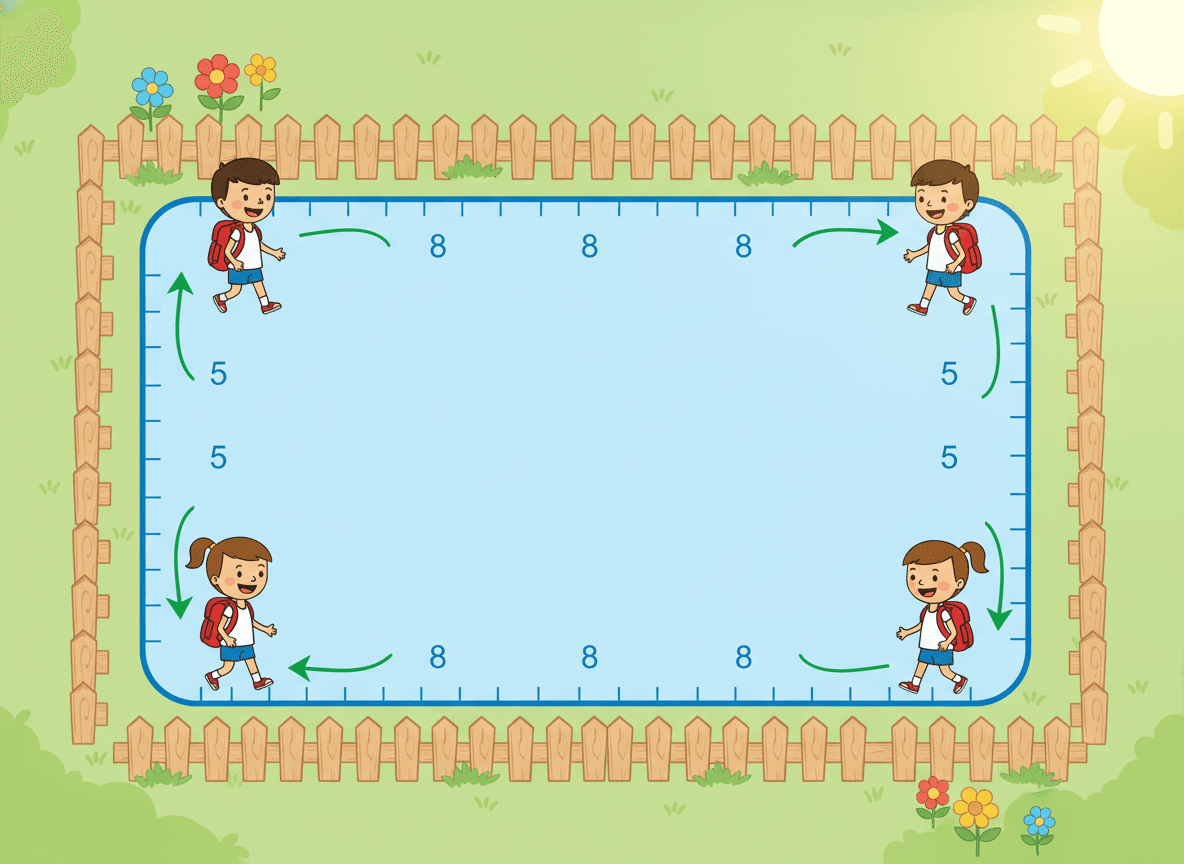
A rectangle with length 6 cm and width 4 cm: P = 6+4+6+4 = 20 cm.
The perimeter of a rectangle formula: P = 2l + 2w (because opposite sides are equal).
Units: Linear, Not Square
An important distinction: perimeter is measured in regular linear units (inches, centimeters, feet), not square units. You're measuring a distance - how far you'd walk if you traced the outside of a shape.
Area uses square units because you're covering a flat space. Perimeter uses regular units because you're measuring a path.
Memory device: Perimeter is the fence around the yard (a line). Area is how much grass is in the yard (a surface).
What Grade Do Kids Learn Perimeter?
3rd Grade: Find the perimeter of polygons by adding side lengths. Recognize rectangles with the same perimeter can have different areas (and vice versa).
4th Grade: Apply the perimeter formula for rectangles. Solve real-world problems involving perimeter. Explore the relationship between perimeter and area.
Common Misconceptions
"Perimeter and area are the same concept." This is the most common confusion. Consistent use of different vocabulary, units, and analogies (fence vs. lawn) helps separate them.
"Count the squares around the edge for perimeter." On a grid, kids sometimes count corner squares twice. Remind them: perimeter counts distances (side lengths), not squares at corners.
"The perimeter formula only works for rectangles." True that P=2l+2w is specific to rectangles. For all other polygons, add every side individually.
How to Teach Perimeter
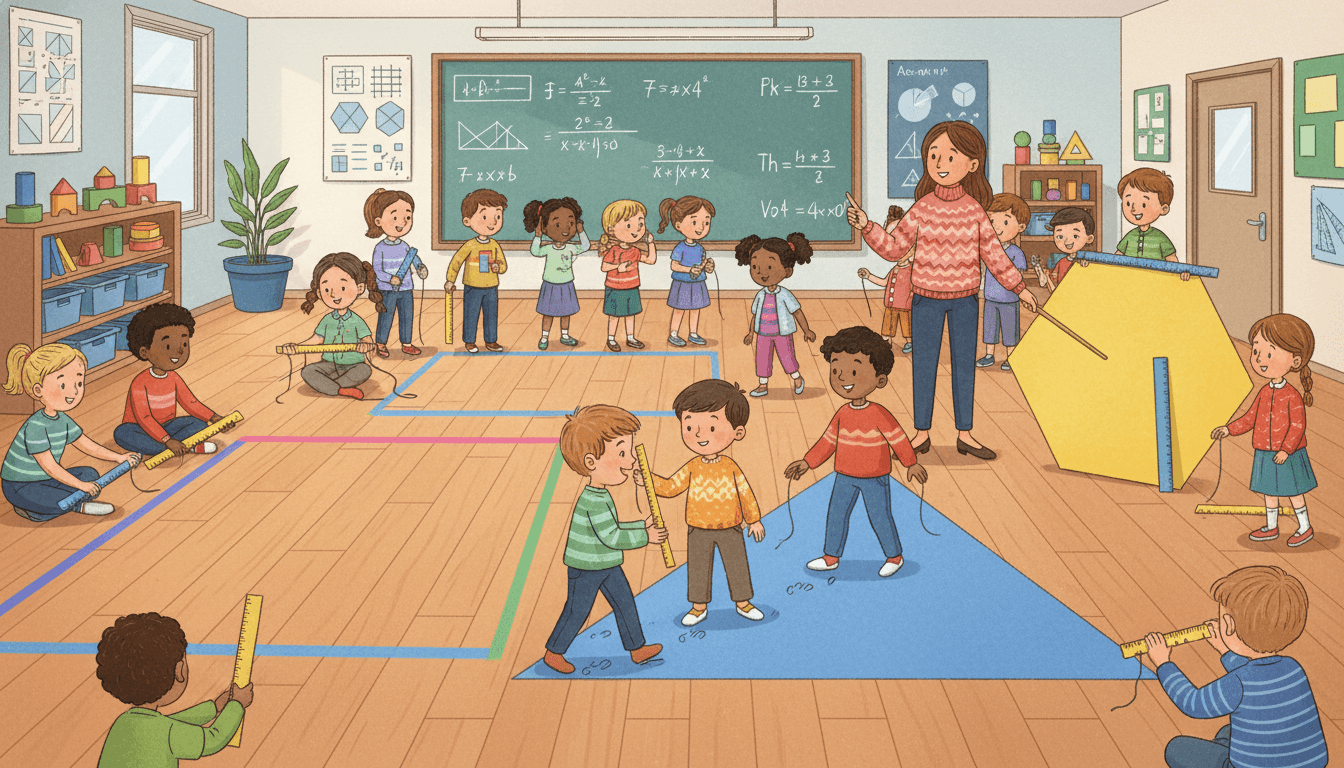
Trace the outline physically. Walk around the perimeter of the classroom. Roll a trundle wheel. Kids who have physically traced shapes understand perimeter as a path.
Use geoboards or graph paper. Create shapes and count unit lengths around the perimeter. Builds the "add all sides" concept before formulas.
Compare perimeter and area simultaneously. Create shapes with equal perimeters and ask: do they have the same area? Create shapes with equal areas: do they have the same perimeter?
Practice Activities
-
Perimeter walk: Measure the classroom perimeter using a measuring tape. Express in feet and inches.
-
Geoboard shapes: Create shapes on a geoboard. Count side lengths to find perimeter.
-
Same perimeter, different area: On grid paper, draw 5 different rectangles all with perimeter 20. Calculate the area of each. Which is largest?
-
Missing side problems: Give all side lengths except one, plus the total perimeter. Find the missing side.
-
Fencing problems: "A garden is 12 feet by 8 feet. How much fencing do you need?" Real context for perimeter.
Frequently Asked Questions
How do you find the perimeter of any polygon?
Add up the lengths of all sides. For a triangle with sides 4, 5, and 6 inches: P = 4+5+6 = 15 inches. For a rectangle with length 8 and width 3: P = 8+3+8+3 = 22 (or use P = 2l+2w = 2×8+2×3 = 22). For irregular shapes: measure every side and add them all.
What is the formula for the perimeter of a rectangle?
P = 2l + 2w, or equivalently P = 2(l+w). Since opposite sides of a rectangle are equal, you just need the length and width. A rectangle 10 cm long and 4 cm wide: P = 2(10)+2(4) = 20+8 = 28 cm. Kids sometimes forget to double the sides - emphasizing 'add all four sides' alongside the formula helps.
How is perimeter different from area?
Perimeter is the distance around the border of a shape (linear units: inches, feet, cm). Area is the space inside the shape (square units: square inches, square feet, square cm). A helpful analogy: perimeter is the length of fence you need to enclose a yard. Area is how much grass is inside the fence. They measure completely different things with different units.
Can two shapes have the same perimeter but different areas?
Yes - and this is a key insight for 4th grade. A 1×9 rectangle has perimeter 20 and area 9. A 4×6 rectangle also has perimeter 20 but area 24. A 5×5 square has perimeter 20 but area 25. Among all rectangles with the same perimeter, the square has the largest area. This relationship between shape efficiency and area is an important 4th grade mathematical concept.
When do kids learn perimeter?
Perimeter is introduced in 3rd grade alongside area. Students first add all sides, then learn the shortcut formulas for rectangles. 4th grade applies perimeter to word problems and explores the relationship between perimeter and area.
Free Perimeter Worksheets
Curriculum-aligned printable worksheets for 3rd – 4th Grade. Download free.