What Is Geometry?
Taught in US schools
Key Takeaways
- Geometry covers shapes, properties, spatial reasoning, angles, area, and coordinate grids.
- 2D shapes (flat) and 3D shapes (solid) are both studied, starting with naming and progressing to properties.
- Angles are introduced in 4th grade as a measurable property; right, acute, and obtuse are the key types.
- The coordinate grid (introduced in 5th grade) connects geometry to algebra.
What Is Geometry?
Geometry is the area of mathematics that studies shapes, their properties, spatial relationships, and measurement. From naming a circle in kindergarten to plotting points on a coordinate grid in 5th grade, geometry builds spatial reasoning skills that students use throughout mathematics and science.
Two-Dimensional (2D) Shapes
2D shapes are flat - they have length and width but no depth.
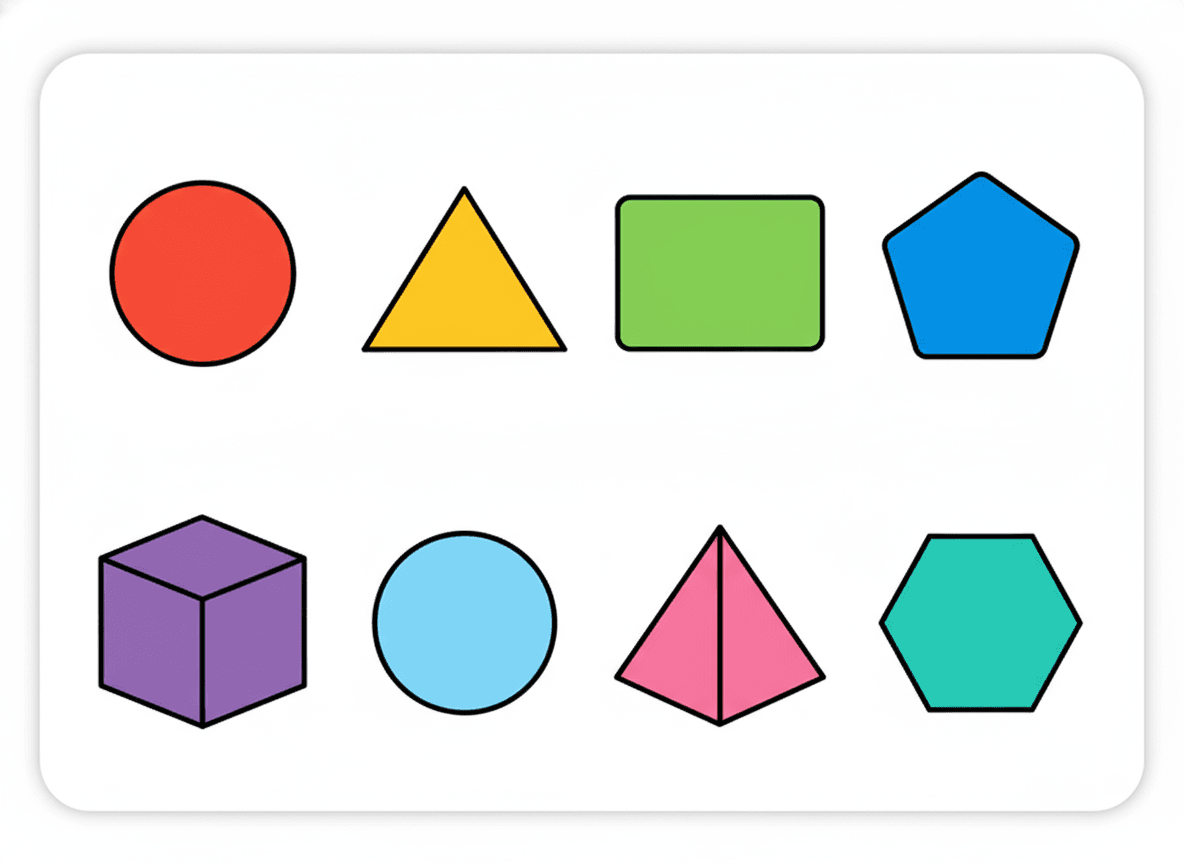
Basic shapes (K-2): Circle, triangle, square, rectangle, hexagon, rhombus, trapezoid.
Polygon attributes: Number of sides, number of angles/vertices (corners), whether sides are equal, whether angles are right angles.
Quadrilaterals (4-sided polygons): Rectangle, square, rhombus, parallelogram, trapezoid. In 5th grade, students understand the hierarchy - a square is a special rectangle, a rectangle is a special parallelogram.
Three-Dimensional (3D) Shapes
3D shapes have depth - they take up space.
Common 3D shapes: Cube, rectangular prism, cylinder, cone, sphere, pyramid.
Key vocabulary: Face (flat surface), edge (where two faces meet), vertex (corner where edges meet). A cube has 6 faces, 12 edges, and 8 vertices.
Angles
An angle is formed by two rays sharing a common endpoint (vertex).
-
Right angle: exactly 90° (marked with a small square)
-
Acute angle: less than 90°
-
Obtuse angle: greater than 90° but less than 180°
Angles are categorized in 3rd grade and measured with a protractor in 4th grade.
What Grade Do Kids Learn Geometry?
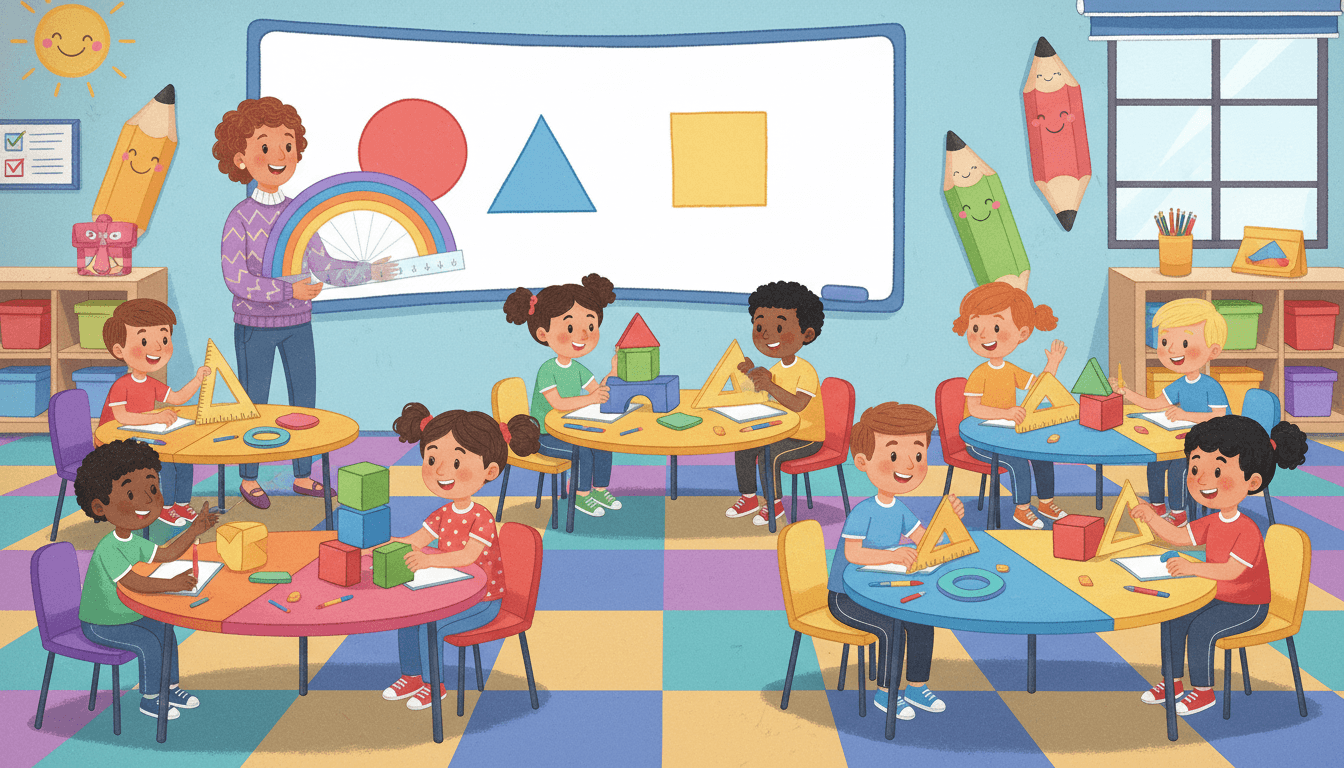
Kindergarten-1st: Naming and describing basic 2D and 3D shapes. Sorting shapes by attributes.
2nd Grade: Polygons by number of sides. Partitioning shapes into equal parts (connecting to fractions).
3rd Grade: Categorizing quadrilaterals by attributes. Area and perimeter.
4th Grade: Angles (measuring with a protractor), lines (parallel, perpendicular, line of symmetry), classification of geometric figures.
5th Grade: Classifying 2D figures in a hierarchy. Coordinate grid.
Common Misconceptions
"A square is not a rectangle." A square is a special rectangle (all sides equal). The hierarchical relationship takes explicit teaching - students benefit from seeing Venn diagrams of quadrilateral families.
"Shapes are defined by their orientation." A triangle tipped on its side or upside down is still a triangle. Varied orientations in examples prevent orientation-dependent thinking.
"All 4-sided shapes are squares." Kids often default to "square" for any quadrilateral. Regular exposure to rectangles, rhombuses, trapezoids, and irregular quadrilaterals expands the category.
Practice Activities
-
Shape sort: Sort shape cards by attribute - number of sides, type of angles, parallel sides.
-
3D shape explorer: Identify faces, edges, and vertices on real objects (tissue box, can, ice cream cone).
-
Angle hunt: Walk around the classroom finding right, acute, and obtuse angles in real objects.
-
Coordinate grid games: Plot points to create shapes or follow directions to a "treasure."
-
Shape hierarchy Venn diagrams: Show which shapes belong inside which categories.
Frequently Asked Questions
What shapes do kids learn in each grade?
Kindergarten: circles, squares, rectangles, triangles, hexagons; 3D: spheres, cubes, cylinders, cones. 1st grade: distinguishing shapes by attributes (sides, corners). 2nd grade: triangles, quadrilaterals, pentagons, hexagons; partitioning shapes into equal parts. 3rd grade: categorizing quadrilaterals; identifying attributes of polygons. 4th grade: lines, angles (right/acute/obtuse), symmetry, parallel and perpendicular lines. 5th grade: coordinate plane; classifying 2D figures in a hierarchy (squares are rectangles, rectangles are parallelograms, etc.).
What are the types of angles kids learn in elementary school?
Right angle: exactly 90°, like the corner of a square. Acute angle: less than 90°. Obtuse angle: greater than 90° but less than 180°. Straight angle: exactly 180° (a straight line). Reflex angle (>180°) is not a K-5 standard. Angles are first named by type in 3rd grade and formally measured with a protractor in 4th grade.
What is the difference between 2D and 3D shapes?
2D (two-dimensional) shapes are flat: circles, squares, triangles, rectangles. They have length and width but no depth. 3D (three-dimensional) shapes have length, width, AND depth (they take up space): cubes, spheres, cylinders, cones, prisms. 2D shapes make up the faces of 3D shapes - a cube has 6 square faces.
What are parallel and perpendicular lines?
Parallel lines run in the same direction and never intersect, no matter how far they extend - like railroad tracks or the two long sides of a rectangle. Perpendicular lines intersect at a right angle (90°) - like the corner of a square or the intersection of two roads. These are 4th grade vocabulary terms that connect to understanding quadrilaterals and later to coordinate grids.
What is the coordinate grid (coordinate plane)?
The coordinate grid is a two-dimensional grid formed by a horizontal axis (x) and a vertical axis (y) that cross at the origin (0,0). Points are located by ordered pairs (x, y): first move right/left along the x-axis, then up/down along the y-axis. The coordinate plane is introduced in 5th grade and becomes essential for graphing in middle school algebra.
Free Geometry Worksheets
Curriculum-aligned printable worksheets for Kindergarten – 5th Grade. Download free.