What Was the American Revolution?
Taught in US schools

Key Takeaways
- The American Revolution was fought from 1775 to 1783 between American colonists and Britain over taxation, representation, and self-governance.
- The Declaration of Independence, written primarily by Thomas Jefferson, was adopted on July 4, 1776, and declared the colonies free and independent states.
- The Revolution ended with the Treaty of Paris in 1783, in which Britain recognized the independence of the United States.
What Was the American Revolution?
The American Revolution (1775–1783) was the war in which 13 British colonies in North America fought for and won their independence from Great Britain, creating the United States of America. It was not just a military conflict - it was also a political revolution that introduced new ideas about democracy, individual rights, and self-government.
Causes: "No Taxation Without Representation"
After the French and Indian War (1754–1763), Britain was deeply in debt and began taxing the American colonies to help pay for it. Colonists were furious: they were being taxed by a Parliament in which they had no elected representatives.
Key events leading to revolution:
Stamp Act: 1765 - Tax on all printed materials; colonists boycotted
Boston Massacre: 1770 - British soldiers killed 5 colonists; outrage spread
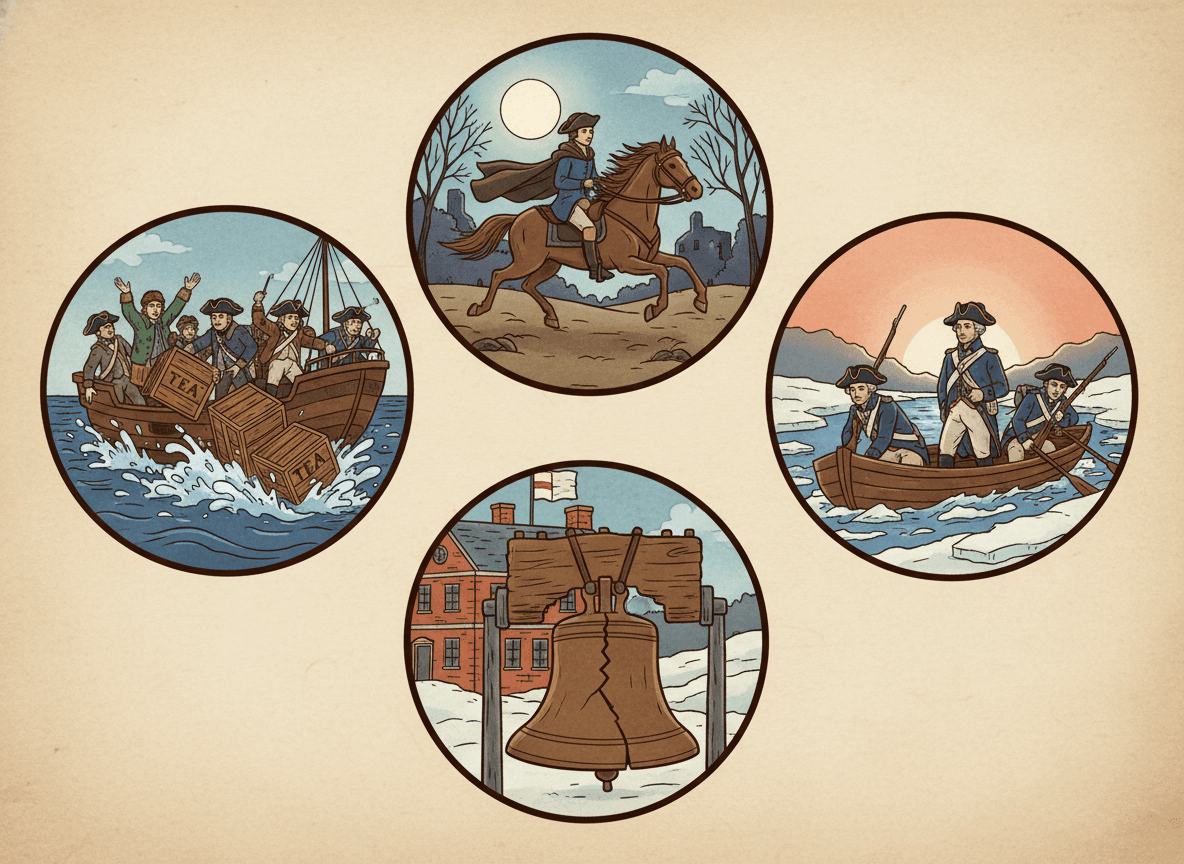
Boston Tea Party: 1773 - Colonists dumped 342 chests of British tea into Boston Harbor
Intolerable Acts: 1774 - Britain punished Massachusetts; united the colonies
Lexington and Concord: April 1775 - First shots of the Revolution fired
Key Events of the War
Lexington and Concord (1775)
On April 18, 1775, Paul Revere and William Dawes rode through the night to warn colonists that British troops were marching. The following day, "the shot heard 'round the world" was fired at Lexington, Massachusetts - and the Revolution began.
The Declaration of Independence (1776)
On July 4, 1776, the Continental Congress adopted the Declaration of Independence, primarily written by Thomas Jefferson. Its most famous lines:
"We hold these truths to be self-evident, that all men are created equal, that they are endowed by their Creator with certain unalienable Rights, that among these are Life, Liberty and the pursuit of Happiness."
Valley Forge (1777–1778)
Washington's army endured a brutal winter at Valley Forge, Pennsylvania, with little food, inadequate clothing, and disease. About 2,000 soldiers died. Those who survived emerged as a disciplined, determined fighting force.
Yorktown (1781)
The last major battle of the Revolution. Washington and his French allies surrounded the British army under General Cornwallis at Yorktown, Virginia. After a siege of several weeks, Cornwallis surrendered on October 19, 1781, effectively ending the war.
The Treaty of Paris (1783)
The war formally ended with the Treaty of Paris, signed September 3, 1783. Britain recognized the independence of the United States and ceded territory east of the Mississippi River to the new nation.
Key Figures
-
George Washington - Commander-in-Chief; future first president
-
Thomas Jefferson - Author of the Declaration of Independence
-
Benjamin Franklin - Diplomat; secured crucial French military alliance
-
John Adams - Advocate for independence; future second president
-
Paul Revere - Silversmith; famous midnight rider
Practice Activities
-
Cause-and-effect chart: Students identify three causes of the Revolution and trace each to its effect.
-
Declaration analysis: Read the Preamble to the Declaration; underline words related to rights and freedom.
-
Revolution timeline: Create an illustrated timeline from the Stamp Act (1765) to the Treaty of Paris (1783).
-
Key figures research: Each student researches one founding figure and presents a 3-minute biography.
-
Debate: Should the colonists have sought independence? Students argue both the Loyalist and Patriot sides.
Frequently Asked Questions
What caused the American Revolution?
The main cause was the colonists' anger over British taxation without colonial representation in Parliament ('no taxation without representation'). Key flashpoints included the Stamp Act (1765), the Townshend Acts (1767), the Boston Massacre (1770), and the Boston Tea Party (1773), when colonists dumped British tea into Boston Harbor to protest a tea tax.
What is the Declaration of Independence?
The Declaration of Independence is the document adopted by the Continental Congress on July 4, 1776, formally announcing that the 13 colonies were independent from Britain. Written primarily by Thomas Jefferson, it declared that all men are created equal and have rights to life, liberty, and the pursuit of happiness that governments cannot take away.
Who were the key figures of the American Revolution?
Key figures include George Washington (Commander of the Continental Army), Thomas Jefferson (author of the Declaration of Independence), Benjamin Franklin (diplomat who secured French support), John Adams (advocate for independence), Paul Revere (midnight rider who warned of British advance), and Abigail Adams (influential voice for women's rights during the Revolution).
Free American Revolution Worksheets
Curriculum-aligned printable worksheets for 4th – 5th Grade. Download free.