What Is Bloom's Taxonomy?
Taught in US schools

Key Takeaways
- Bloom's Taxonomy classifies thinking skills from lower-order (Remember, Understand) to higher-order (Analyze, Evaluate, Create).
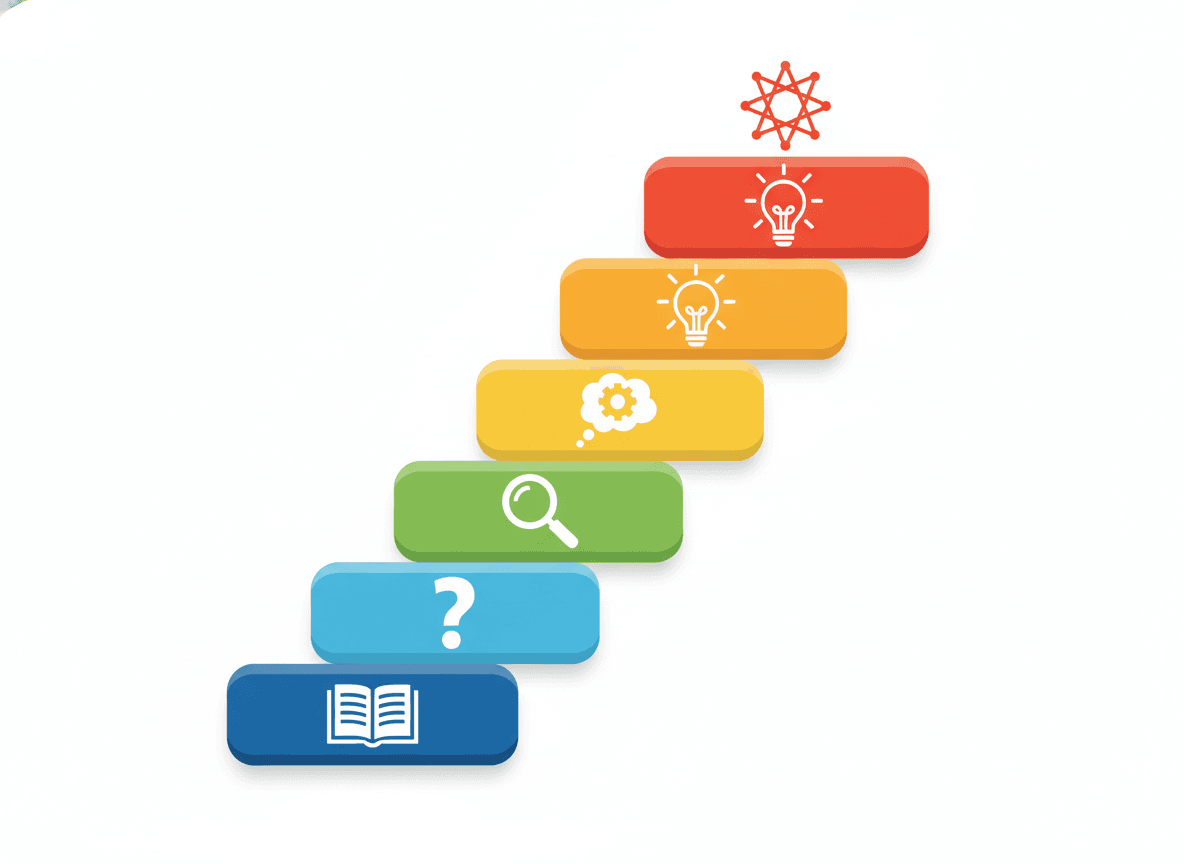
- The Revised Bloom's Taxonomy (2001) uses six levels: Remember, Understand, Apply, Analyze, Evaluate, and Create - with Create at the top.
- Teachers use Bloom's to write learning objectives, craft higher-order questions, and design tasks that push beyond surface-level recall.
What Is Bloom's Taxonomy?
Bloom's Taxonomy is a hierarchical framework for classifying educational learning objectives by the level of cognitive complexity they require. It helps teachers write clear learning goals, design meaningful activities, and ask questions that promote deep thinking rather than surface-level recall.
The original taxonomy was developed by educational psychologist Benjamin Bloom and colleagues in 1956. It was revised in 2001 by Anderson, Krathwohl, and others, and the revised version is the one most commonly used in classrooms today.
The Six Levels of the Revised Bloom's Taxonomy
The revised taxonomy moves from lower-order thinking at the base to higher-order thinking at the top:
1. Remember: Recall facts and basic concepts - define, list, name, identify, recite
2. Understand: Explain ideas in your own words - explain, summarize, describe, paraphrase
3. Apply: Use knowledge in a new situation - use, solve, demonstrate, illustrate
4. Analyze: Break information into parts, find relationships - compare, contrast, examine, classify
5. Evaluate: Make judgments based on criteria - judge, argue, defend, critique, assess
6. Create: Produce something new - design, build, compose, invent, write
Lower-Order vs. Higher-Order Thinking
Remember, Understand, Apply: Analyze, Evaluate, Create
Recall and replicate: Reason and produce
Necessary foundation: Ultimate goal LOTS build the knowledge base. HOTS require students to do something with that knowledge - connect it, question it, extend it, or use it to create something new.
Writing Learning Objectives with Bloom's
A strong learning objective includes a specific, observable verb from Bloom's. Compare:
"Students will know about fractions.": "Students will compare equivalent fractions using models." (Analyze)
"Students will learn about Rosa Parks.": "Students will evaluate Rosa Parks's impact on the Civil Rights Movement." (Evaluate) The verb tells you - and students - exactly what kind of thinking is required.
Bloom's Question Stems by Level
Remember: "What is the definition of...?" / "Name three..."
Understand: "Explain in your own words..." / "What is the main idea of...?"
Apply: "Use what you know to solve..." / "How would you show that...?"
Analyze: "What is the difference between...?" / "How does this connect to...?"
Evaluate: "Do you agree with...? Why?" / "Which solution is better and why?"
Create: "Design a..." / "What would happen if...?" / "Compose your own..."
Using Bloom's in the Classroom
Assessment: Exit tickets that ask students to summarize (Understand) or explain how they'd solve a similar problem (Apply) check deeper understanding than simple recall.
Discussion questions: Bloom's helps teachers move beyond "what happened?" (Remember) to "why did it happen?" (Analyze) and "what should have been done instead?" (Evaluate).
Task design: A worksheet that only asks students to list vocabulary (Remember) can be upgraded with an added activity asking students to write a sentence using the words in context (Apply) or compare two terms (Analyze).
Practice Activities
- Give teachers a set of sample questions about a text and have them sort by Bloom's level - then rewrite a lower-level question at the Analyze or Evaluate level.
- Use the "Question Ladders" activity: students write one question about a topic at each of the six levels.
- Design a project rubric where each section of the project targets a different level of Bloom's.
- Plan a lesson where each activity moves up one level - start with identifying (Remember), move to explaining (Understand), then apply in a new context.
- Share Bloom's question stems with students and have them generate their own higher-order questions about a book they've read.
Frequently Asked Questions
What is the difference between the original and revised Bloom's Taxonomy?
Benjamin Bloom's original taxonomy (1956) had six levels using nouns: Knowledge, Comprehension, Application, Analysis, Synthesis, Evaluation. The revised taxonomy (Anderson and Krathwohl, 2001) changed the names to action verbs and reordered the top two levels: Remember, Understand, Apply, Analyze, Evaluate, Create. 'Create' replaced 'Synthesis' and was moved to the highest level, reflecting the view that creating something new is the pinnacle of cognitive engagement.
What are higher-order thinking skills (HOTS)?
Higher-order thinking skills (HOTS) refer to the top three levels of Bloom's Taxonomy - Analyze, Evaluate, and Create. These require students to do more than recall or explain - they must break information apart (analyze), make judgments (evaluate), or produce something new (create). Lower-order thinking skills (LOTS) - Remember, Understand, Apply - build the foundation, but HOTS are the goal for deep learning.
What are some Bloom's question stems teachers can use?
Remember: 'What is...? List... Define...' Understand: 'Explain why... Describe... Summarize...' Apply: 'Use this concept to... Solve... Show how...' Analyze: 'What is the relationship between... Compare... Break down...' Evaluate: 'Judge whether... Defend your position... What would you recommend and why?' Create: 'Design... Compose... Invent... What would happen if...?'
Free Bloom's Taxonomy Worksheets
Curriculum-aligned printable worksheets for PreK – 5th Grade. Download free.