What Are Context Clues?
Taught in US schools
Key Takeaways
- Context clues are hints in surrounding text that help unlock the meaning of unknown words.
- Types: definition/restatement, synonym, antonym, example, and inference clues.
- Using context clues is a Strategy - not a passive guess - that can be explicitly taught.
- Context clues don't always give the exact meaning; sometimes they narrow it to 'approximately right.'
What Are Context Clues?
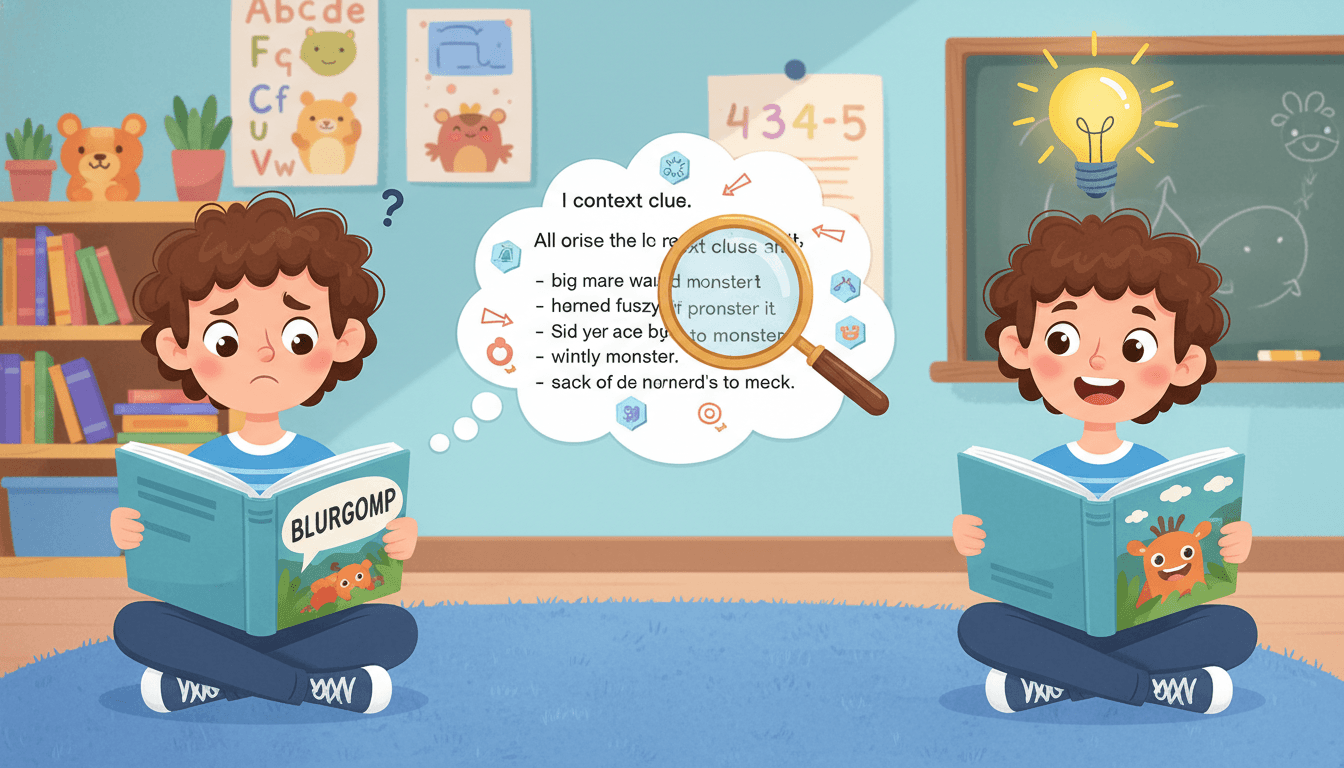
Context clues are hints within a text that help readers determine the meaning of an unfamiliar word.
Instead of stopping at an unknown word, a skilled reader:
- Keeps reading (or re-reads from before the word)
- Looks for clues in surrounding words and sentences
- Forms a hypothesis about the word's meaning
- Checks that the meaning makes sense in context
Context clues are the primary vocabulary strategy for independent reading - and the most teachable.
Types of Context Clues
Definition/Restatement: The text directly defines the word.
"The fauna, or animals, of the rainforest include thousands of species." Signal words: or, that is, which means, also known as
Synonym: A nearby word means roughly the same thing.
"The child was famished - starving after skipping lunch."
Antonym/Contrast: The opposite meaning is given nearby.
"Unlike her loquacious brother, Mia rarely spoke in class." Signal words: but, however, unlike, although, on the other hand
Example: Examples illustrate the word's meaning.
"Deciduous trees, such as oaks, maples, and elms, lose their leaves in fall." Signal words: such as, for example, for instance, like, including
Inference: The surrounding ideas allow the reader to reason out the meaning.
"The scientist scrutinized the sample, peering through the microscope for an hour before making any notes." (scrutinized = examined very carefully)
What Grade Do Kids Learn Context Clues?
2nd Grade: Use sentence-level context to help determine or clarify word meaning.
3rd Grade: Use context clues in text (definition, example, restatement) to determine word meaning; use signal words.
4th Grade: Use context clues at the sentence and paragraph level; explain reasoning for word choices.
5th Grade: Independently apply multiple types of context clues; recognize when context clues are insufficient and use reference tools.
Common Misconceptions
"Just look it up in the dictionary." Dictionary use is a separate skill. Context clues build the ability to sustain reading without breaking flow - essential for reading volume and fluency.
"Any guess about an unknown word is using context clues." Context clue use is strategic - it requires looking for specific types of clues, not just guessing randomly.
"Context clues always give the exact meaning." They give approximate or partial meaning. For technical terms, supplemental instruction is still needed.
Practice Activities
-
Underline and identify: Students circle unknown words, underline the context clue that helped them, and write what type of clue it was.
-
Signal word hunt: Give passages; students highlight signal words (or, for example, but) that indicate a context clue type.
-
Substitute and check: Write a trial definition in place of the unknown word and check if the sentence still makes sense.
-
Cloze activities: Passages with blanks; students use context to choose the correct word from 3 options.
-
Create-a-clue: Students write sentences for vocabulary words that include a specific type of context clue. Partner tries to infer the meaning.
Frequently Asked Questions
What are the main types of context clues?
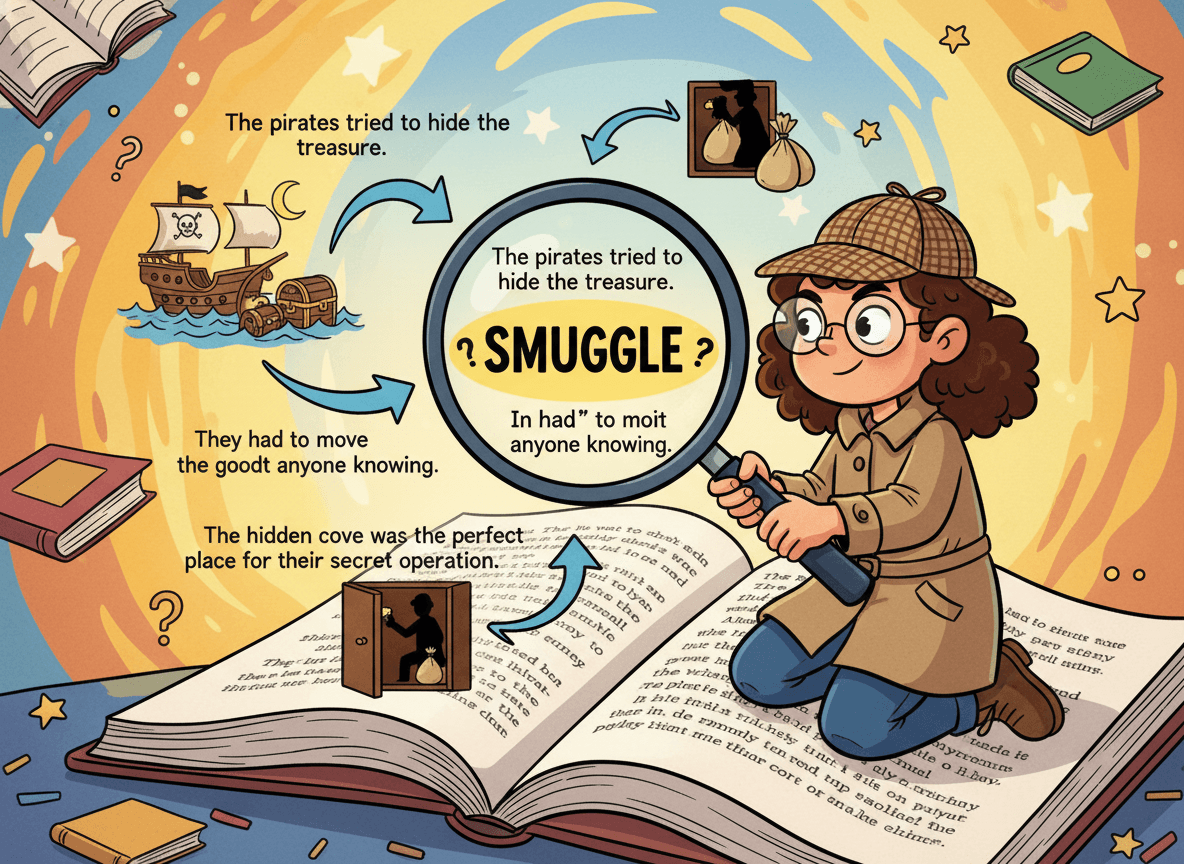
Definition/Restatement: the word is defined right in the sentence ('The arid, or extremely dry, climate made farming difficult'). Synonym clues: a nearby word with similar meaning ('She was parsimonious - always frugal with money'). Antonym/Contrast: the opposite is given ('Unlike his gregarious sister, Tom was shy'). Example clues: examples illustrate the meaning ('Citrus fruits, such as lemons, limes, and oranges, are high in vitamin C'). Inference clues: surrounding ideas allow the reader to reason out the meaning ('The detective scrutinized the note, reading each word three times, looking for any small detail she might have missed' → scrutinized means examined closely).
How do you teach students to use context clues?
Step 1: When you hit an unknown word, don't stop - keep reading to the end of the sentence. Step 2: Look backward and forward for clues: definitions, examples, restatements, signal words (or, for example, but, however). Step 3: Substitute a trial word that makes sense and reread. Step 4: Check: does the sentence still make sense? If not, try again. Practice with a think-aloud first so students see the reasoning process. Gradually transfer responsibility to students through scaffolded practice before independent application.
What signal words help identify context clues?
Definition/restatement signals: 'or,' 'that is,' 'which means,' 'in other words,' 'also known as.' Synonym signals: 'like,' 'also called,' 'similarly.' Antonym/contrast signals: 'but,' 'however,' 'unlike,' 'on the other hand,' 'although.' Example signals: 'for example,' 'for instance,' 'such as,' 'like.' Teaching these signal words gives students a concrete handle for noticing when context clues are present.
When are context clues NOT enough?
Context clues give approximate meaning but aren't always precise. For technical vocabulary (photosynthesis, denominator), context clues may hint at direction but a definition is still needed. For words with multiple meanings, context narrows which meaning applies but may not make it clear. Context clues are most effective for words students have heard orally but not seen in print, since background knowledge fills the gap. For genuinely unknown concepts, context clues are a starting point, not an endpoint.
How do context clues connect to vocabulary growth?
Most vocabulary is learned through wide reading - encountering words multiple times in varied contexts. Context clues are the mechanism that allows a reader to pick up words incidentally during independent reading. Students who can use context clues learn thousands more words over a school year than those who skip unfamiliar words or depend only on dictionary look-ups. However, instruction in how to use context clues is necessary - students who aren't explicitly taught the strategy often skip unfamiliar words entirely.
Free Context Clues Worksheets
Curriculum-aligned printable worksheets for 2nd – 5th Grade. Download free.