What Is Reading Comprehension?
Taught in US schools
Key Takeaways
- Reading comprehension is understanding the meaning of what you read - not just reading words aloud correctly.
- Comprehension depends on decoding (phonics), fluency, vocabulary, background knowledge, and active thinking strategies.
- Key strategies: predicting, questioning, visualizing, clarifying, summarizing, making connections, and inferring.
- The 'reading wars' debate (phonics vs. whole language) has mostly been resolved: strong phonics foundation + rich comprehension strategy instruction = best outcomes.
If decoding is learning the code, comprehension is using it to actually communicate. A child who can read every word on a page but can't tell you what happened, why a character acted a certain way, or what the author was trying to say - that child is not yet reading. They're decoding. Comprehension is the point of reading, and it's worth understanding in depth.
What Is Reading Comprehension?
Reading comprehension is the ability to understand, interpret, and make meaning from text.
It sounds obvious, but it's actually multi-layered. Comprehension involves:
- Understanding what words and sentences literally say (literal comprehension)
- Drawing conclusions the text implies but doesn't state directly (inferential comprehension)
- Evaluating, critiquing, or synthesizing what you read (critical and evaluative comprehension)
A fully comprehending reader does all three levels, often simultaneously.
The Components of Reading Comprehension
Comprehension doesn't come from one skill - it's the product of several working together:
Decoding: Reading words accurately. You can't comprehend text you can't read.
Fluency: Reading smoothly, at a reasonable pace, with appropriate expression. Fluency frees up cognitive capacity for meaning-making. A child laboring to decode every word has no mental energy left for comprehension.
Vocabulary: Knowing what words mean. You can decode a word perfectly and still not understand the sentence if you don't know what the word means.
Background knowledge: What you already know about a topic. Comprehension is dramatically easier when readers have context. A child who has never heard of the Underground Railroad will struggle to comprehend a passage about it no matter how fluently they read.
Active thinking strategies: Predicting, questioning, visualizing, summarizing, inferring, making connections. These are the mental moves skilled readers make almost automatically.
What Grade Do Kids Work on Reading Comprehension?
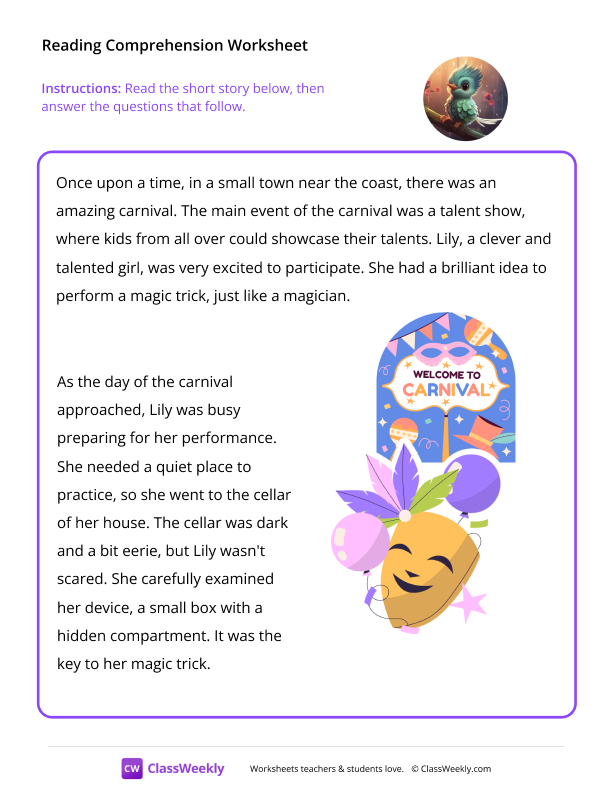
Kindergarten – 1st Grade: Answering basic literal questions about stories read aloud (who, what, where). Identifying characters, setting, and main events. Beginning to make predictions and connections.
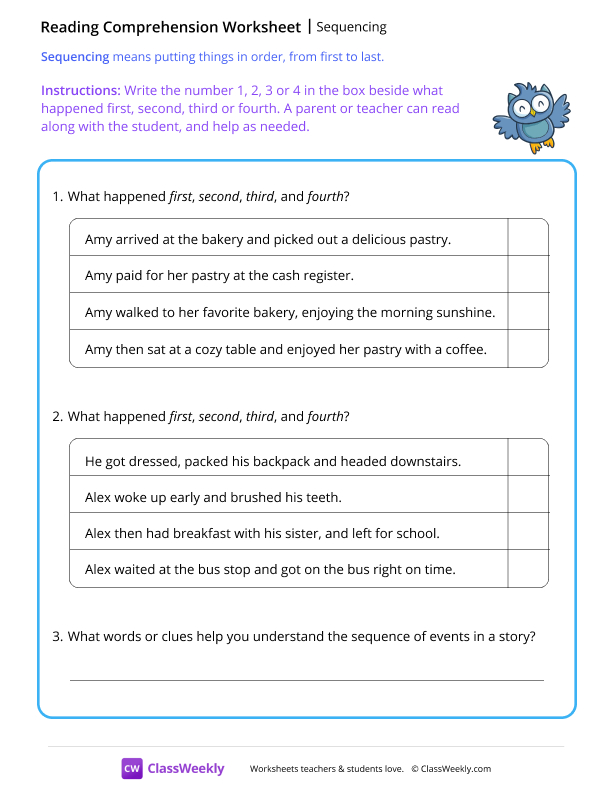
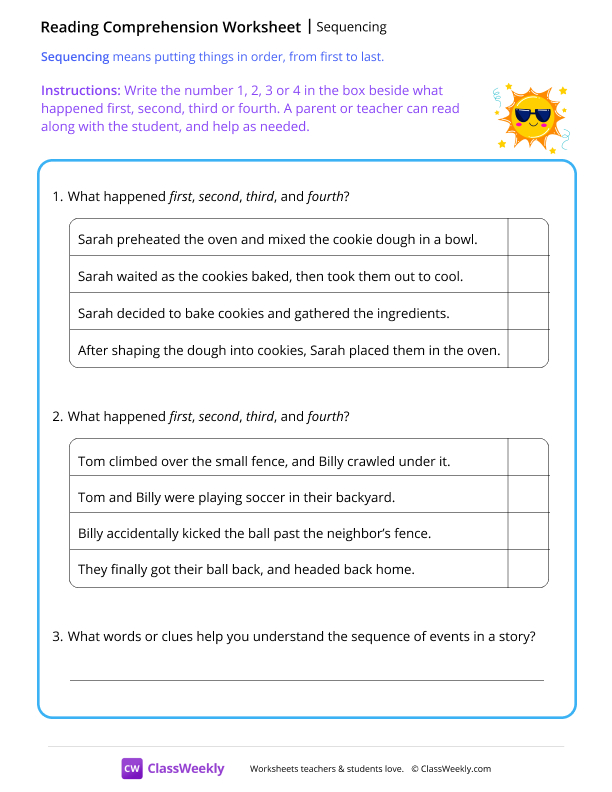
2nd Grade: Retelling stories with beginning, middle, and end. Main idea and key details in nonfiction. Making simple inferences. Text-to-self connections.
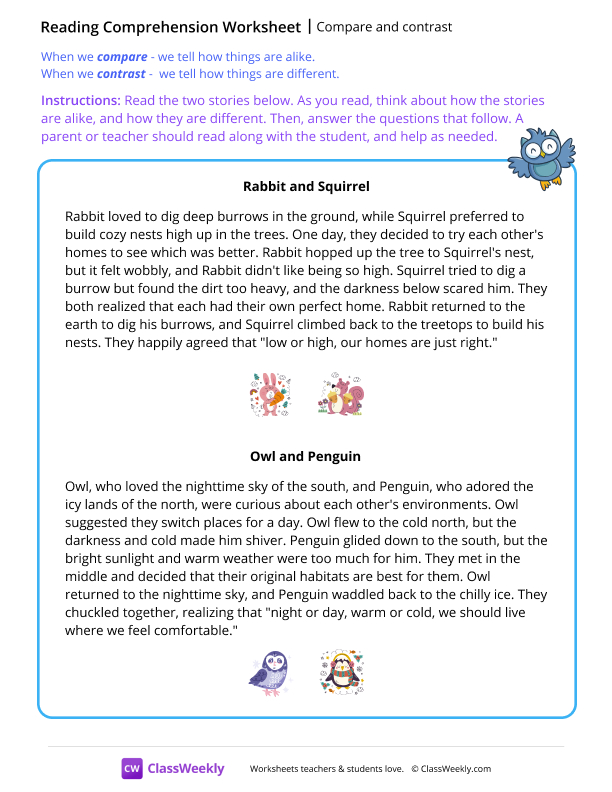
3rd Grade: Theme and central message. Point of view. Text structure in nonfiction (cause/effect, compare/contrast, problem/solution). Evidence-based responses in writing.
4th Grade: Inferential thinking from text evidence. Multiple texts on the same topic. Author's purpose and point of view. Figurative language (similes, metaphors, idioms).
5th Grade: Theme across texts. Synthesizing information from multiple sources. Analyzing how structure contributes to meaning. Critical evaluation of author's claims.
Core Comprehension Strategies
Before reading:
-
Predicting from title, cover, headings: "What might this be about?"
-
Setting purpose: "What am I trying to find out?"
-
Activating background knowledge: "What do I already know about this topic?"
During reading:
-
Questioning: Ask questions about confusing parts, predictions, and character motivations
-
Visualizing: Form mental images ("I can picture the forest the author is describing")
-
Clarifying: Notice when meaning breaks down and re-read or use context clues
After reading:
-
Summarizing: Main idea + key details. What was this really about?
-
Inferring: What was implied but not stated?
-
Making connections: Text-to-self (this reminds me of...), text-to-text (this is like...), text-to-world (this connects to what I know about...)
Common Misconceptions
"If a child reads aloud fluently, they comprehend." Not necessarily. Fluency (accurate, smooth, expressive oral reading) is necessary but not sufficient for comprehension. Always check understanding through retelling, questions, or written response.
"Reading comprehension is mainly about phonics." Phonics is essential for decoding, and decoding is a prerequisite for comprehension. But many children who decode well still struggle with comprehension due to vocabulary gaps or limited background knowledge. Comprehension has its own instructional needs beyond phonics.
"Comprehension strategies should be taught one at a time, in isolation." Research suggests that teaching a repertoire of strategies and helping kids know when and how to apply them is more effective than isolated strategy drills.
"Good readers just naturally comprehend." Skilled readers have internalized strategies that were once explicitly taught. Comprehension skills are learned, not innate.
How to Teach Reading Comprehension
Read aloud to kids even after they can read independently. Read-alouds build vocabulary, background knowledge, and expose kids to more complex text than they can read on their own. This feeds comprehension directly.
Think aloud while reading. Model your own comprehension process: "I'm confused here. Let me re-read that part." "I'm predicting that..." "The word 'reluctant' in this sentence probably means..."
Ask questions that require evidence. Not just "what happened?" but "how do you know? What in the text supports that?" This builds the habit of returning to the text.
Teach text structure. Narrative structure (beginning-middle-end, problem-solution) and nonfiction text structures (cause-effect, compare-contrast, description, sequence) help kids organize their understanding.
Build background knowledge broadly. Science, social studies, art, history - kids who know more about the world comprehend more text. Wide reading across topics is the long-term investment.
Discuss what kids read. Rich discussion - not quiz-style interrogation - is one of the most powerful comprehension tools. Kids who articulate their thinking to others deepen their own understanding.
Practice Activities
-
Story map: Character, setting, problem, events, solution. Organizes narrative comprehension.
-
Main idea / key details graphic organizer: Central idea in the middle, supporting details around it. Essential for nonfiction comprehension.
-
Turn-and-talk while reading: Pause and have students share a connection, question, or prediction with a partner.
-
Written summaries: Summarizing in writing is a powerful comprehension check - more revealing than oral answers.
-
Inference task cards: Provide a short passage with implied information; students write what the text suggests but doesn't state directly.
Frequently Asked Questions
What's the difference between decoding and reading comprehension?
Decoding is translating print to speech - sounding out or recognizing words. Comprehension is understanding the meaning of what those words say. A child can decode perfectly (read every word correctly aloud) without comprehending the text. Conversely, a fluent reader can lose comprehension if the vocabulary or concepts are unfamiliar. Both skills are necessary; neither alone is sufficient.
Why do some kids read words fine but still not understand what they read?
The Simple View of Reading (Gough & Tunmer, 1986) says: Reading Comprehension = Decoding × Language Comprehension. If either factor is near zero, comprehension is near zero. Kids who decode well but don't comprehend usually have a language comprehension gap - weak vocabulary, limited background knowledge, or underdeveloped listening comprehension. The fix isn't more phonics practice; it's rich vocabulary instruction, read-alouds, and building knowledge through science and social studies content.
What are the best reading comprehension strategies to teach?
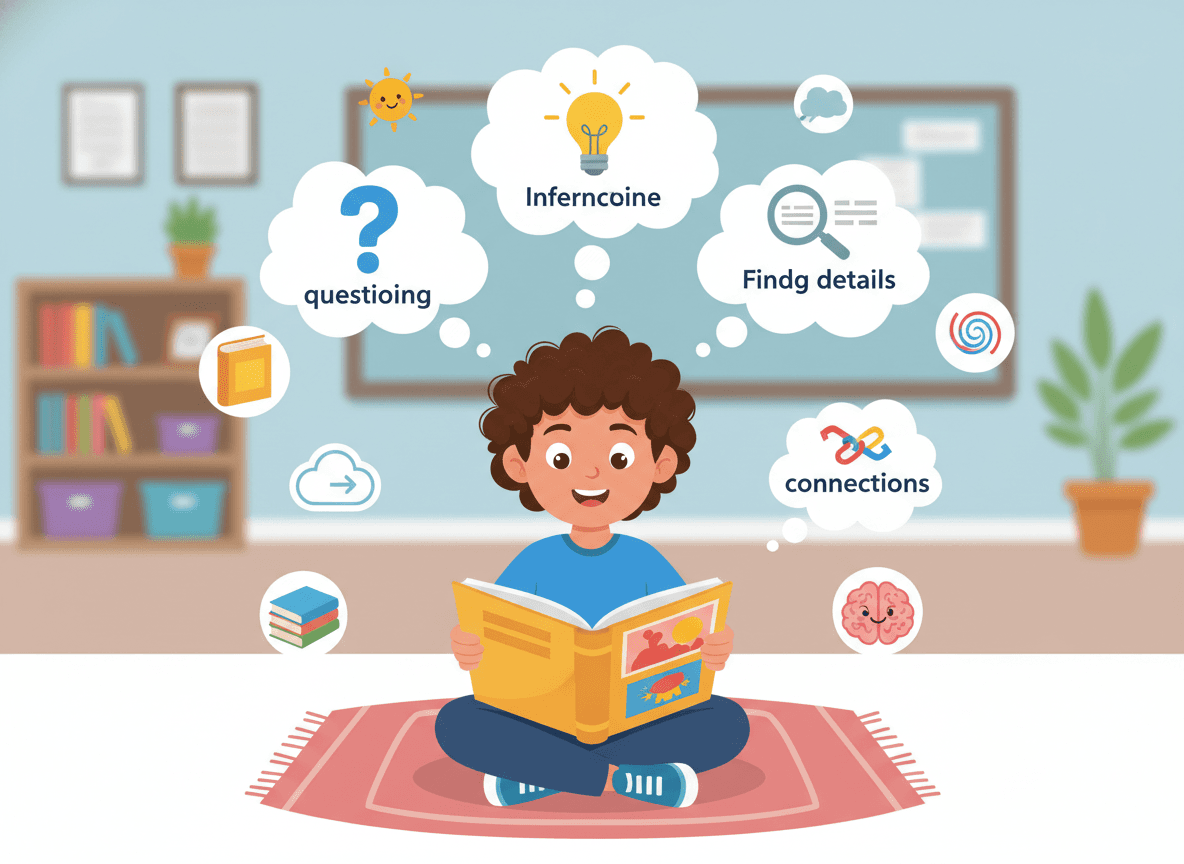
Research-backed strategies include: predicting (what will happen / what will the author say next?), questioning (asking questions before, during, and after reading), visualizing (forming mental images of the text), clarifying (identifying confusing parts and re-reading), summarizing (identifying the main idea and key details), making connections (text-to-self, text-to-text, text-to-world), and inferring (reading between the lines to understand unstated meaning). Most effective is explicit instruction in multiple strategies, then gradual release to independent use.
What is 'the Matthew effect' in reading?
The Matthew effect (named after the biblical passage 'the rich get richer') describes how early reading skill differences compound over time. Kids who read well in early elementary read more, build more vocabulary and background knowledge, and become even better readers. Kids who struggle early read less, fall further behind in vocabulary and knowledge, and face increasing comprehension challenges. This is why early intervention matters: reading gaps that look small in 1st grade can become enormous by 4th grade.
How can parents support reading comprehension at home?
Read aloud every day, even to older kids. Ask questions while reading: 'What do you think will happen next? Why did the character do that? What does that word mean?' Discuss books after reading. Encourage reading in areas of personal interest - engaged readers build comprehension naturally. Build background knowledge through experiences, conversations, documentaries, and nonfiction - comprehension depends heavily on what readers already know about the topic.
Free Reading Comprehension Worksheets
Curriculum-aligned printable worksheets for Kindergarten – 5th Grade. Download free.