What Is Phonics?
Taught in US schools
Key Takeaways
- Phonics teaches kids to connect letters to sounds so they can decode words independently.
- Synthetic phonics (sounding out letter by letter) is the most research-backed approach.
- Most kids learn phonics in kindergarten through 2nd grade - with K and 1st grade being the heaviest lift.
- Phonics is different from phonemic awareness: phonics involves print; phonemic awareness is purely about sounds.
Phonics is one of those foundational skills that looks simple from the outside but does a lot of heavy lifting. When kids learn phonics, they're learning the relationship between letters (graphemes) and the sounds those letters make (phonemes). That connection is what allows them to look at a word they've never seen before and take a reasonable shot at reading it.
What Exactly Is Phonics?
At its core, phonics is a code-cracking system. English uses 26 letters to represent about 44 different sounds, and phonics teaches kids which letter or letter combination maps to which sound.
A few examples:
- The letter B makes the /b/ sound (as in bat)
- The letters SH together make the /ʃ/ sound (as in ship)
- The letter pattern -ight makes the /aɪt/ sound (as in night, light, right)
Once a child knows the code, they can decode unfamiliar words independently - which is the whole point.
The Four Main Approaches to Phonics
Not all phonics instruction looks the same. Here are the main methods:
Synthetic phonics (the most research-backed): Kids learn individual letter sounds, then blend them together to read whole words. Left-to-right sounding out. Most US reading programs today use this approach.
Analytic phonics: Kids identify patterns by analyzing whole words they already know. Instead of sounding out letter by letter, they recognize that bat, cat, and hat all share the same pattern.
Analogy phonics: Building on word families. If a child knows sing, they can figure out ring, king, and sting by analogy.
Embedded phonics: Phonics skills are taught in the context of reading real texts, not as isolated drills. Skills are introduced as needed rather than following a structured sequence.
Most US classrooms today use structured literacy programs that lean heavily on systematic synthetic phonics - teaching sounds in a deliberate sequence from simple to complex.
What Grade Do Kids Learn Phonics?
Phonics is front and center in kindergarten through 2nd grade. Here's a rough breakdown:
Kindergarten: Letter-sound correspondences for all 26 letters, simple CVC (consonant-vowel-consonant) words like cat and hop, beginning and ending sounds.
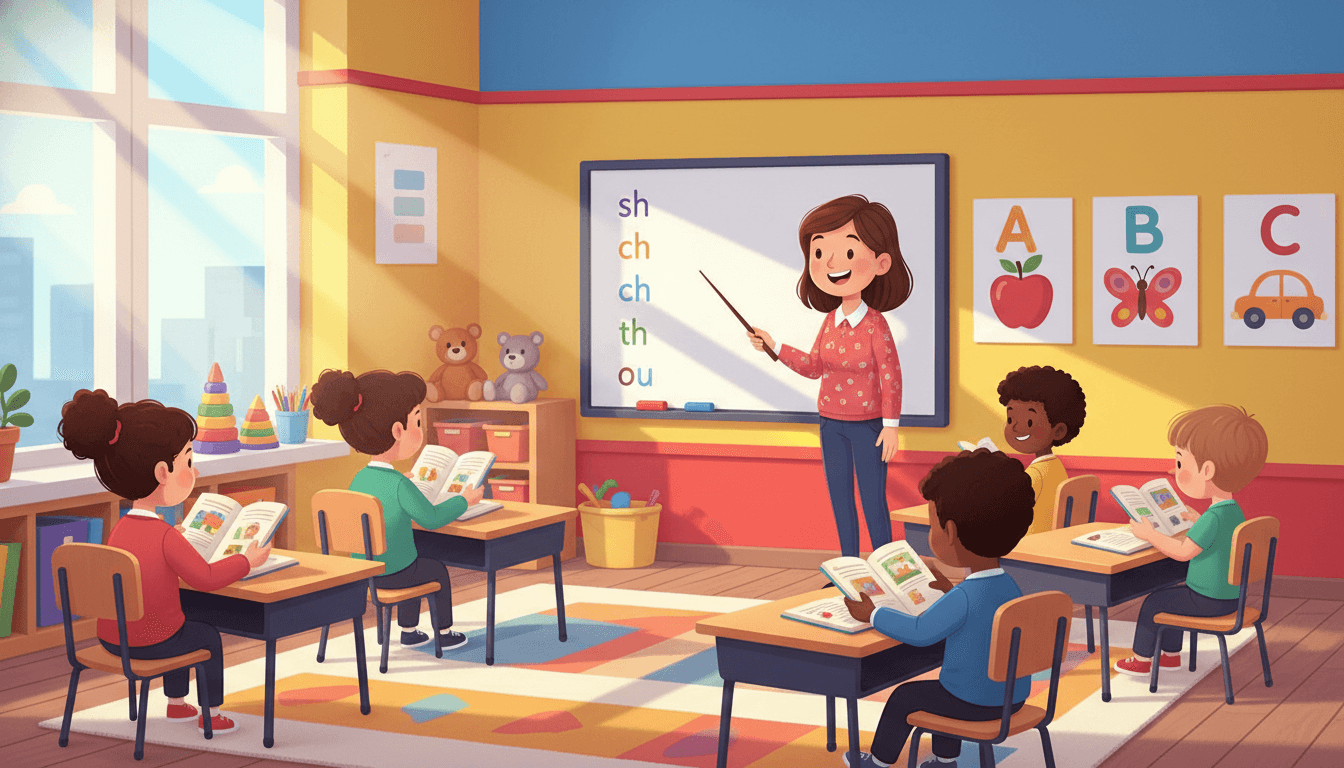
1st Grade: Consonant blends (bl-, cr-, str-), digraphs (ch, sh, th, wh), long vowel patterns (silent-e like cake, vowel teams like rain), and r-controlled vowels (ar, er, ir, or, ur).
2nd Grade: More complex vowel patterns, multisyllabic words, prefixes and suffixes, irregular words that don't follow the rules.
By the end of 2nd grade, most kids have the phonics tools they need for independent reading. After that, vocabulary and comprehension become the focus.
Common Misconceptions About Phonics
"If a child knows all the letter sounds, they know phonics." Not quite. Knowing isolated sounds is just the first step. Kids also need to learn blending (putting sounds together to form words), segmenting (breaking words into sounds for spelling), and dozens of spelling patterns beyond single letters.
"Phonics is just for struggling readers." Phonics instruction benefits all beginning readers, including those who pick up reading easily. It gives them a more reliable system than guessing from context or pictures.
"English is too irregular for phonics to work." About 84% of English words follow predictable phonics patterns. The irregular words (sight words) represent a manageable minority that kids memorize separately.
"More phonics practice always helps." If a child is stuck, it's worth asking whether their phonemic awareness (hearing sounds) is solid before adding more phonics drill. The problem might be upstream.
How to Teach Phonics
Start with the most useful sounds first. Don't go A-to-Z alphabetically. Begin with high-frequency letters like s, a, t, p, i, n - they let kids form dozens of words quickly.
Use a decodable text library. Once kids know a set of letter sounds, give them texts that only use words they can decode. This practice builds fluency and confidence faster than mixed-text books.
Build in daily blending practice. Sounding out words needs to become automatic. Short, frequent practice (5–10 minutes) beats occasional long sessions.
Teach encoding alongside decoding. Have kids spell words using their phonics knowledge, not just read them. The two-way practice deepens the learning.
Use multisensory techniques. Tracing letters in sand, using letter tiles, or finger-tapping sounds helps kids who learn better with movement - which is most young children.
Address phonemic awareness if needed. If a child can hear the individual sounds in spoken words (phonemic awareness), phonics instruction has a foundation to build on. If not, start there.
Be explicit and systematic. Don't rely on kids to discover patterns on their own. Name the rule, show examples, practice together, then release to independent practice.
Practice Activities
-
Word chains: Change one sound at a time. cat → bat → bad → bed → red. This builds the habit of attending to every sound.
-
Sound boxes (Elkonin boxes): Draw a box for each sound in a word, then push tokens into the boxes while saying each sound. Great for CVC words with young learners.
-
Decodable readers: Books matched to exactly the phonics patterns a child currently knows. Not too hard, not too easy - right in the sweet spot.
-
Sorting by pattern: Give kids a stack of word cards to sort into groups (short vowel vs. long vowel, -at words vs. -an words). Pattern recognition sticks faster than memorization.
Frequently Asked Questions
What is the difference between phonics and phonemic awareness?
Phonemic awareness is the ability to hear and manipulate individual sounds (phonemes) in spoken words - it's a purely auditory skill. Phonics connects those sounds to printed letters. Kids build phonemic awareness first, then use it as the foundation for phonics. Think of phonemic awareness as the ear training, and phonics as reading the music.
When should kids start learning phonics?
Most kids begin formal phonics instruction in kindergarten, around ages 5-6. By the end of 1st grade, children typically know most single-letter sounds plus common blends, digraphs, and simple vowel patterns. Solid phonics mastery is usually the goal by the end of 2nd grade.
What is synthetic phonics?
Synthetic phonics is the most widely taught approach. Kids learn individual letter sounds (phonemes), then blend them together to read words. For example: /k/ + /æ/ + /t/ = 'cat'. It's called 'synthetic' because kids synthesize (combine) sounds to build words.
Is phonics the same as spelling?
They're closely related but not identical. Phonics is about decoding - using letter-sound knowledge to read words. Spelling (encoding) uses the same knowledge in reverse. Kids who understand phonics patterns generally become stronger spellers too, but spelling involves additional memory for irregular words.
What if my child is struggling with phonics?
Start by checking whether phonemic awareness is solid - if a child can't hear individual sounds in words, phonics instruction won't stick. Multisensory approaches (tracing letters while saying sounds, using manipulatives) often help. If struggles persist past 2nd grade, an evaluation for dyslexia may be worthwhile.
Free Phonics Worksheets
Curriculum-aligned printable worksheets for Kindergarten – 2nd Grade. Download free.