What Are Fact Families?
Taught in US schools
Key Takeaways
- A fact family is a set of related math facts built from the same three numbers using two inverse operations.
- Addition and subtraction fact families show four related equations; multiplication and division fact families also show four.
- Learning fact families helps students understand that addition and subtraction (or multiplication and division) are inverse operations - they undo each other.
What Are Fact Families?
A fact family is a group of related math equations that all use the same three numbers. The equations in a fact family are connected by inverse operations - operations that undo each other.
There are two types of fact families:
-
Addition and subtraction fact families (Grades K–2)
-
Multiplication and division fact families (Grade 3+)
Addition and Subtraction Fact Families
An addition/subtraction fact family uses three numbers to write four related equations - two addition and two subtraction.
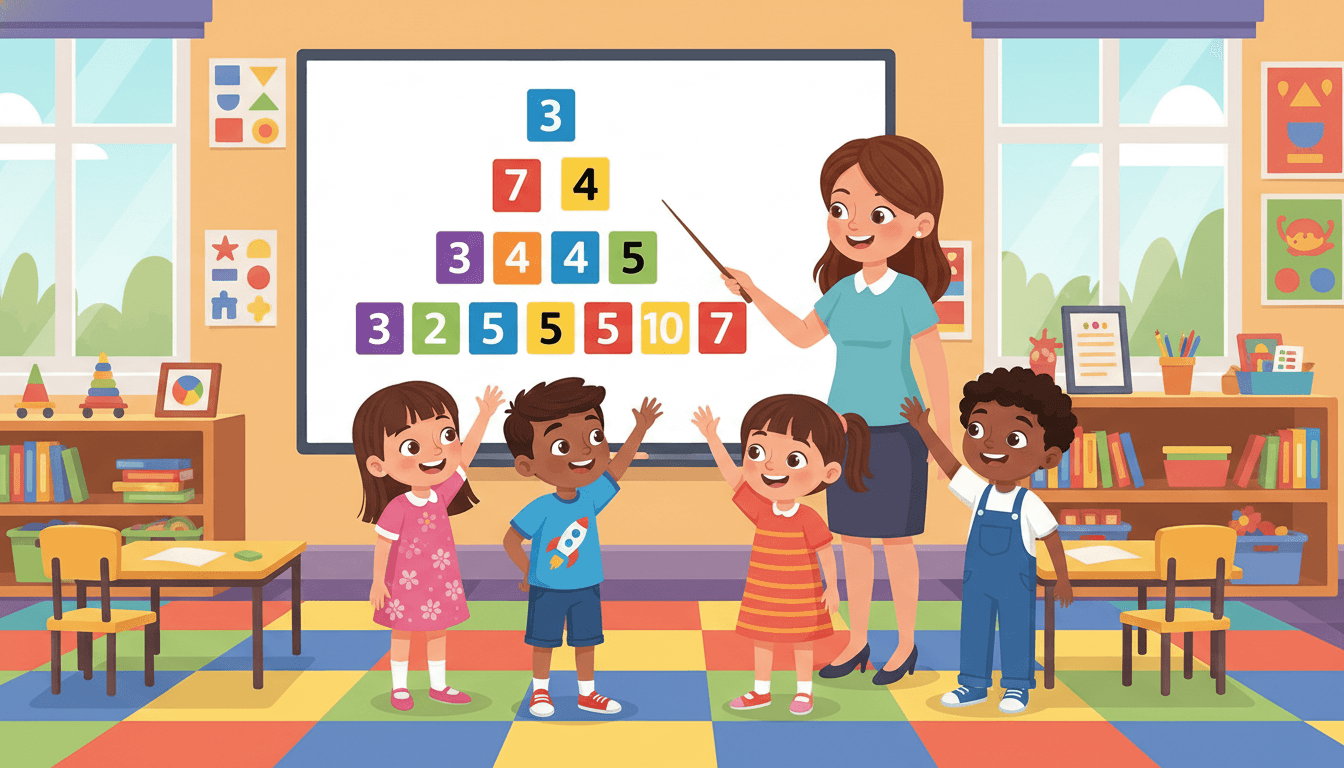
Example - Fact Family for 3, 4, and 7:
- 3 + 4 = 7
- 4 + 3 = 7
- 7 − 3 = 4
- 7 − 4 = 3
The largest number (7) is called the sum and always appears as the result of addition or as the starting number in subtraction.
Multiplication and Division Fact Families
A multiplication/division fact family also uses three numbers and produces four equations:
Example - Fact Family for 3, 4, and 12:
- 3 × 4 = 12
- 4 × 3 = 12
- 12 ÷ 3 = 4
- 12 ÷ 4 = 3
These fact families are introduced in 3rd grade alongside multiplication.
The Special Case: Same Numbers
When two of the three numbers in a fact family are equal, the family has only two facts instead of four, because the two addition facts (or two multiplication facts) are identical.
Example: The fact family for 5, 5, and 10:
- 5 + 5 = 10
- 10 − 5 = 5
Fact Family Houses and Triangles
Two popular visual tools help students organize fact families:
-
Fact Family House: a house-shaped diagram with three numbers written in the roof, and the four equations written in the walls below.
-
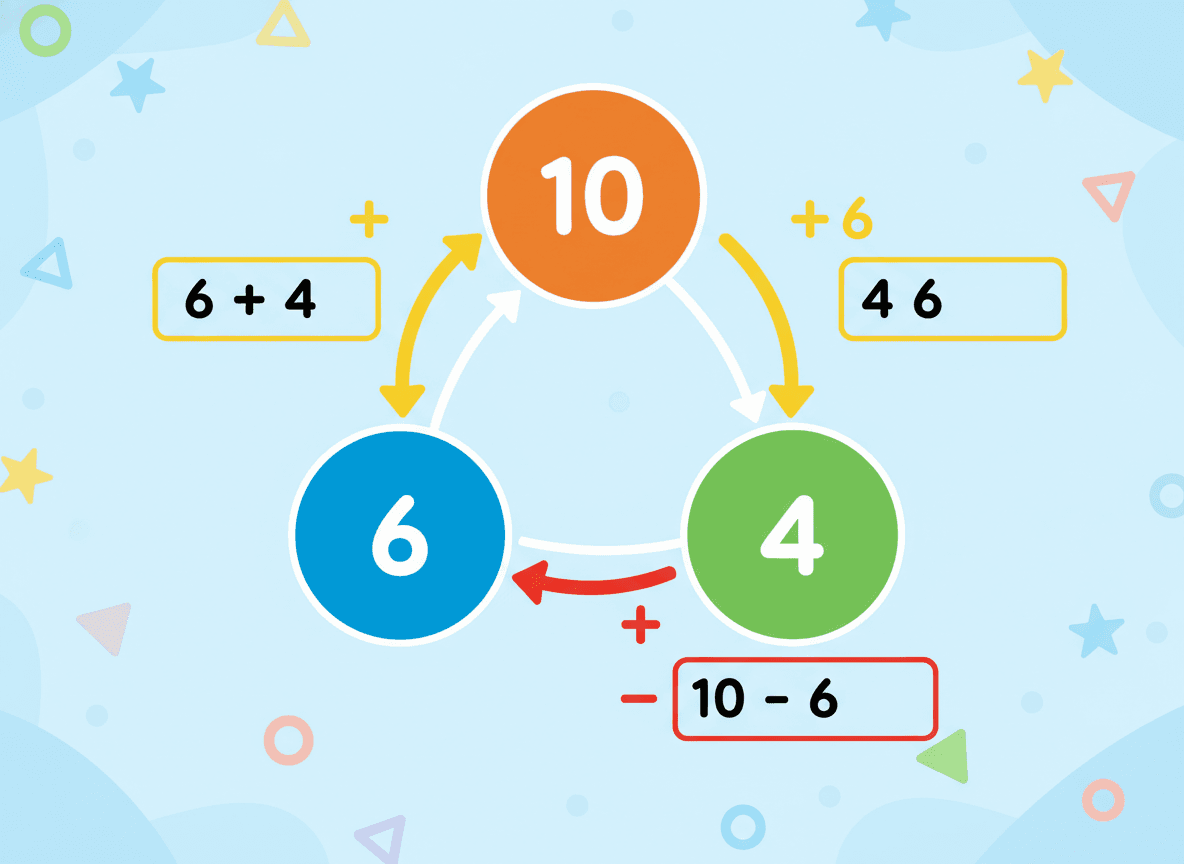
Fact Family Triangle: a triangle with one number in each corner. Students cover one corner and use the other two to write a related equation.
Both tools make it easy to see all related facts at once.
Why Fact Families Matter
Fact families build two critical skills:
- Fluency - instead of memorizing 20 separate addition facts and 20 subtraction facts, students see them as groups of 4 connected facts, reducing memory load.
- Understanding inverse operations - students learn that subtraction is the "opposite" of addition, and division is the "opposite" of multiplication. This understanding is foundational for algebra.
Connecting Fact Families to the Number Bond
A number bond is a related visual tool showing a whole number and its two parts. Fact families extend the number bond idea by making all four equations explicit.
Practice Activities
- Give students three number cards (e.g., 6, 8, 14) and ask them to write all four fact family equations on a mini-whiteboard.
- Use a fact family triangle printable - cover one number and challenge students to name the missing number.
- Play "Fact Family Flip": call out two numbers, and students race to write the whole fact family.
- Have students sort equation cards into correct fact family groups on a sorting mat.
- Use connecting cubes to build a fact family model: snap 3 red and 4 blue cubes, then break them apart in different ways.
Frequently Asked Questions
How many facts are in a fact family?
Most fact families contain four related equations. For addition and subtraction, the fact family for 3, 4, and 7 is: 3+4=7, 4+3=7, 7-3=4, and 7-4=3. However, when two of the three numbers are the same (like 4, 4, 8), the family has only two facts: 4+4=8 and 8-4=4.
What are fact families for multiplication and division?
A multiplication/division fact family uses three numbers related by multiplication. For example, 3, 4, and 12: 3×4=12, 4×3=12, 12÷3=4, and 12÷4=3. These families are typically taught in 3rd grade when multiplication is introduced.
Why do fact families help students learn math facts?
Fact families reduce the number of separate facts students need to memorize. If a student knows 6+7=13, they automatically know 7+6=13, 13-6=7, and 13-7=6. Grouping related facts together also builds understanding of how addition and subtraction (or multiplication and division) are connected.
Free Fact Families Worksheets
Curriculum-aligned printable worksheets for Kindergarten – 3rd Grade. Download free.