What Is a KWL Chart?
Taught in US schools

Key Takeaways
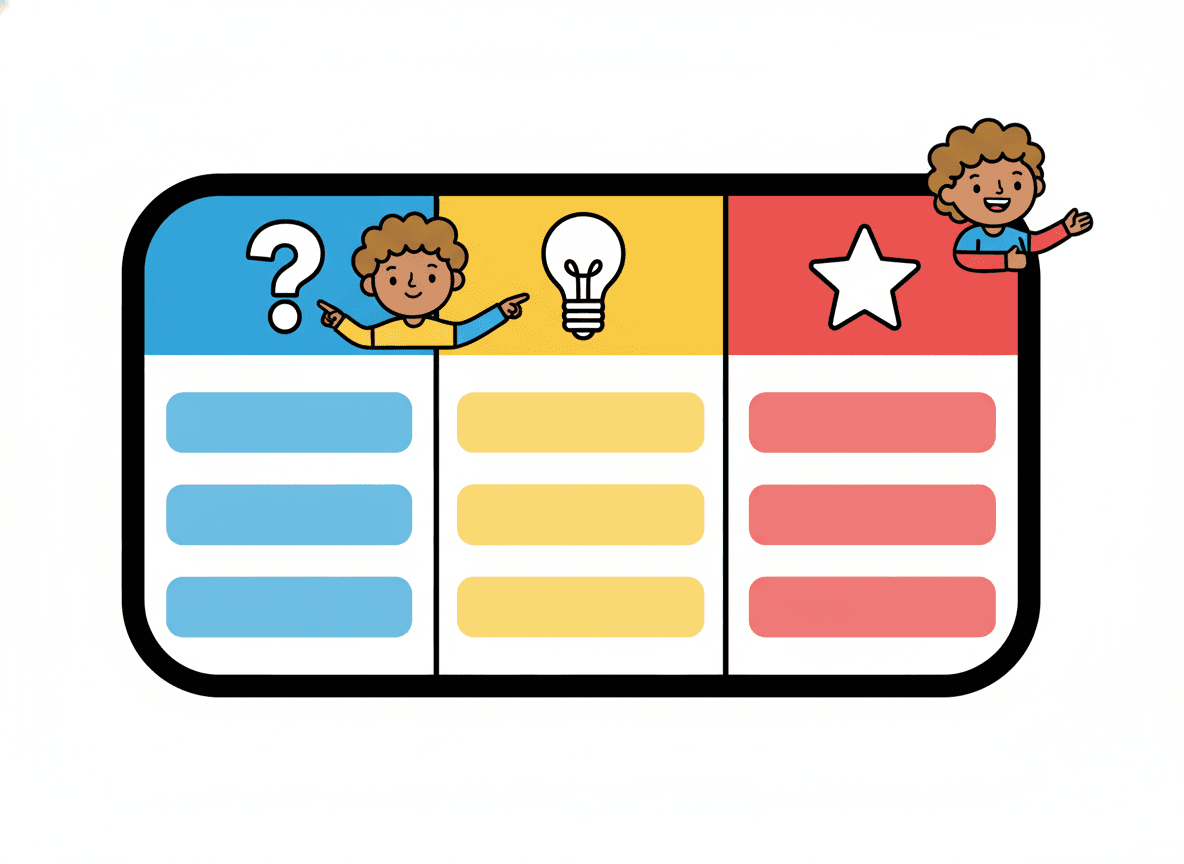
- A KWL chart has three columns: K (what students already Know), W (what they Want to know), and L (what they Learned after the lesson).
- The K and W columns are filled in BEFORE the lesson to activate prior knowledge and set purpose; the L column is filled in AFTER to summarize learning.
- KWL was invented by educator Donna Ogle in 1986 and has many popular variations, including KWHL and KWLS.
What Is a KWL Chart?
A KWL chart is a three-column graphic organizer used before, during, and after reading or a lesson to help students connect prior knowledge to new learning and set a purpose for inquiry.
The acronym stands for:
-
K - What do I Know? (prior knowledge)
-
W - What do I Want to know? (questions and curiosity)
-
L - What did I Learn? (new knowledge and conclusions)
KWL was developed by educator Donna Ogle in 1986 and has become one of the most widely used instructional strategies in elementary and middle school.
The Three Columns
K - Know: Before the lesson - Prior knowledge, facts, associations with the topic
W - Want to Know: Before the lesson - Questions, curiosities, things students wonder about
L - Learned: After the lesson - New facts, answers to W questions, surprises
How to Use a KWL Chart
Step 1: Activate Prior Knowledge (K column)
Before the lesson or reading:
- Introduce the topic and ask: "What do you already know about ___?"
- Give students time to think individually, then share as a class.
- Record student responses in the K column (teacher on a class chart, students on individual sheets).
Misconceptions are acceptable here - you'll revisit them in the L column.
Step 2: Set Purpose for Learning (W column)
Still before the lesson:
- Ask: "What questions do you have? What do you WANT to know about this topic?"
- This step sets a purpose for reading/learning - students are now looking for specific answers.
- Questions can come from gaps in knowledge, curiosities, or wonder.
Step 3: Summarize New Learning (L column)
After the lesson, reading, or unit:
- Students record what they learned - especially answers to their W questions.
- Revisit the K column: what was confirmed? What was actually incorrect?
- Celebrate when a misconception is corrected - that's real learning!
Why KWL Charts Are Effective
-
Schema activation - connecting new information to prior knowledge is one of the most powerful learning strategies.
-
Metacognition - students think about what they know and don't know, building self-awareness as learners.
-
Purpose setting - students read or listen more actively when they have specific questions to answer.
-
Formative assessment - the K column reveals misconceptions; the L column shows what students actually learned.
KWL Variations
KWHL: H = How will we learn? - Adds research strategy planning
KWLS: S = Still want to know - Identifies lingering questions for further inquiry
KWWL: Second W = Where can we find out? - Focuses on sourcing information
Classroom Tips
- Use a class KWL chart (anchor chart or whiteboard) for whole-group instruction.
- Give students individual KWL sheets during independent research projects.
- Post the chart in a visible location throughout the unit so students can refer back to their questions.
- Circle or star W questions that get answered - students love seeing their curiosity rewarded.
Practice Activities
- Launch a new science or social studies unit with a class KWL chart - fill in K and W together, post it, and revisit at the end.
- Have students create individual KWL charts before reading an informational text independently.
- Use KWHL for a research project - students plan their research strategy in the H column.
- After completing the L column, have students write a summary paragraph based only on what they wrote there.
- Compare K and L columns: "What was true that you already knew? What was new? What did you think was true but wasn't?"
Frequently Asked Questions
When do you fill in each column of a KWL chart?
The K column is filled in at the START of a unit or lesson - students write what they already know about the topic. The W column is also filled in at the start - students write questions they want answered. The L column is filled in at the END - students write what they actually learned. This structure makes the KWL chart a bridge between prior knowledge and new learning.
What is a KWHL chart?
A KWHL chart adds a fourth column: H - How will we learn? This column, filled in after W, asks students to think about the resources and strategies they will use to find answers to their questions (books, experiments, videos, interviews, etc.). The KWHL variation encourages students to think metacognitively about the learning process itself.
What if students write something incorrect in the K column?
Misconceptions in the K column are actually valuable! When students return to the chart after the lesson and complete the L column, teachers can guide discussion about what was confirmed, what was new, and what was actually incorrect. Revising misconceptions is a powerful learning moment - the chart makes that revision visible.
Free KWL Chart Worksheets
Curriculum-aligned printable worksheets for Kindergarten – 5th Grade. Download free.