Who Was Martin Luther King Jr.?
Taught in US schools

Key Takeaways
- Martin Luther King Jr. was a civil rights leader who fought for equal rights for Black Americans through peaceful, nonviolent protest.
- He delivered the 'I Have a Dream' speech at the March on Washington in 1963, calling for racial equality and justice.
- King was awarded the Nobel Peace Prize in 1964 and was assassinated on April 4, 1968. MLK Day is a federal holiday celebrated on the third Monday of January.
Who Was Martin Luther King Jr.?
Martin Luther King Jr. (January 15, 1929 – April 4, 1968) was a Baptist minister, civil rights leader, and Nobel Peace Prize winner who dedicated his life to fighting for equality and justice for Black Americans - and for all people. His commitment to nonviolent protest changed the laws of the United States and inspired movements around the world.
Early Life
King was born in Atlanta, Georgia, into a family of ministers. He was an exceptional student who entered college at 15 and earned his doctorate in theology from Boston University. He became a pastor at Dexter Avenue Baptist Church in Montgomery, Alabama, where his civil rights leadership began.
The Montgomery Bus Boycott (1955–1956)
When Rosa Parks was arrested on December 1, 1955, for refusing to give up her bus seat to a white passenger, King helped organize the Montgomery Bus Boycott. For 381 days, Black residents of Montgomery walked or carpooled rather than ride the segregated buses. The boycott ended in victory when the Supreme Court ruled bus segregation unconstitutional.
The March on Washington and "I Have a Dream" (1963)
On August 28, 1963, King led 250,000 people in the March on Washington for Jobs and Freedom. Standing before the Lincoln Memorial, he delivered the "I Have a Dream" speech, one of the greatest speeches in American history:
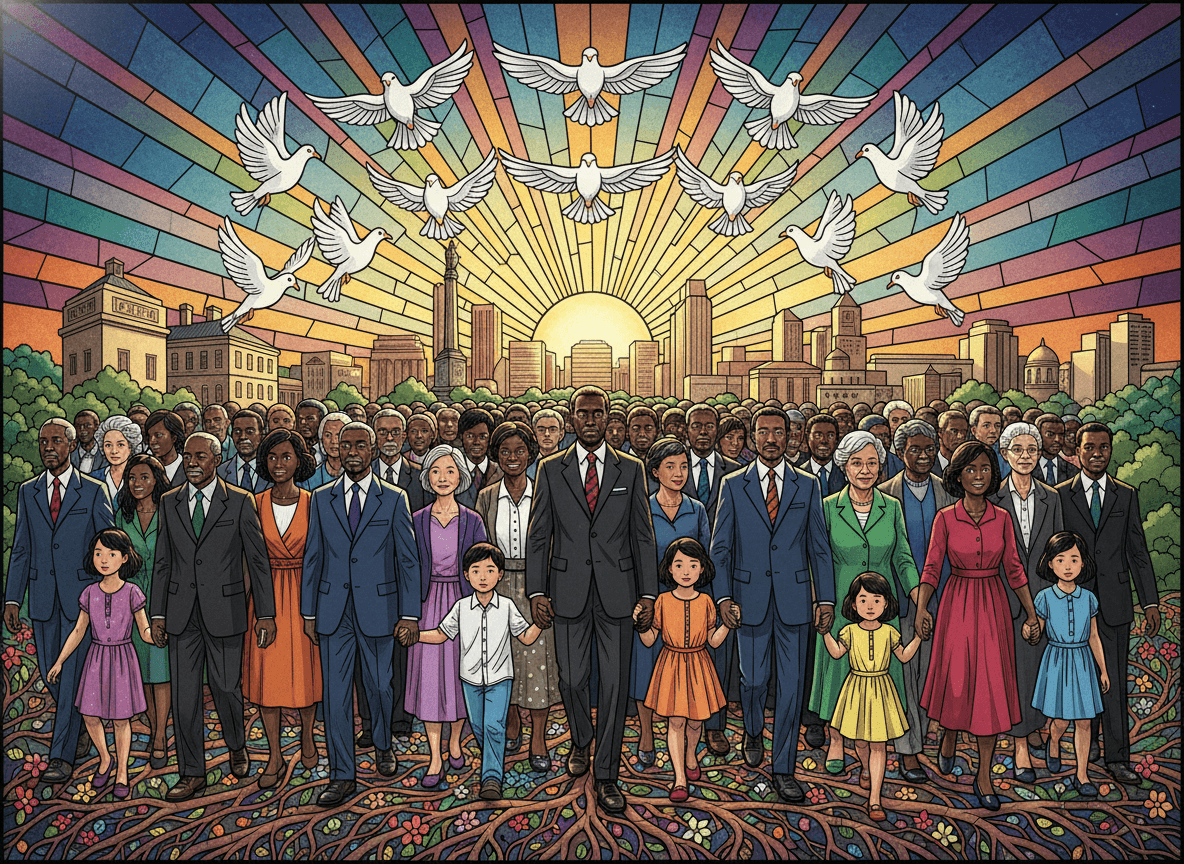
"I have a dream that my four little children will one day live in a nation where they will not be judged by the color of their skin but by the content of their character."
Key Accomplishments
Montgomery Bus Boycott: 1955–56 - Ended bus segregation
Birmingham Campaign: 1963 - Exposed brutality of segregation nationwide
March on Washington: 1963 - "I Have a Dream" speech; pressure for civil rights law
Civil Rights Act: 1964 - Outlawed segregation and discrimination
Nobel Peace Prize: 1964 - International recognition of nonviolent leadership
Voting Rights Act: 1965 - Protected Black Americans' right to vote
Nonviolent Protest
King was deeply influenced by Mahatma Gandhi's teachings of nonviolent resistance. He believed that peaceful protest - marches, boycotts, sit-ins - was the most powerful and morally correct way to fight injustice. He insisted that protesters must remain peaceful even when attacked.
Legacy
King was assassinated on April 4, 1968, in Memphis, Tennessee. His death shocked the nation and the world. In 1983, Congress established Martin Luther King Jr. Day as a federal holiday, celebrated on the third Monday of January. King's face appears on a memorial on the National Mall in Washington, D.C.
Practice Activities
-
"I Have a Dream" reading: Read excerpts of the speech; students identify King's dream and discuss what equality means today.
-
Civil rights timeline: Create a timeline from the Montgomery Bus Boycott (1955) through the Voting Rights Act (1965).
-
Nonviolence discussion: Discuss what nonviolent protest means; brainstorm peaceful ways to respond to unfair situations.
-
MLK biography report: Students write a 5-paragraph biography using key facts from King's life.
-
Dream poem: Students write their own "I Have a Dream" poem about something they hope for in the world.
Frequently Asked Questions
What did Martin Luther King Jr. believe about protest?
King believed strongly in nonviolent protest - peaceful, organized demonstrations like marches, sit-ins, and boycotts, rather than violence. He was inspired by Mahatma Gandhi's methods in India. King believed that peaceful protest would win the moral support of the nation and change unjust laws.
What was the Montgomery Bus Boycott?
After Rosa Parks was arrested for refusing to give up her bus seat to a white passenger in Montgomery, Alabama, in 1955, Martin Luther King Jr. helped organize a boycott of the city's bus system. For 381 days, Black residents refused to ride the buses, costing the bus company major revenue. The Supreme Court eventually ruled bus segregation unconstitutional.
What is the 'I Have a Dream' speech?
On August 28, 1963, at the March on Washington, King delivered his most famous speech before 250,000 people at the Lincoln Memorial. He called for an end to racism and described his vision of an America where people are judged by their character, not the color of their skin. It is one of the most quoted speeches in American history.
Free Martin Luther King Jr. Worksheets
Curriculum-aligned printable worksheets for Kindergarten – 5th Grade. Download free.