What Is a Ratio?
Taught in US schools

Key Takeaways
- A ratio compares two quantities and can be written as 3:4, 3 to 4, or 3/4.
- Part-to-part ratios compare one group to another; part-to-whole ratios compare one group to the total.
- Equivalent ratios work like equivalent fractions - multiply or divide both quantities by the same number.
What Is a Ratio?
A ratio is a comparison of two quantities that shows the relationship between them. Ratios tell us how much of one thing there is relative to another thing.
Ratios can be written three ways and all mean the same thing:
Colon form: 3:4
Word form: 3 to 4
Fraction form: 3/4
Example: In a bag with 3 red marbles and 4 blue marbles, the ratio of red to blue is 3:4. For every 3 red marbles, there are 4 blue marbles.
Part-to-Part vs. Part-to-Whole Ratios
There are two main types of ratios:
Part-to-part ratios compare one group to another group.
In a class of 12 boys and 15 girls, the ratio of boys to girls is 12:15, or simplified, 4:5.
Part-to-whole ratios compare one group to the total.
In the same class of 27 students, the ratio of boys to total students is 12:27, or simplified, 4:9.
Important: Always read the problem carefully to know which type of ratio is being asked for.
Equivalent Ratios
Equivalent ratios represent the same relationship - just like equivalent fractions. You create them by multiplying or dividing both quantities by the same number.
Example: 2:3 is equivalent to 4:6, 6:9, and 10:15.
A ratio table organizes equivalent ratios in columns:
2: 3
4: 6
6: 9
10: 15
Unit Rate
A unit rate is a special ratio where the second quantity equals 1. Unit rates make comparisons easy.
Example: A car travels 240 miles in 4 hours.
Unit rate: 240 ÷ 4 = 60 miles per 1 hour (60 mph).
Example: A bag of 5 oranges costs $3.00.
Unit rate: $3.00 ÷ 5 = $0.60 per orange.
Ratios in Real Life
Recipe: 2 cups of flour to 1 cup of sugar → 2:1
Map scale: 1 inch = 50 miles → 1:50 (scaled)
Sports: 8 wins and 2 losses → win-to-loss ratio 4:1
Mixing: 1 part juice to 3 parts water → 1:3
Ratios and Fractions
Ratios and fractions are closely related, but they are not the same thing:
- A fraction always represents a part of a whole.
- A ratio can compare any two quantities - part to part or part to whole.
However, when a ratio is written in fraction form (3/4), you can apply fraction rules to simplify it and find equivalent ratios.
Practice Activities
- Write the ratio of boys to girls in your class three ways (colon, word, fraction form).
- Use a recipe and scale it up by doubling or tripling the ratio of ingredients.
- Fill in a ratio table and identify the unit rate from the pattern.
- Compare two products' prices using unit rates to determine which is the better buy.
- Draw a tape diagram to model a part-to-part and part-to-whole ratio from the same situation.
Frequently Asked Questions
What is the difference between a ratio and a fraction?
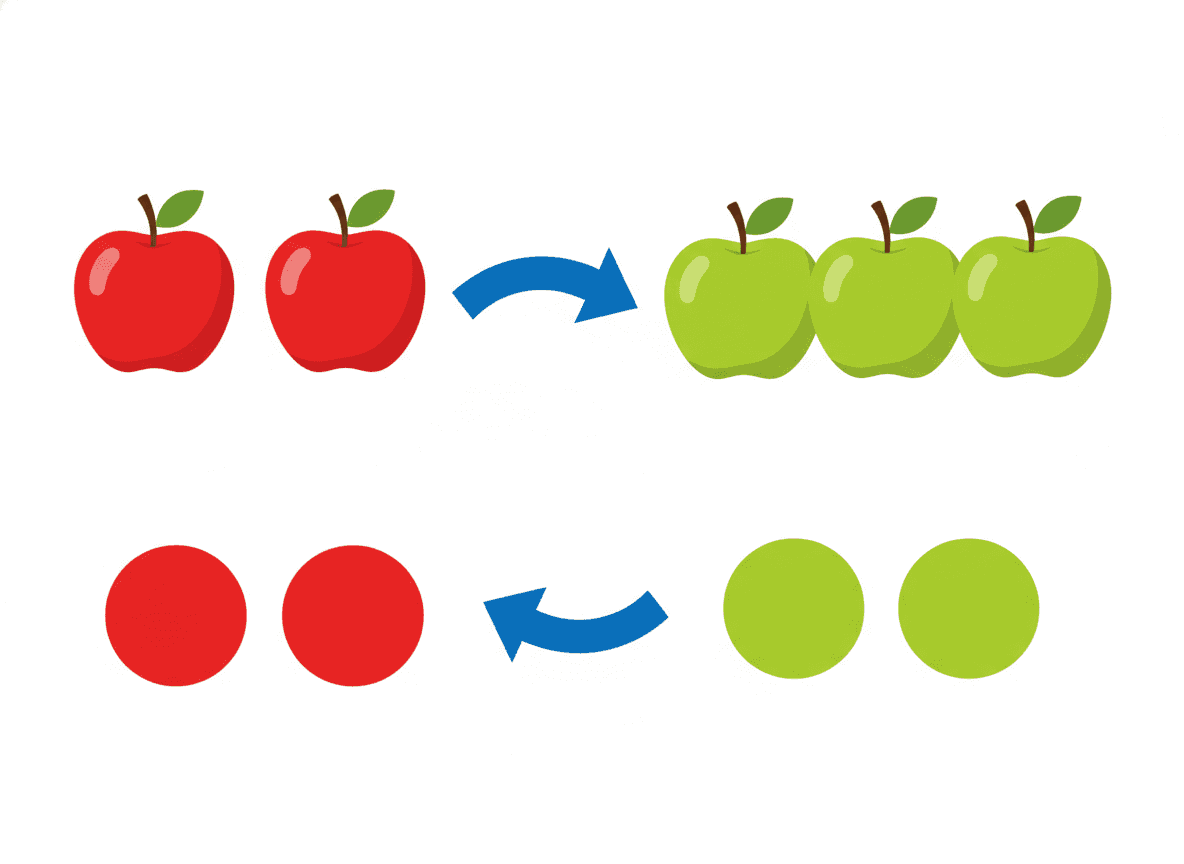
A fraction always represents part of a whole (part-to-whole). A ratio can compare part-to-part or part-to-whole. For example, if there are 3 red apples and 5 green apples, the ratio of red to green is 3:5 - not a fraction of the whole.
What is a unit rate?
A unit rate is a ratio where the second quantity is 1. For example, if a car travels 150 miles in 3 hours, the unit rate is 50 miles per 1 hour, or 50 miles per hour.
Where are ratios used in real life?
Ratios appear in recipes (2 cups of flour for every 1 cup of sugar), map scales (1 inch = 50 miles), sports statistics (3 wins to 1 loss), and mixing paint or cleaning solutions.
Free Ratio Worksheets
Curriculum-aligned printable worksheets for 5th Grade. Download free.
Common Core Standards