What Are Rocks and Minerals?
Taught in US schools
Key Takeaways
- The three types of rocks are igneous (formed from cooled magma), sedimentary (formed from compressed layers of sediment), and metamorphic (formed when existing rocks are changed by heat and pressure).
- Minerals are natural, nonliving solid substances with a definite chemical composition. Key properties include hardness, luster, color, streak, and cleavage.
- The rock cycle shows how rocks slowly change from one type to another over millions of years.
What Are Rocks and Minerals?
Rocks are solid materials that make up Earth's surface (and much of its interior). They are found everywhere - in mountains, ocean floors, deserts, and under our feet. Minerals are the building blocks of rocks: pure natural substances with a specific chemical composition.
Think of it this way: minerals are like ingredients, and rocks are like recipes made from those ingredients.
The Three Types of Rocks
1. Igneous Rocks
Igneous rocks form when magma (melted rock underground) or lava (magma that reaches the surface) cools and solidifies.
-
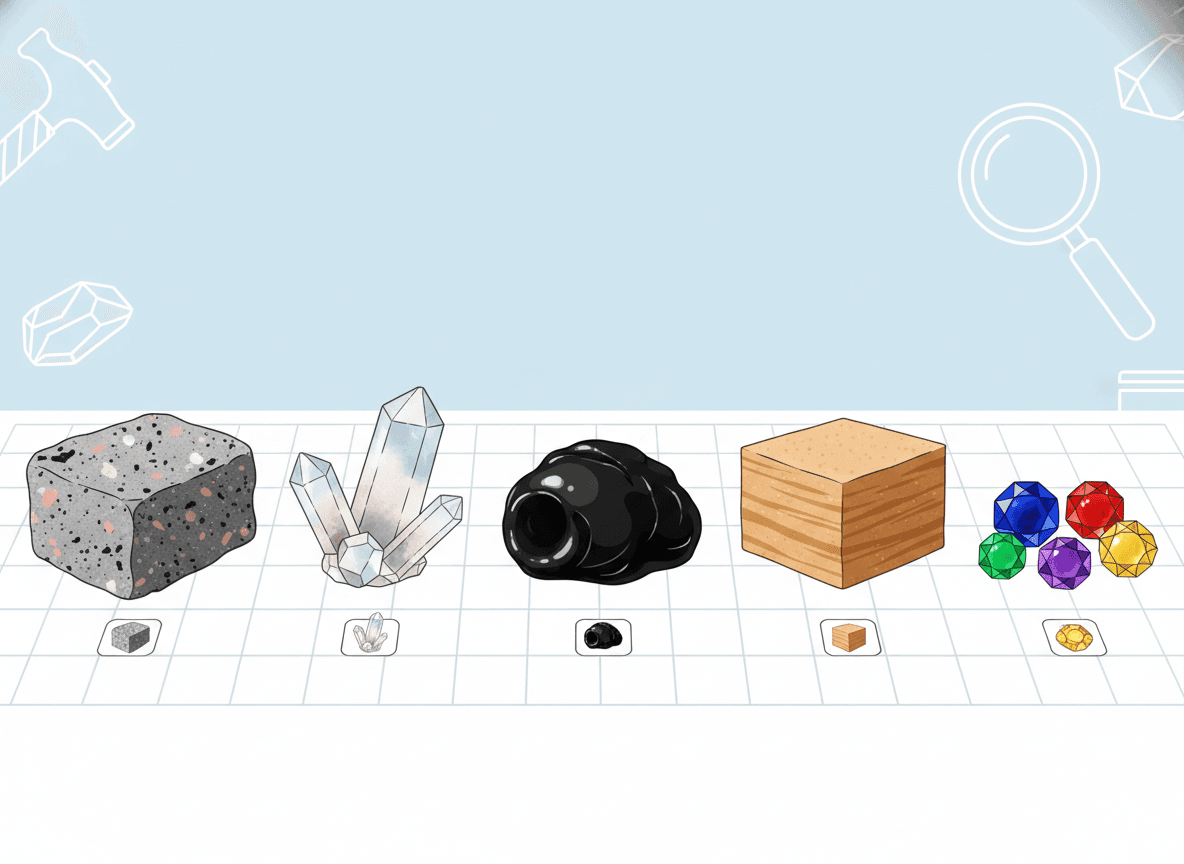
Intrusive igneous rocks cool slowly underground and have large crystals → granite
-
Extrusive igneous rocks cool quickly at the surface and have small or no crystals → basalt, obsidian
2. Sedimentary Rocks
Sedimentary rocks form when layers of sediment (sand, silt, dead organisms, shells) are pressed together over millions of years. Many sedimentary rocks contain fossils.
Examples: sandstone, limestone, shale, chalk, coal
3. Metamorphic Rocks
Metamorphic rocks form when existing rocks are changed by intense heat and pressure deep underground. They are not melted - just transformed.
Examples: marble (from limestone), slate (from shale), quartzite (from sandstone)
The Rock Cycle
Rocks are constantly - very slowly - changing from one type to another:
Magma cools → Igneous rock
↓ (erosion, compaction)
Sedimentary rock
↓ (heat and pressure)
Metamorphic rock
↓ (melting)
Back to magma → Igneous rock
The rock cycle has no beginning or end - it is continuous over millions of years.
Minerals
A mineral is a naturally occurring, inorganic (nonliving), solid substance with a definite chemical composition and crystal structure. There are over 4,000 known minerals, but about 30 make up most of Earth's crust.
Properties Used to Identify Minerals
Hardness: Resistance to scratching (Mohs scale 1–10) - Diamond = 10; Talc = 1
Luster: How it reflects light (metallic or nonmetallic) - Gold is metallic; quartz is glassy
Color: Surface color (not always reliable) - Quartz can be many colors
Streak: Color of powder left when rubbed on a tile - Pyrite has a black streak
Cleavage: How it breaks (along flat planes) - Mica splits into thin sheets
Common Minerals
-
Quartz (SiO₂) - very hard, glassy; found in granite and sand
-
Feldspar - most abundant mineral in Earth's crust; pink or white
-
Mica - splits into thin, shiny sheets; found in granite
-
Calcite - main mineral in limestone and marble
-
Halite - table salt; one of the softest minerals
Practice Activities
-
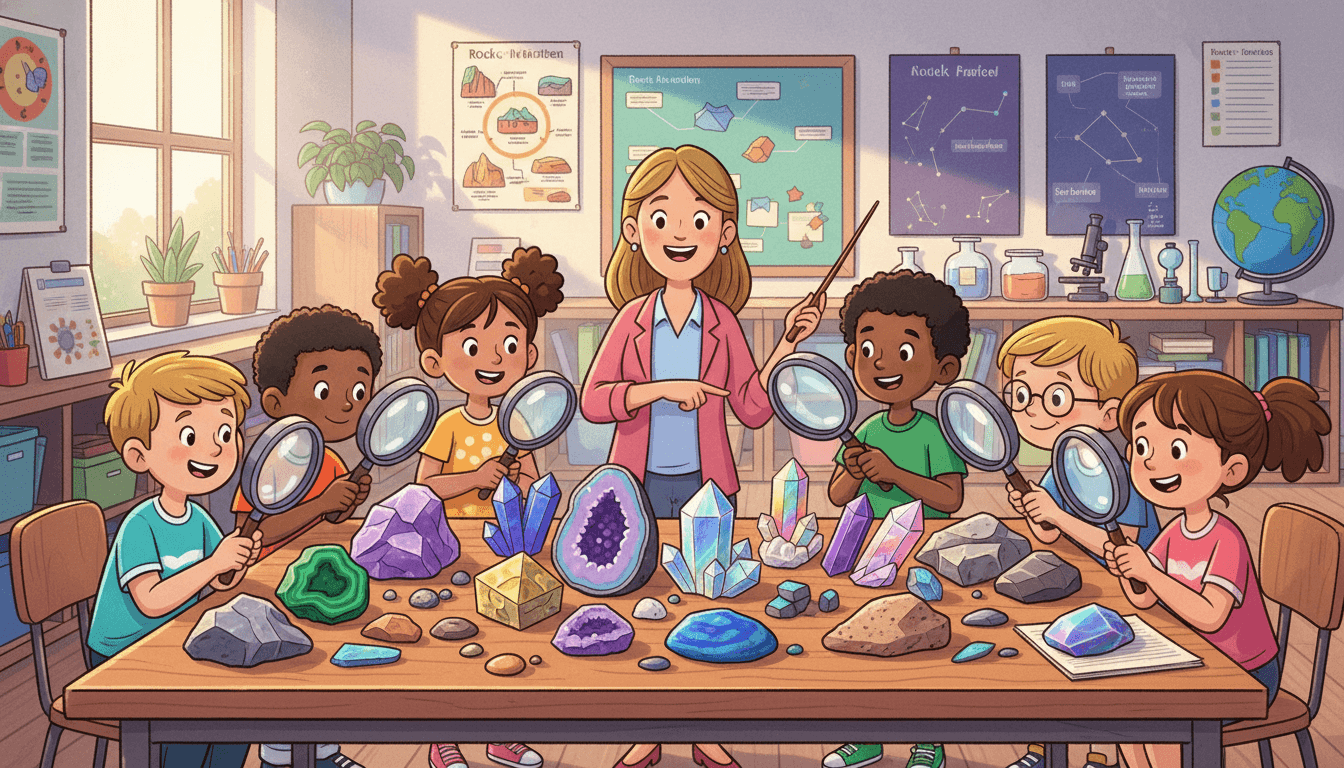
Rock type sorting: Provide sample rocks (or pictures) and have students sort them into igneous, sedimentary, and metamorphic.
-
Mineral scratch test: Test classroom minerals with a fingernail, penny, and nail to estimate hardness on the Mohs scale.
-
Rock cycle diagram: Students label and color a rock cycle diagram with arrows showing how each rock type transforms.
-
Sedimentary model: Layer sand, small rocks, and soil in a clear cup; press down firmly and observe how the layers form.
-
Mineral identification lab: Use color, luster, streak, and hardness to identify 5 unknown minerals from a sample set.
Frequently Asked Questions
What are the three types of rocks?
Igneous rocks form when magma (molten rock) cools and hardens - examples include granite and basalt. Sedimentary rocks form when layers of sediment are compressed over time - examples include sandstone and limestone. Metamorphic rocks form when heat and pressure change existing rocks - examples include marble and slate.
How is a mineral different from a rock?
A mineral is a single natural solid substance with a specific chemical formula (like quartz, which is always SiO2). A rock is made of one or more minerals mixed together. Granite, for example, is a rock that contains the minerals quartz, feldspar, and mica.
What is the Mohs hardness scale?
The Mohs scale ranks minerals from 1 (softest, talc) to 10 (hardest, diamond). It tests hardness by seeing which mineral scratches another. A fingernail is about 2.5 on the scale; a copper penny is about 3.5; a steel nail is about 5.5.
Free Rocks and Minerals Worksheets
Curriculum-aligned printable worksheets for 2nd – 4th Grade. Download free.


