What Is a Running Record?
Taught in US schools

Key Takeaways
- A running record records and analyzes a student's oral reading in real time.
- It measures accuracy rate, fluency, and error patterns to inform instruction.
- Running records reveal not just that a student made an error, but WHY - which cues they used.
- A 95%+ accuracy rate = independent level; 90-94% = instructional level; below 90% = frustration level.
What Is a Running Record?
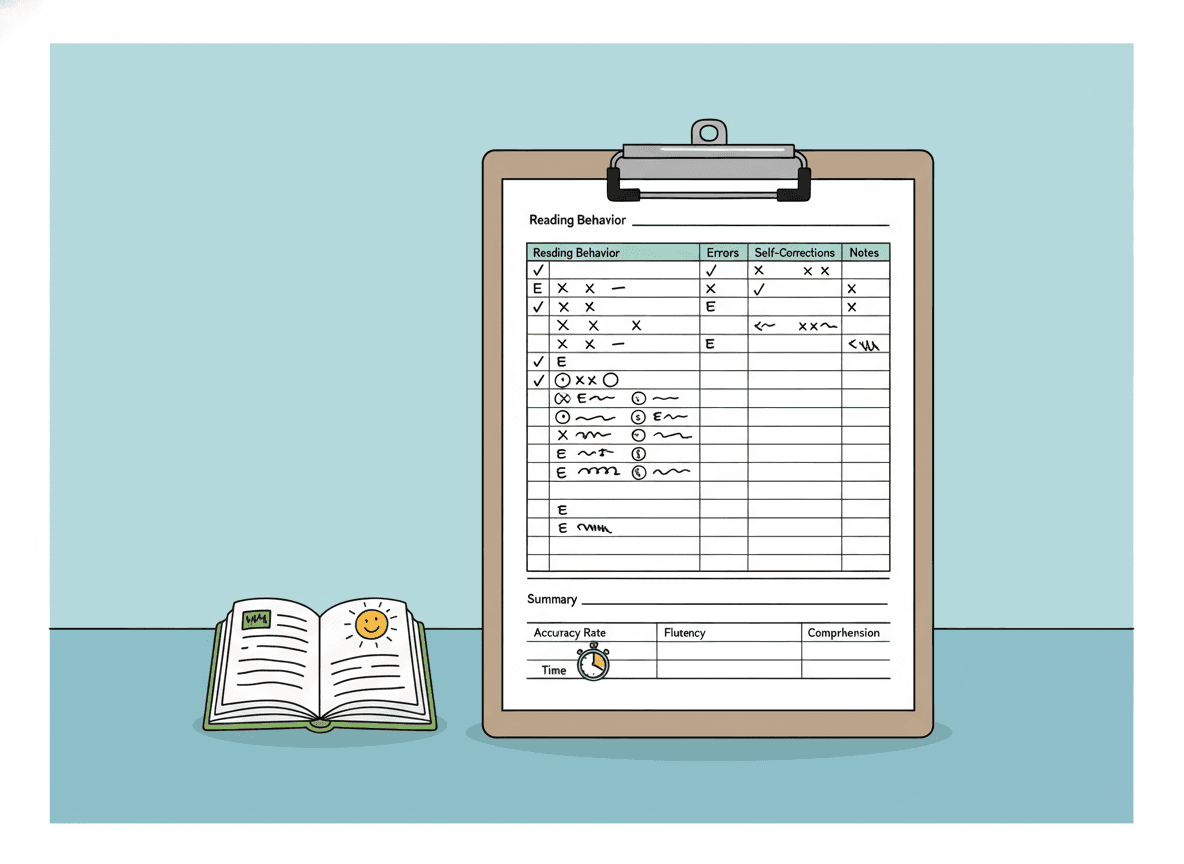
A running record is an assessment tool developed by Dr. Marie Clay (creator of Reading Recovery) that teachers use to systematically record and analyze exactly what a student does while reading aloud. It captures errors, self-corrections, and reading behaviors in real time using a standardized notation system.
Running records are widely used in grades K-3 as a formative assessment to monitor reading progress and guide instructional decisions.
What Running Records Measure
Accuracy Rate - What percentage of words did the student read correctly?
95-100%: Independent - student can read without support
90-94%: Instructional - good for guided reading with teacher support
Below 90%: Frustration - text is likely too difficult
Self-Correction Rate - When the student made an error, how often did they catch and correct it? Self-correction shows metacognitive reading behavior - the student is monitoring their own reading for sense.
Reading Behaviors - Hesitations, re-reads, finger-pointing, and expressions of confusion all inform the teacher about the student's processing.
The MSV Cue System: Error Analysis
The most powerful element of a running record is not the accuracy score - it is what happens when you analyze the errors (also called miscues).
Each error is analyzed according to three cue systems:
M - Meaning: Did the error make semantic sense in context? ("The dog ran into the house" read as "The dog ran into the home" - "home" makes semantic sense)
S - Structure: Did the error sound grammatically correct? (Substituting "runs" for "run" - grammatically, it sounds okay)
V - Visual: Did the error look like the actual word? Did the student use letter/sound cues? ("cat" read as "car" - uses the beginning letters but ignores the ending)
Understanding which cues a student over-relies on or ignores tells the teacher exactly what to teach next.
Taking a Running Record
- Student reads a text aloud while the teacher listens and records
- Teacher marks a check (✓) for every correct word
- Teacher records the exact error when a word is misread
- Teacher notes self-corrections (SC)
- After reading, ask 2-3 comprehension questions
- Calculate accuracy rate and self-correction rate
- Analyze errors for MSV patterns
Practice Activities
- Practice running records with easy picture books first - the teacher needs to develop fluency with the notation before using them for high-stakes instructional decisions.
- Use running records to match students to guided reading groups: students reading at the same instructional level are grouped together.
- Share running record data with students (especially self-correction rate): "Look - you caught 6 of your own errors and fixed them. That's a really important reading skill."
- Take running records at regular intervals (every 4-6 weeks) to track progress and adjust book levels and guided reading focus.
Frequently Asked Questions
What is a running record in reading?
A running record is a diagnostic assessment tool developed by Marie Clay (founder of Reading Recovery) in which a teacher listens to a student read aloud and records every word, error, self-correction, and behavior in real time using a standardized marking system. The resulting record reveals the student's accuracy rate, fluency, and - most importantly - what strategies the student is using when they encounter difficulty.
How is a running record scored?
The teacher counts: (1) errors (any substitution, omission, insertion, or word given by the teacher); (2) self-corrections (errors the student caught and corrected themselves). Accuracy rate = (total words - errors) ÷ total words × 100. A 95-100% accuracy rate = independent level. 90-94% = instructional level (good for guided reading). Below 90% = frustration level - the book is likely too hard.
What does error analysis tell teachers?
Error analysis is the most powerful part of a running record. Teachers categorize each error by which cue system the student was using: Meaning (M) - did the error make sense in context? Structure (S) - did it sound grammatically correct? Visual (V) - did it look like the text word? A student who substitutes 'house' for 'home' used meaning and structure cues but ignored visual cues. This tells the teacher exactly where to focus instruction.
Free Running Record Worksheets
Curriculum-aligned printable worksheets for Kindergarten – 3rd Grade. Download free.