What Is Student Engagement?
Taught in US schools

Key Takeaways
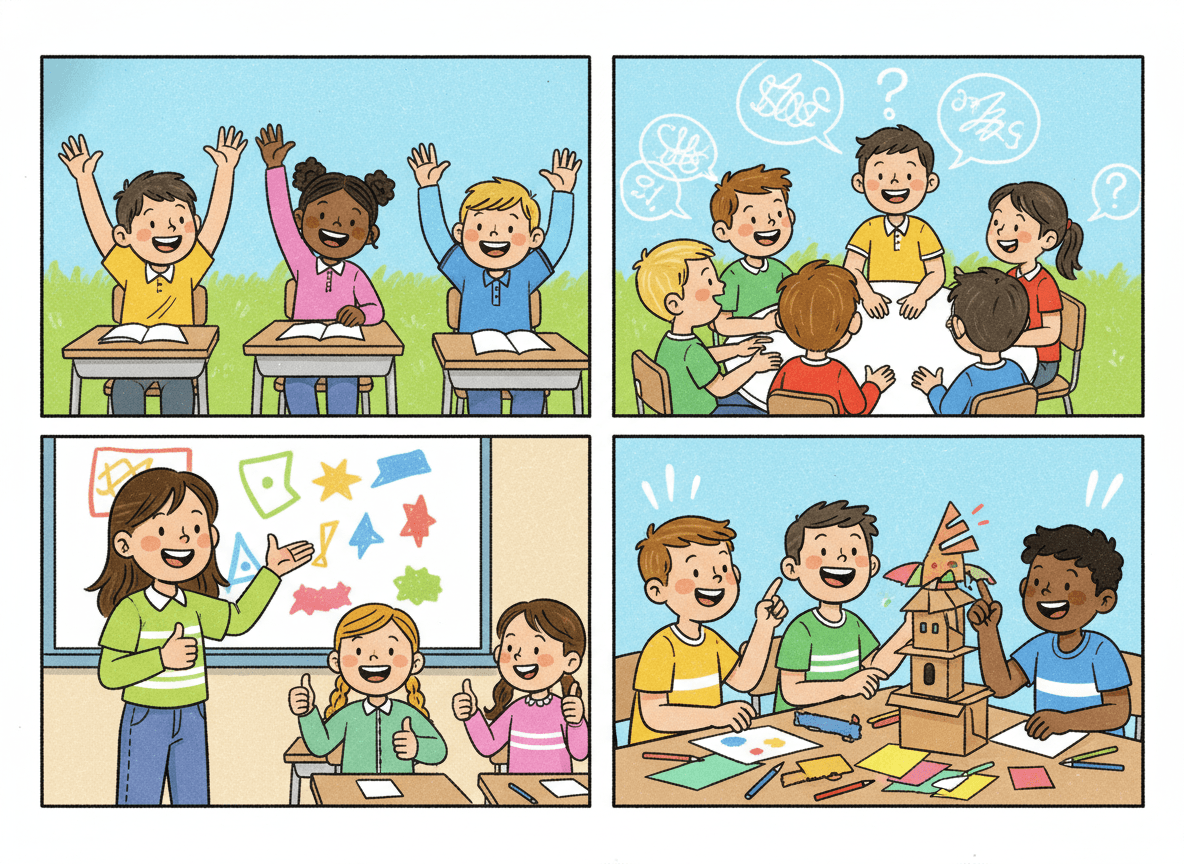
- Student engagement has three dimensions: behavioral (participation), cognitive (thinking), and emotional (caring about learning).
- Engagement is not the same as compliance - a quiet, compliant student may be disengaged; an active, curious student is engaged.
- High-engagement classrooms use frequent response structures, relevant content, student choice, and positive relationships.
- Research shows engagement is strongly influenced by teacher practice - it is not fixed by student characteristics.
What Is Student Engagement?
Student engagement is the degree to which students are actively invested in their learning - thinking deeply, participating actively, and caring about what they're doing. It is one of the strongest predictors of academic achievement, persistence, and school success.
Engagement is not the same as sitting still or following directions. Research identifies three interconnected dimensions of engagement, all of which matter for learning.
The Three Dimensions of Engagement
Behavioral Engagement: Observable participation and on-task behavior.
- Attending to instruction
- Completing tasks
- Raising a hand, responding to questions
- Participating in discussion
Cognitive Engagement: The depth of mental investment in a task.
- Using strategies to comprehend and problem-solve
- Thinking critically rather than completing mechanically
- Persisting through difficulty
- Asking genuine questions
Emotional Engagement: The affective investment in learning and school.
- Feeling interested in content
- Feeling a sense of belonging and connection
- Caring about doing well
- Experiencing curiosity, wonder, or excitement about learning
All three dimensions interact. A student can be behaviorally engaged (on task) but cognitively passive (not thinking deeply). Research shows cognitive and emotional engagement predict learning outcomes more strongly than behavioral engagement alone.
High-Engagement Classroom Practices
High-Frequency Response Structures
Instead of calling on one student at a time, use structures that require ALL students to respond:
-
Think-Pair-Share: Every student thinks, every student talks
-
Mini-whiteboards: Every student writes and shows an answer
-
Response cards: Cards held up with choices (A/B/C/D, True/False)
-
Choral response: Whole class responds simultaneously to closed questions
-
Fist-to-five: All students show understanding on a 0-5 scale
Relevant and Purposeful Content
Students engage more deeply when content connects to their lives, interests, and real-world applications. Questions like "When would you actually use this?" and tasks that mimic authentic purposes (writing for a real audience, solving a real problem) increase investment.
Appropriate Challenge
The "Goldilocks zone" of challenge - not too easy (boring) and not too hard (frustrating) - is where engagement peaks. Vygotsky's Zone of Proximal Development describes this as the range where a student can succeed with support.
Student Choice and Agency
When students have some control over topic, format, partner, or pace, their investment increases. Even small choices ("Do you want to show your thinking in a diagram or in writing?") increase sense of ownership.
Positive Relationships
Students consistently report that they are more engaged in classes where the teacher knows them, respects them, and shows genuine interest in their learning. Relationships are not separate from academics - they are a precondition for engagement.
Common Misconceptions
An engaged classroom is a loud classroom: Engagement can look quiet (a student deeply absorbed in reading) or active (students animatedly discussing in pairs). Volume is not the metric. The relevant question is: Are students thinking and caring about what they're doing?
Engagement is about making things fun and entertaining: Entertainment and engagement are not the same. Students can be entertained by a video without engaging cognitively with its content. Genuine engagement involves thinking, which can happen with dry material if the student cares about understanding it. The goal is intellectual interest and purpose, not passive entertainment.
Some students are just disengaged: Engagement is not a fixed trait. Research consistently shows that engagement is highly responsive to teacher practice, classroom climate, and instructional design. Many students who appear chronically disengaged in one setting are highly engaged in another - the setting matters as much as the student.
Practice Activities
-
Entry ticket + exit ticket pair: Brief check at the start ("What do you remember about yesterday's lesson?") and end ("What is one question you still have?") - bookends that require cognitive engagement.
-
Participation tracker: Keep a simple tally of who responds in class discussions over a week - most teachers are surprised to find a small set of students answering most questions. Use data to structure more equitable response opportunities.
-
Student interest survey: At the start of the year, survey students about their interests, hobbies, and what they find exciting to learn. Reference this data when selecting texts, examples, and project topics.
-
Engagement self-rating: At the end of a lesson, students rate their engagement 1-5 and write one sentence about what they were most interested in. Reviews in 2 minutes; surfaces patterns quickly.
-
Task redesign: Take a low-engagement assignment and redesign it with one added element: real audience, student choice, collaborative component, or connection to a current event or student interest.
Frequently Asked Questions
What is student engagement?
Student engagement is the extent to which students are actively involved in their learning - paying attention, thinking deeply, participating, and caring about what they're doing. Researchers identify three dimensions: behavioral engagement (on-task behavior, participation, attendance), cognitive engagement (investing mental effort, using strategies, thinking critically), and emotional engagement (interest, belonging, motivation, enthusiasm). All three dimensions matter - a student can be behaviorally compliant but cognitively and emotionally disengaged.
How is engagement different from compliance?
Compliance means following instructions and rules - sitting still, raising a hand before speaking, completing assignments on time. Engagement means actively investing in learning - thinking, questioning, caring, persisting. A student can be highly compliant but disengaged (completing work mechanically, without thinking). A student can be engaged but challenging to manage (lots of questions, excited, hard to redirect). Both compliance and engagement matter in classrooms, but research shows cognitive and emotional engagement - not just behavioral compliance - predict learning outcomes.
What classroom practices increase student engagement?
High-engagement practices include: (1) High-frequency response structures - all students respond often (think-pair-share, response cards, mini-whiteboards, choral response) rather than one student at a time. (2) Relevance - content is connected to students' lives, interests, and real-world contexts. (3) Student choice - agency in topic, format, or approach increases ownership. (4) Challenge - tasks that are slightly difficult but achievable (the Goldilocks zone) maintain cognitive engagement. (5) Positive relationships - students engage more when they feel known, respected, and safe. (6) Clear expectations - students understand what they're doing and why.
How do you measure student engagement?
Engagement can be observed and measured in multiple ways. Behavioral engagement: Are students on task? Are they participating? Are they attending? Cognitive engagement: Are responses thoughtful and substantive? Are students asking questions? Are they persisting through difficulty? Emotional engagement: Do students seem interested? Do they choose to extend their work? Do they express enthusiasm or curiosity? Teachers can use structured observation tools, student surveys (asking students how engaged they felt), and participation data to track engagement. Brief student surveys ('Rate your interest today 1-5') provide direct data with minimal effort.
What is the connection between student engagement and classroom management?
Engagement and management are deeply connected - but the relationship often runs in the opposite direction from what teachers expect. High engagement prevents most behavior problems: when students are genuinely interested, appropriately challenged, and feel respected, off-task behavior drops dramatically. 'Prevention-focused' classroom management focuses on designing engaging instruction rather than reacting to misbehavior. Research on classroom management consistently shows that maximizing instructional time and engagement is more effective than reactive discipline in producing positive behavior and academic outcomes.
Free Student Engagement Worksheets
Curriculum-aligned printable worksheets for Kindergarten – 5th Grade. Download free.