What Is Explicit Instruction?
Taught in US schools
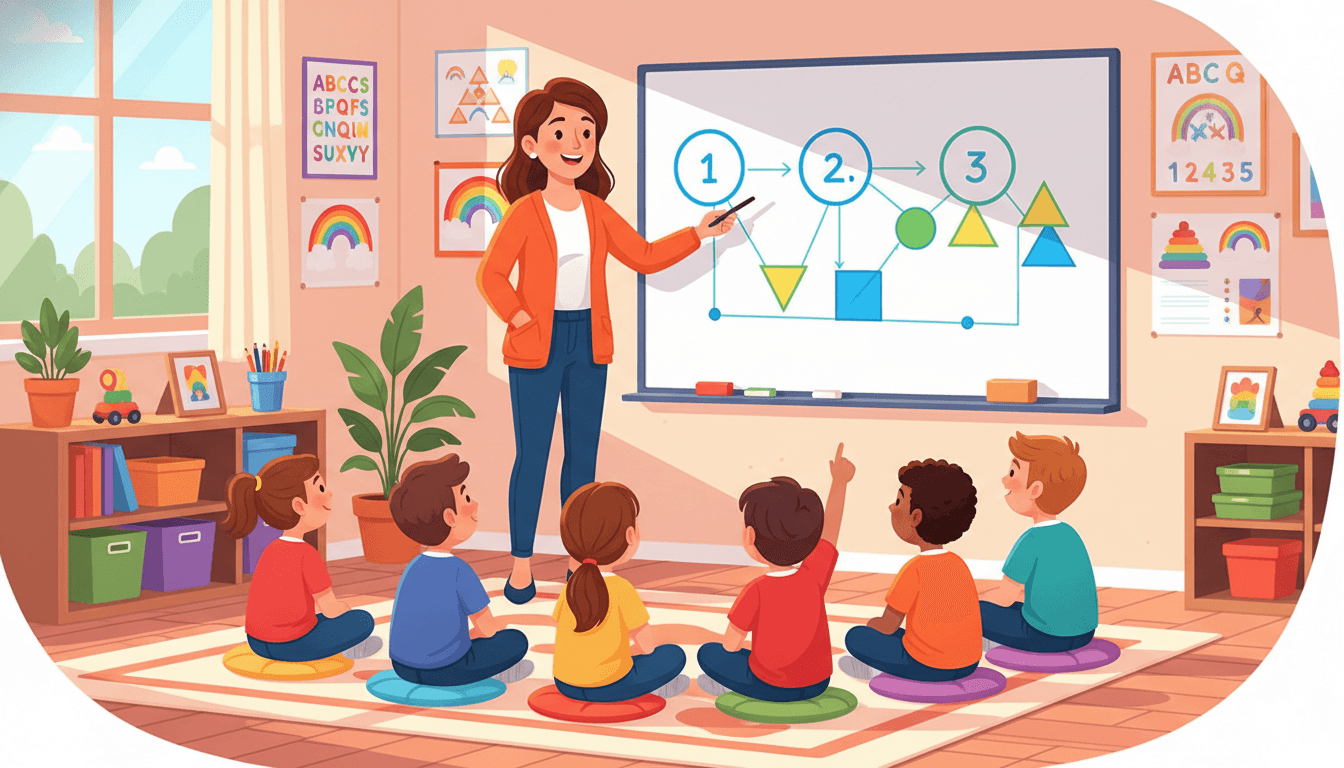
Key Takeaways
- Explicit instruction is direct, clear teaching of a skill - the teacher models, then guides, then releases to independent practice.
- The gradual release model (I Do / We Do / You Do) is the structure of explicit instruction.
- Explicit instruction is especially critical for foundational skills: phonics, decoding, math procedures, and writing conventions.
- Research consistently shows explicit instruction outperforms discovery learning for new or complex skills.
What Is Explicit Instruction?
Explicit instruction is a structured, teacher-led approach in which new skills and concepts are taught directly, clearly, and systematically. The teacher models exactly what to do and think, guides students through practice with feedback, and then releases students to independent practice.
The defining feature of explicit instruction is transparency: the learning goal is stated, the process is made visible, and the path to success is clear. Nothing is left for students to infer or discover on their own.
The Gradual Release of Responsibility (I Do / We Do / You Do)
The most common framework for explicit instruction is the gradual release of responsibility model:
I Do (Modeling)
The teacher demonstrates the skill while thinking aloud:
- "I'm going to show you how to find the main idea of this paragraph."
- "Watch what I do first - I read the whole paragraph."
- "Now I ask myself: what is this mostly about? I see the word 'photosynthesis' repeated three times..."
The teacher makes the invisible thinking visible.
We Do (Guided Practice)
Teacher and students practice together. The teacher provides prompts and feedback:
- "Let's try this paragraph together. Read it with me. What do you notice about the repeated words?"
- Teacher provides immediate corrective feedback when students err.
You Do Together (Collaborative Practice)
Students practice with partners or small groups while the teacher circulates and monitors.
You Do Alone (Independent Practice)
Students apply the skill independently. This is when worksheets, written responses, and assessments occur - AFTER sufficient guided practice.
What Makes Explicit Instruction Effective?
Clear learning objective: Students know exactly what they are learning and why it matters.
Sequenced steps: Complex skills are broken into smaller, teachable steps taught in logical order.
Think-aloud modeling: The teacher externalizes internal thinking, making the cognitive process audible.
Frequent checks for understanding: Questions, signals, and formative checks throughout the lesson - not just at the end.
Immediate corrective feedback: Errors are caught and corrected during guided practice, not reinforced through independent practice.
High success rate: Students should experience approximately 80% success during guided practice before moving to independent work.
Explicit Instruction in Key Content Areas
Phonics: "The letters 'oa' make the long O sound. Watch me: b-o-a-t. Boat. Your turn: coat, road, soap."
Math: "To multiply two-digit numbers, I start with the ones place. Watch: 23 × 4. First, 4 × 3 = 12. I write 2 and carry the 1..."
Writing: "A strong topic sentence states the main idea AND gives the reader a reason to keep reading. Watch how I write one..."
Reading comprehension: "When I read a confusing sentence, I use the context clues around it. Watch - I read before it, I read after it..."
Common Misconceptions
Explicit instruction is boring or passive: Effective explicit instruction includes frequent student responses, choral responses, partner work, movement, and engagement. It is not lecturing. Students are responding, practicing, and getting feedback - active not passive.
Discovery learning is better for deep understanding: Research consistently shows that for new, unfamiliar skills - especially foundational literacy and numeracy - explicit instruction produces stronger, faster learning than discovery approaches. Discovery works for applying and extending already-established knowledge, not for initial acquisition.
Explicit instruction is only for struggling students: Explicit instruction is effective for all learners. It is particularly critical in early grades (K-3) for foundational skills, and remains important at all grade levels when introducing genuinely new concepts.
Practice Activities
-
Model-with-mistakes: Deliberately make an error during modeling and think aloud through correcting it - builds error-detection skills in students.
-
Choral response: After modeling a step, ask the whole class to respond together - "What do we do first?" - so all students are practicing, not just those called on.
-
Anchor chart co-creation: Build an anchor chart of the steps during the I Do phase so students have a visual reference during independent practice.
-
Exit ticket: Quick formative check at the end - one problem or question - to assess whether students are ready for independent practice.
-
Gradual release tracking: Keep a simple table to track when each student has moved from guided to independent practice on a skill.

Frequently Asked Questions
What is explicit instruction?
Explicit instruction is a teaching approach in which the teacher directly and clearly teaches a skill or concept - stating the objective, modeling the skill step by step, providing guided practice with feedback, and then releasing students to practice independently. Nothing is left to be inferred or discovered; the teacher makes the learning goal, the process, and the criteria for success transparent. Explicit instruction is the opposite of inquiry-only or discovery-only learning.
What is the gradual release of responsibility model?
The gradual release of responsibility (GRR) model, developed by Pearson and Gallagher, describes four phases of instruction: (1) I Do - the teacher models and thinks aloud, making the process visible. (2) We Do - teacher and students practice together with teacher guidance. (3) You Do Together - students practice with partners or small groups. (4) You Do Alone - students practice independently. The model gradually shifts cognitive responsibility from teacher to student, ensuring students are supported before being asked to work independently.
When is explicit instruction most important?
Explicit instruction is especially important when: (1) Teaching a skill that students cannot be expected to discover on their own (phonics patterns, math algorithms, grammar conventions). (2) Teaching a foundational skill that will be needed for future learning. (3) A student is struggling and needs a clear explanation of what to do. (4) Introducing any new, unfamiliar concept regardless of grade level. Research from the Science of Reading is unambiguous that phonics and decoding must be taught explicitly - implicit or incidental approaches are insufficient for many learners.
How is explicit instruction different from direct instruction (DI)?
These terms are often used interchangeably, but they have different origins. 'Direct Instruction' (capital D, capital I) refers to specific scripted programs developed by Siegfried Engelmann (DISTAR, Reading Mastery) with highly structured, scripted lessons. 'Explicit instruction' (lowercase) is a broader pedagogical approach - clear, direct teaching with modeling and guided practice - that encompasses many programs and approaches. All Direct Instruction is explicit instruction; not all explicit instruction is Direct Instruction.
Is explicit instruction the only effective approach?
Explicit instruction is the most effective approach for teaching new, unfamiliar, or foundational skills - especially reading and math skills. However, once skills are established, inquiry-based, project-based, and discovery approaches can deepen understanding and motivation. The research supports explicit instruction as the primary vehicle for initial skill acquisition, particularly in early literacy and numeracy. Effective teaching uses explicit instruction to build the foundation, then leverages richer, more open-ended activities to apply and extend those skills.
Free Explicit Instruction Worksheets
Curriculum-aligned printable worksheets for Kindergarten – 5th Grade. Download free.