What Is an Anchor Chart?
Taught in US schools

Key Takeaways
- Anchor charts capture key learning during instruction and remain displayed for student reference.
- They are created collaboratively with students - not pre-made and posted before the lesson.
- Effective anchor charts are clear, concise, visually organized, and regularly referenced.
- Anchor charts support all learners by providing a persistent visual scaffold.
What Is an Anchor Chart?
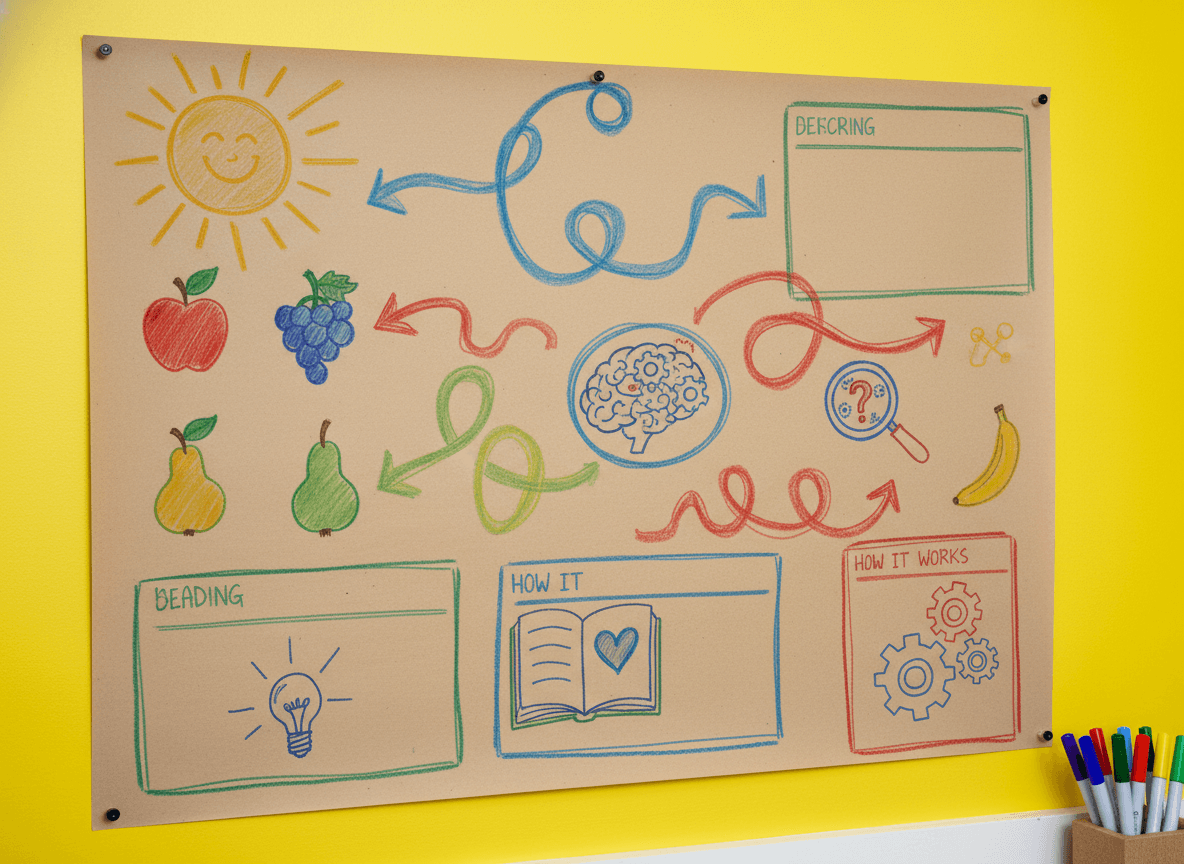
An anchor chart is a large, visually organized classroom display created during instruction to capture key ideas, strategies, vocabulary, or procedures. It is posted where students can see and reference it during independent work - "anchoring" the lesson's content in visible, accessible form.
Anchor charts are a hallmark of the Workshop Model classroom, where teachers create these charts collaboratively with students during the mini-lesson and then students apply the learning independently.
What Goes on an Anchor Chart?
Reading strategies: "Strategies Good Readers Use" with examples of each.
Writing checklists: "Before I turn in my writing, I check..." with a bulleted list.
Grammar rules: "When to use a comma" with examples.
Math procedures: Steps for long division, with a worked example.
Vocabulary: Key terms with definitions and pictures.
Story elements: Characters, Setting, Problem, Solution with icons.
Academic language starters: "I agree with ___ because..." / "My evidence is..."
Content knowledge: Diagram of the water cycle labeled in student words.
The Key Principle: Co-Creation
The most effective anchor charts are built during instruction with student input:
- Teacher poses a question or introduces a concept.
- Students contribute ideas.
- Teacher scribes (or students scribe) on chart paper.
- Chart is posted and referenced throughout the unit.
The act of building the chart together makes it a record of shared class knowledge, not a teacher document imposed on students.
Principles of Effective Anchor Charts
Readable: Large lettering visible from anywhere in the room.
Concise: Key ideas, not paragraphs. Students should be able to grasp it quickly.
Visual: Use color coding, icons, boxes, and arrows to organize information.
Referenced: A chart only works if students are encouraged to look at it. Explicitly direct students to consult charts during independent work.
Current: Display charts that are actively needed. Retire charts that are no longer relevant.
What Grade Are Anchor Charts For?
Anchor charts are effective across all K-5 grades. The reading level, visual complexity, and content scale with the grade. Kindergarten charts might use pictures more than words; 5th grade charts might use academic vocabulary and more complex diagrams.
Common Misconceptions
Pre-made charts are just as effective: Pre-made charts skip the collaborative construction process, which is itself a learning activity. They can also feel generic rather than specific to the class's learning journey.
More charts = better classroom: Cluttered walls with dozens of posted charts can actually distract rather than support. Quality and relevance matter more than quantity.
Anchor charts are only for reading and writing: Anchor charts are equally effective in math, science, social studies, and social-emotional learning. Any content that students need to remember and apply is a candidate.
Practice Activities
-
Student-illustrated charts: Students draw examples next to teacher-written text.
-
Interactive charts: Sticky notes added by students (e.g., predictions, questions, connections) turn the chart into a living document.
-
Chart reference signals: Teach students to look at the relevant chart before asking the teacher for help.
-
Gallery walk: Post 4-5 charts on different topics around the room; students rotate and add one sticky note of new thinking to each.
-
Student-made mini charts: Students create a personal-size version of a class anchor chart for their notebooks.
Frequently Asked Questions
What is an anchor chart?
An anchor chart is a large classroom display - typically on chart paper or poster board - that captures key ideas, strategies, vocabulary, or procedures from a lesson. It is created during instruction (often collaboratively with students) and posted where students can reference it during independent work. The term comes from the idea that the chart 'anchors' students' learning.
What kinds of things can be on an anchor chart?
Anchor charts can display: reading strategies (Ways Good Readers Think), writing checklists, grammar rules, math procedures and vocabulary, sentence starters for discussion, parts of a story, types of text features, class-generated vocabulary lists, problem-solving steps, and content area concepts. Any information students need to remember and apply independently is a candidate for an anchor chart.
Should anchor charts be pre-made before the lesson?
Ideally, no. The most effective anchor charts are created during instruction, with student input. The process of building the chart together - students contributing ideas, the teacher scribing - is itself part of the learning. Pre-made charts miss this co-construction and feel like decoration rather than shared knowledge. However, lightly pre-drawn templates (headers, boxes) can help organize without removing student voice.
How many anchor charts should be displayed at once?
The number depends on the class's needs, but research on cognitive load suggests that too many charts on the walls can be overwhelming and actually reduce their effectiveness. Best practice: display only charts that are actively being used and relevant to current work. Retire older charts (store them rolled up and bring them back as needed) and rotate in new ones as units progress.
What makes an anchor chart effective vs. ineffective?
Effective charts: Large enough to read from anywhere; key words highlighted; visually organized; concise (not too much text); include examples and visuals; are regularly referenced. Ineffective charts: Too small or crowded to read; cluttered with too much text; too many charts competing for attention; posted and never referenced again. The acid test: can students use this chart independently during work time?
Free Anchor Chart Worksheets
Curriculum-aligned printable worksheets for Kindergarten – 5th Grade. Download free.