What Is a Graphic Organizer?
Taught in US schools

Key Takeaways
- Graphic organizers are visual tools that help students organize information, ideas, and relationships.
- Common types include: Venn diagrams, T-charts, KWL charts, story maps, webs, and timelines.
- They support reading comprehension, prewriting, note-taking, and content-area learning.
- Graphic organizers make abstract thinking visible and reduce the cognitive load of organizing ideas.
What Is a Graphic Organizer?
A graphic organizer is a visual tool that uses shapes, diagrams, and structures to help students organize information, ideas, and relationships. Instead of writing in traditional paragraphs, students record information in a structured visual format that makes the organization of ideas explicit.
Graphic organizers bridge thinking and writing - they externalize the cognitive work of organizing so students can focus on content rather than structure.
Common Types of Graphic Organizers
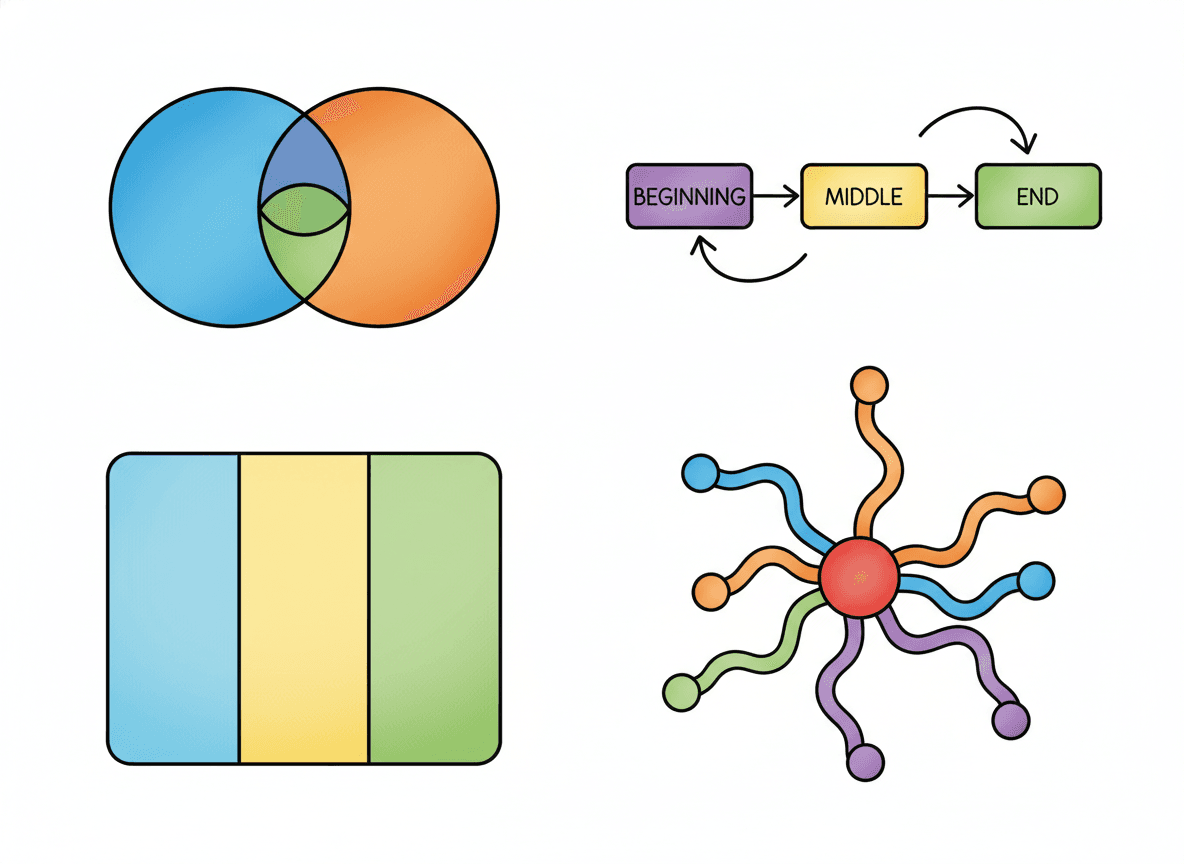
Venn Diagram: Two overlapping circles for comparing/contrasting two subjects. Best for: compare and contrast
T-Chart: Two columns for comparing attributes, listing pros/cons, or separating ideas. Best for: fact vs. opinion, cause vs. effect, two perspectives
KWL Chart: Three columns - Know, Want to Know, Learned. Best for: before/during/after reading; activating prior knowledge
Story Map: Boxes for characters, setting, problem, events, and solution. Best for: retelling, story analysis, narrative planning
Web / Mind Map: Central idea surrounded by related branches and sub-branches. Best for: brainstorming, vocabulary, concept mapping
Sequence Chain: Boxes connected by arrows showing ordered steps or events. Best for: procedures, timelines, story sequence
Cause-Effect Diagram: Shows how one event or condition leads to outcomes. Best for: informational and historical texts
Fishbone Diagram: Shows multiple causes contributing to one effect. Best for: problem analysis and complex cause-effect relationships
Using Graphic Organizers in Reading and Writing
Before reading: KWL chart, web of prior knowledge, vocabulary preview
During reading: Story map, timeline, cause-effect diagram, two-column notes
After reading: Venn diagram for comparison, sequence chain, summary graphic
Before writing: Web for brainstorming, story map for narrative planning, T-chart for argument planning
During writing: Outline or tiered organizer guiding paragraph structure
What Grade Do Kids Use Graphic Organizers?
Graphic organizers are appropriate across all elementary grades, with scaffold and complexity adjusted by level. Kindergartners draw in graphic organizers; 5th graders create more complex multi-level organizers or modify templates for their own purposes.
Common Misconceptions
Completing the graphic organizer IS the assignment: The organizer is a scaffold, not the final product. Students should use it as a planning tool and then transfer ideas into writing or discussion. A filled organizer that never leads to deeper thinking or writing has missed its purpose.
One organizer works for everything: Different thinking tasks need different organizers. Using a story map for a compare-contrast activity, or a Venn diagram for a sequence task, creates confusion.
Digital tools are superior to paper organizers: Both have value. Paper allows freeform drawing; digital allows easy revision and sharing. The best tool depends on the task and the learner.
Practice Activities
-
Organizer choice: Give students a reading task and 3 organizer options - they choose the best one and explain why.
-
Compare the same text two ways: Use both a T-chart and a Venn diagram for the same comparison; discuss which captured the ideas better.
-
KWL before a unit: Complete K and W columns before a science or social studies unit; revisit and complete L at the end.
-
Student-created organizers: Older students design their own graphic organizer to fit a specific task.
-
Whole-class modeling: Teacher completes a graphic organizer aloud, thinking through decisions, before students work independently.
Frequently Asked Questions
What is a graphic organizer?
A graphic organizer is a visual framework that helps students organize information, ideas, or relationships. By using boxes, circles, arrows, lines, and other visual elements, graphic organizers represent complex information in a structured, easy-to-navigate format. They reduce the difficulty of organization by giving students a visual scaffold to work within.
What are the most common types of graphic organizers?
Common graphic organizers: Venn diagram (compare/contrast), T-chart (two columns for comparing or listing pros/cons), KWL chart (Know-Want to know-Learned), story map (characters/setting/problem/solution), web/mind map (central idea with radiating branches), timeline (chronological events), cause-and-effect diagram, and sequence chain. Each is best suited to a particular type of thinking or content.
What is a KWL chart?
A KWL chart has three columns: K (What I Know), W (What I Want to Know), and L (What I Learned). Students fill in K and W before reading or learning about a topic - activating prior knowledge and setting a purpose. After reading, they complete the L column. KWL charts are used across all grade levels and content areas as a before-during-after reading strategy.
How do graphic organizers help different types of learners?
Graphic organizers especially benefit visual-spatial learners who think in images and patterns rather than linear text. They also help students who struggle with organizing ideas in prose, students learning English (visual structures transcend language barriers), and students with working memory challenges who benefit from having ideas externalized and visible. They are a powerful scaffold for diverse learners.
Are graphic organizers always paper-based?
No. Graphic organizers can be created on paper, on whiteboards, on digital platforms (Google Jamboard, Padlet, Google Slides), and with drawing tools on tablets. Many educational websites offer printable and interactive graphic organizer templates. Digital graphic organizers allow easy revision and sharing. The format matters less than the thinking the organizer supports.
Free Graphic Organizer Worksheets
Curriculum-aligned printable worksheets for 1st – 5th Grade. Download free.