What Is the Writing Process?
Taught in US schools
Key Takeaways
- The 5 stages: Prewriting → Drafting → Revising → Editing → Publishing.
- Revising = improving CONTENT and IDEAS. Editing = fixing MECHANICS (spelling, punctuation, grammar).
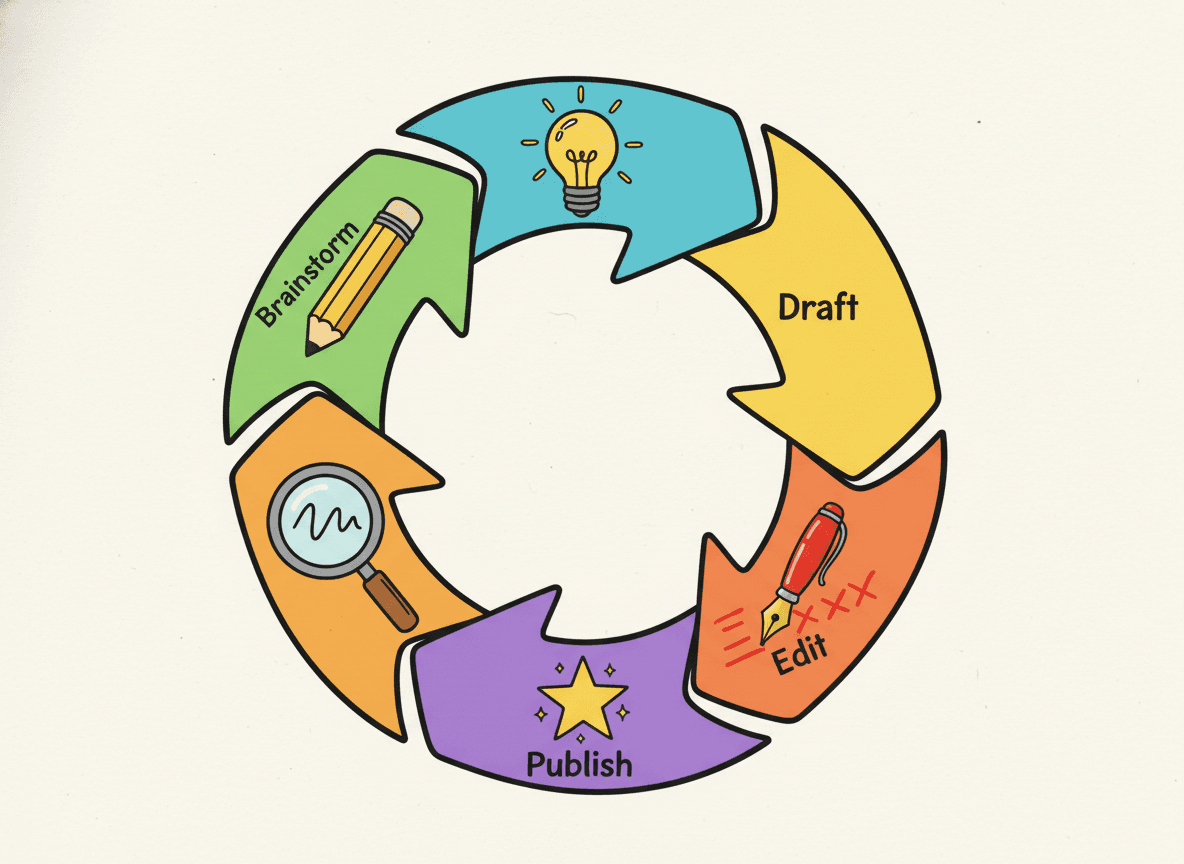
- The process is recursive - writers move back and forth between stages, not through them in a straight line.
- Real writers don't get it right the first time. The process normalizes struggle and drafting.
What Is the Writing Process?
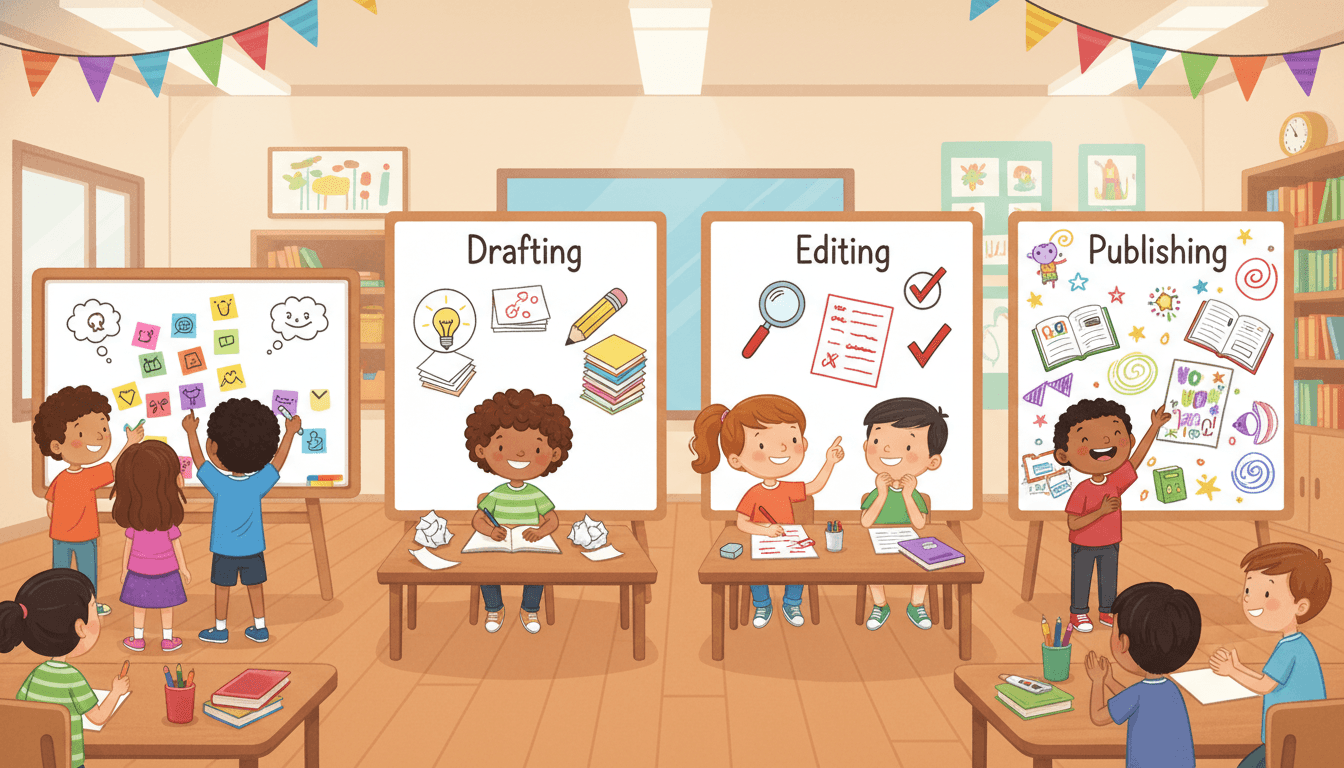
The writing process is a framework of five stages that writers move through to develop a polished piece of writing:
- Prewriting - plan and organize
- Drafting - get ideas on paper
- Revising - improve content and structure
- Editing - fix mechanics
- Publishing - share with an audience
The most important thing to understand: real writers don't get it right on the first try. The process normalizes struggle and revision - it shows students that messy first drafts are not failure, they're step one.
The Five Stages in Detail
1. Prewriting
Plan before you write. Think, brainstorm, organize.
-
Tools: graphic organizers, story maps, outlines, webs, lists, partner talk
-
Goal: know what you're going to say before you say it
2. Drafting
Get ideas on paper. Don't stop to fix everything - focus on content.
-
Mindset: "I'm getting my ideas out. I can fix it later."
-
Goal: a complete draft, however rough
3. Revising
Improve the piece at the level of IDEAS and ORGANIZATION.
-
Ask: Is my main idea clear? Are there enough details? Does the organization make sense? Is my voice strong?
-
Actions: add, delete, move, and rework - sometimes entire paragraphs
-
Goal: stronger content; the writing says what it needs to say
4. Editing
Fix the MECHANICS: spelling, punctuation, grammar, capitalization.
-
Tools: editing checklist, CUPS (Capitalization, Usage, Punctuation, Spelling)
-
Goal: clean, correct final draft ready to publish
5. Publishing
Share the finished piece with a real audience.
-
Forms: typed copy, read-aloud, class book, bulletin board, blog post, school paper
-
Goal: connect writing to real-world communication
Revising vs. Editing
This distinction is critical:
Content, ideas, organization: Spelling, punctuation, grammar
Big changes (add, delete, restructure): Small corrections
"Does this say what I want it to say?": "Is this written correctly?"
Done BEFORE editing: Done AFTER revising
Common mistake: students "revise" by only fixing spelling. Teach them to make content decisions first.
The Process Is Recursive
The stages don't always happen in a straight line. Writers:
- Go back to prewriting when they realize they need more information
- Return to revising after editing reveals organizational problems
- Draft a new section mid-revision
This back-and-forth is normal - the process is a spiral, not a line.
What Grade Do Kids Learn the Writing Process?
1st–2nd Grade: Develop ideas with support from adults and peers; practice basic revision (adding details) and editing (capitalization, end punctuation).
3rd Grade: Begin applying the full writing process; use feedback from peers and adults to improve drafts.
4th Grade: Plan, draft, revise, and edit with increasing independence; use technology for publishing (W.4.5).
5th Grade: Use the full process independently; produce clear and coherent writing for various audiences and purposes (W.5.5).
Common Misconceptions
"First draft = final draft." Most student writing issues come from treating the first draft as the final version. The writing process is the solution.
"Editing is the most important revision step." Editing (fixing mechanics) happens after revising (improving content). Students who jump to editing skip the most important improvement work.
"The teacher's job is to fix my draft." The teacher's role during writing process instruction is to guide and question, not to correct. Students do the thinking. Teacher conferences ask: "What are you trying to say here? What more can you tell me?"
Practice Activities
-
Two-column draft: Students fold paper in half; left side = first draft, right side = revision notes and additions.
-
ARMS revision: Add, Remove, Move, Substitute - four specific revision moves students can make.
-
CUPS editing checklist: Capitalization, Usage, Punctuation, Spelling - go through each one separately.
-
Author's chair: Students share published pieces aloud; class gives specific praise feedback.
-
Track changes: In digital writing tools, use Track Changes or highlighting to show what was revised between drafts.
Frequently Asked Questions
What are the five stages of the writing process?
Prewriting: Plan before writing. Brainstorm ideas, choose a topic, gather information, create an outline or graphic organizer. This stage prevents writer's block and produces more organized drafts. Drafting: Get ideas on paper without worrying about perfection. Focus on content - spelling and grammar can be fixed later. Revising: Improve the content, organization, voice, word choice, and sentence fluency. Revising is about BIG changes - adding, deleting, moving, or reworking ideas. Editing: Fix the mechanics - spelling, punctuation, grammar, capitalization. Editing is about SMALL corrections. Publishing: Share the final piece in some form - typed, illustrated, read aloud, posted, or submitted.
What is the difference between revising and editing?
Revising focuses on CONTENT and IDEAS: Is the main idea clear? Are there enough supporting details? Does the organization make sense? Is the voice engaging? Do the sentences vary? Revising often means adding paragraphs, deleting sections, or restructuring ideas. Editing focuses on MECHANICS: spelling, punctuation, grammar, capitalization. The most common teaching error is doing both at once - students end up fixing commas in a paragraph they should delete. Teach them as separate passes, with revision always coming before editing.
What happens during prewriting?
Prewriting is any planning that happens BEFORE drafting begins. It includes: Brainstorming (listing ideas, free-writing, talking with a partner), choosing a topic and narrowing it, thinking about audience and purpose, organizing ideas (graphic organizer, outline, story map, web), and gathering information (for research-based writing). Prewriting prevents the 'blank page' problem and produces more organized drafts. Strong prewriting can make the actual drafting faster and the final product better - yet it's the stage most students want to skip.
What is peer revision and how does it work?
Peer revision is the process of having a classmate read and give feedback on a draft - not to correct errors (that's editing) but to respond as a reader: What's confusing? What's working well? What do you want to know more about? Structured peer revision works better than open-ended feedback. Use a revision checklist or specific questions: 'Is the introduction engaging?' 'Does each paragraph have a main idea?' 'Are there enough details?' 'Where did you want more?' Teach students to give specific, actionable feedback rather than generic praise.
What does 'publishing' mean in the elementary classroom?
Publishing is sharing the finished piece with an audience - it doesn't have to mean print publication. Publishing options: typing and printing a final draft, reading aloud to the class or a partner, posting on a class blog or bulletin board, creating an illustrated book, recording as a video or podcast, submitting to a school newspaper or literary magazine, sending to a pen pal or family member. Publishing provides real-world motivation - writing for an audience changes the writer's investment. Even small audiences (a partner, the teacher) matter more than writing that goes straight into a folder.
Free Writing Process Worksheets
Curriculum-aligned printable worksheets for 1st – 5th Grade. Download free.